

How greed brought down Byju Raveendran's empire from $22 billion to zero
Once valued at $22 billion, Byju's is now buried under debt, lawsuits, unpaid dues, and careers that are still not recovered. Founder Byju Raveendran has been sentenced in absentia to jail in Singapore. Byju's collapse has become India's biggest cautionary tale on startup greed and unchecked ambition.
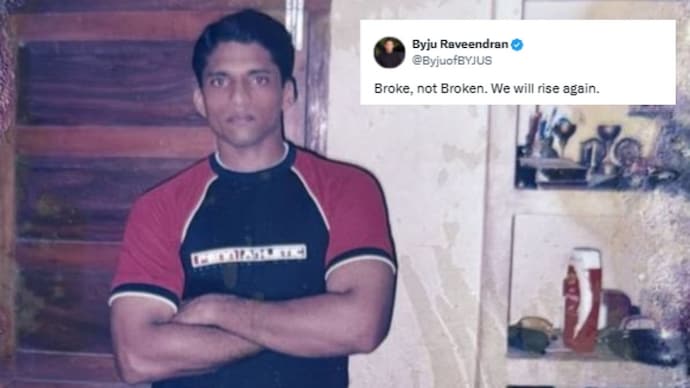


Once hailed as India's most valuable startup, Byju's soared to a $22-billion valuation in 2022. Its growth was fuelled by demand for online learning driven by the Covid pandemic, massive venture capital inflows, and an ambitious founder. Today, the EdTech giant's valuation is not even zero. It's minus Rs 8,245 crore, given the money and incentives it still owes to its employees. Its founder, Byju Raveendran, was sentenced to six months in prison in Singapore. The trial was conducted in absentia with Ravindran reportedly in Dubai. The spectacular collapse of Byju's, an EdTech pioneer in India, is a tale of caution for start-ups.
After its collapse, while some Byju's employees have moved on to greener pastures, many others were forced to accept substantial pay cuts in their next jobs, which rarely matched the lucrative compensation Byju's had offered at its peak. Several former employees are still coming to terms with the sudden reversal of fortunes. Parents of millions of students who bought education packages from Byju's have lost money.
The company faces debt worth billions, and is mired in dozens of lawsuits. The recent sentencing of founder Byju Raveendran to six months in jail for contempt of court in Singapore is a stark reminder of how unchecked ambition and poor governance can kill even the brightest success stories.
We will return to how greed and unchecked ambition led to the collapse of Byju's but after looking at the latest case in Singapore.
WHY HAS BYJU RAVEENDRAN BEEN SENTENCED TO JAIL IN SINGAPORE?
The trigger for this latest chapter came on Wednesday, when a Singapore court ordered Raveendran to serve six months in jail for non-compliance with disclosure orders related to his assets. The ruling, initiated by a subsidiary of Qatar Investment Authority (QIA), stems from disputes over document disclosure in ongoing financial proceedings. Raveendran must surrender to authorities, pay legal costs of 90,000 Singapore dollar, or about Rs 67 lakh, and provide proof of ownership of Beeaar Investco Pte, a corporate entity linked to the company.
In a statement, Raveendran described the order as "procedural contempt" tied to document disputes, not a finding of fraud or dishonesty on the merits. He emphasised that settlement discussions with lenders and investors, including GLAS Trust and QIA, were nearing conclusion and expressed disappointment that the matter was being pursued at this stage.
"The parties have also acknowledged that there has been no wrongdoing on my part or on the part of the other founders," he said in a statement, adding that he prioritises resolution over confrontation and plans to appeal.
It must be noted that Byju Raveendran still harbours hopes of reviving his EdTech empire.
"Byju Ravindran firmly believes the company can be turned around. Despite the fall, he plans to return to India and is convinced that one strong turnaround moment could help restore the business. I don't know exactly how he intends to do it, but he remains remarkably positive," a top associate and close confidant of the founder told India Today Digital.
A LOOK AT THE RISE AND EXPANSION OF BYJU'S
Byju Raveendran, a former maths tutor, built Byju's from a simple learning app into a global EdTech powerhouse. The Covid-19 pandemic supercharged its growth as schools shut and parents turned to online education. The company raised billions of dollars from top investors, expanded aggressively, and signed high-profile brand ambassadors, like Shah Rukh Khan and Lionel Messi, while sponsoring major events like the Indian Premiere League (IPL).
At its peak, Byju's claimed over 150 million users and positioned itself as a one-stop learning platform.
However, this ascent laid the groundwork for its fall.
A top executive at Byju's, who requested anonymity due to ongoing sensitivities, told India Today Digital, "We rode the wave perfectly during the pandemic. Demand was insane, money was flowing, and the vision was to build the world's largest learning company. But we scaled too fast without building strong foundations."
THEN CAME BYJU'S FALL, FUELLED BY FOUNDER'S GREED
The core issue was greed-fuelled overexpansion.
Flush with capital, Byju's spent over $2.5–3.6 billion on more than a dozen acquisitions between 2019 and 2022.
Major deals included Aakash Educational Services for nearly $1 billion, WhiteHat Jr for $300 million, Epic for $500 million, Toppr for $150 million and others like Great Learning and Osmo. Many acquisitions were poorly integrated, delivered limited synergies, and continued to bleed cash.
When the pandemic eased, demand for paid online learning dropped sharply as schools reopened.
The company's revenue growth stalled, but costs, especially from acquisitions and heavy marketing, remained high. The company posted massive losses, reportedly Rs 4,588 crore in one year, with cash burn accelerating. Aggressive, sometimes predatory sales tactics exacerbated the problem.
Its sales teams faced intense pressure to meet targets, leading to complaints of misleading parents about course benefits, pushing EMI options, and hard-selling to vulnerable families.
Parents lost significant money on courses that didn't deliver promised results or flexibility for refunds. Many reported being locked into long-term subscriptions or facing aggressive recovery calls.
This correspondent received multiple SOS messages from both parents and employees about the losses incurred by them at the behest of the company.
Meanwhile, the company's internal financial health kept deteriorating.
"There was pressure to maintain hyper-growth led to decisions that prioritised short-term optics only," a top lawyer associated with Byju's told India Today Digital.
TOP-TIER EMPLOYEES AT BYJU'S VS EVERYONE ELSE
While Byju's empire crumbled, the pain was unevenly distributed.
Top executives and the founder reportedly retained significant personal wealth and benefits even as the company struggled. In contrast, mid- and lower-level employees faced months of salary delays, sudden layoffs (sometimes via phone calls), and harsh working conditions.
Many worked 14–15 hour shifts to meet the intense sales pressure.
The top executive, who spoke to India Today Digital, said, "At the leadership level, we knew what was about to come, but we were still chasing big visions and deals. Meanwhile, people at lower levels were waiting for salaries. It created immense guilt, but we continued till the ship sank."
Parents, too, bore the brunt of the collapse of Byju's.
Thousands have taken to social media to complain about poor learning outcomes and persistent technical glitches in the tablets. These are issues that fell on deaf ears, despite the expensive courses aggressively pushed during uncertain pandemic times. Even today, Byju's tablets keep surfacing in clearance sales and grey markets. Parents of millions of students lost money.
THE LEGAL BATTLES BYJU'S IS MIRED IN
Byju's faces accusations of mismanagement, including alleged fraudulent transfers of funds. The company entered insolvency proceedings in some arms, with creditors fighting over assets.
Raveendran and his team have maintained that funds were used for legitimate business purposes and that no personal wrongdoing occurred. They argue external factors, like the post-pandemic shift and lender actions, contributed heavily to the value erosion.
A US Bankruptcy Court in Delaware earlier adjusted a $1-billion judgment, ordering fresh proceedings on damages.
Byju's story is a cautionary tale of how greed, manifested in reckless spending, unchecked ambition, and weak governance, can destroy enormous value.
From $22 billion to near zero in just a couple of years, the collapse not only wiped out investor capital but also disrupted thousands of livelihoods. As Raveendran fights legal battles and pushes for settlements, the future of Byju's remains uncertain.