

59 for Tamil Nadu, 30 for Kerala: BJP MP says delimitation move best deal for South
The key concern for the South over the Delimitation Bill is that it would cost them seats and influence. However, BJP MP Tejasvi Surya asserted that the government would increase the share of all states uniformly by 50%, which would, in fact, benefit the southern states.
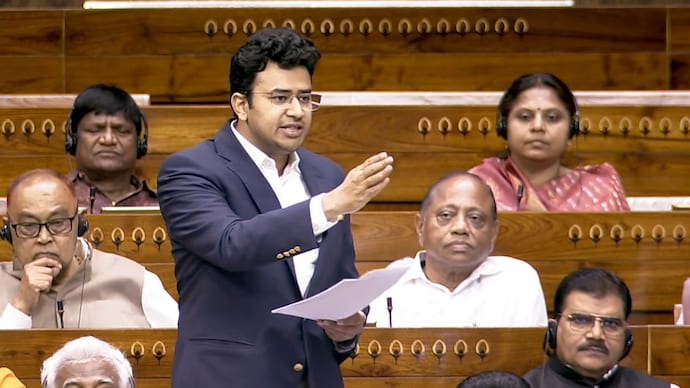


The proposed delimitation exercise, which is linked to the implementation of the Women's Reservation Act, has become a major flashpoint between the Centre and the southern states. The key concern in the South is that the redrawing of constituencies would cost them seats and influence. However, BJP MP Tejasvi Surya asserted that the government would increase the share of all states uniformly by 50%, which would, in fact, benefit the region. It was also assured by Home Minister Amit Shah later during his speech.
"The opposition is misleading the people of the southern states. This is the best deal the Modi government has provided to the South and smaller states that have controlled their population," Surya said during the debate in Parliament over the legislation. On Thursday, the Centre introduced three bills that would pave the way for the early implementation of 33% women's reservation in the Lok Sabha and state assemblies.
THE DELIMITATION MUDDLE
Among these, the Delimitation Bill, which proposes to set up a commission that will redraw the constituencies based on the 2011 Census, has become a major bone of contention. The exercise will see the total number of Lok Sabha seats rising from 543 to 850 (815 seats for states and 35 for Union Territories) - roughly a 50% increase. Out of them, 273 seats will be reserved for women.
The key argument of the southern states is that a population-based delimitation would unfairly benefit the North, where population growth has been higher. The southern states, which have performed better in population control, fear they will be penalised.
A smaller increase in seats than the northern states, where the BJP wields influence, will result in the South losing its voice in Parliament, influence, as well as tax devolution. The six southern states - Kerala, Tamil Nadu, Andhra Pradesh, Karnataka, Odisha and Telangana - account for around 24% of the population.
However, Tejasvi Surya sought to assuage the concerns of the South. He underlined that the increase in Lok Sabha seats would be uniform across all states and as per existing proportions. That is a 50% increase in the number of Lok Sabha seats from each state. This will, in fact, result in an increase in seats for southern states as compared to the 2011 Census formula.
"The Delimitation Commission carries out its work under Article 81(2) of the Constitution... it will have to follow this mandate. The only practical way to do this is to give each state a similar proportional increase - about 50% more seats," the BJP MP said.
Later, Amit Shah gave the example of Karnataka to buttress the government's position. Presently, Karnataka has 28 Lok Sabha seats, which is about 5.15 per cent of the total representation.
"After the passage of this bill, Karnataka's seats will increase from 28 to 42. In a House of 816 members, its share will be around 5.14 per cent. So, there will be no real loss to Karnataka," he said.
HOW WILL THE 50% FORMULA WORK OUT FOR SOUTH?
Let's understand the maths.
Presently, Tamil Nadu has 39 Lok Sabha seats. Its share turns out to be 7.2%. Now, as per Tejasvi Surya, the share will remain 7.2% when the Lok Sabha strength increases to 850 seats. If the strength of each state is increased by 50%, in Tamil Nadu's case, the state will likely have 59 seats.
Coming to Kerala, which has 20 Lok Sabha seats. If calculated based on the 2011 Census, it would get 23 seats. But with the 50% formula, it stands to get 30 seats.
Similarly, Andhra Pradesh, which currently has 25 seats, will get 37 seats under the 50% formula. If it were based on the 2011 Census, Andhra would get 33 seats.
Odisha currently has 21 Lok Sabha seats. Based on the 2011 Census, it would get 28 seats. With the 50% formula, it stands to get 31 seats.
Down south, Telangana currently has 17 seats. Under the new formula, it will get 25 seats - one more than if it were calculated using the 2011 Census data.
Karnataka, which currently has 28 seats, also stands to gain considerably. Based only on the 2011 Census, it will get 41 seats. But with the 50% formula, it will get 42 seats.