

Energy war now defines the West Asia conflict
India Today's mapping reveals a widening energy war across nine countries, tracking strikes on key infrastructure, vessel disruptions in Hormuz, and threats to bypass routes, showing how the conflict is engineered to impose costs and transmit the heat of war onto the US, allies, and even uninvolved states.
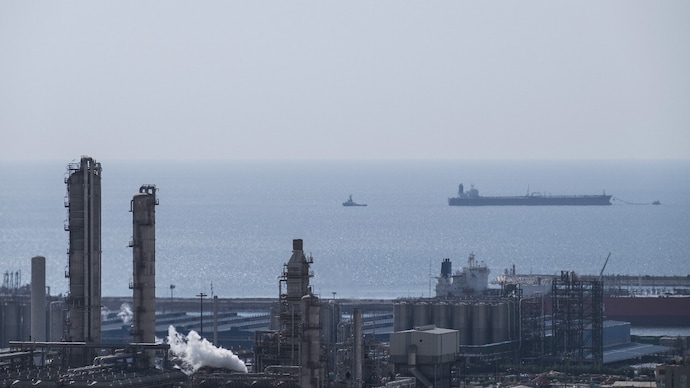


When the Iran war broke out, the nuclear question was at its core. The conversation soon shifted to Shahed drones and Iran’s vast missile stockpiles, including ballistic systems. The focus then turned to a battle of endurance, who would exhaust first: Iran’s strike capabilities, or the interception capacity of the US, Israel, and their allies, driven largely by cost and production constraints. However, another storyline had always been running in parallel and is now overtaking the broader perception of the conflict: the energy war.
Both sides relentlessly targeted energy infrastructure from the outset until US President Donald Trump "instructed" the Department of War on March 23 to postpone all military strikes against Iranian power plants and energy infrastructure for five days. By then, however, significant damage had already been inflicted. A parallel “war within the war” had disrupted critical energy assets across the region. Iran’s strategy appears rooted in its ability to choke energy supplies, both regionally and globally. To some extent, this has already been demonstrated. The objective is to make others, who are not even directly involved in the war, feel the heat of the conflict and, eventually, build pressure on Washington, if not directly, then through US allies, to reassess its strategic goals.
So far, the damage has been significant, and this can be deduced from the statement made by IEA Executive Director Dr. Fatih Birol on the same day, when he stated that “at least 40 energy assets in the Middle East region are severely or very severely damaged across nine countries.”
India Today’s Open Source Intelligence (OSINT) team has assessed the scale of the energy crisis triggered by the Iran war by analysing major energy sites targeted across nine Gulf countries, tracking vessel incidents in the Strait of Hormuz, and examining whether alternative routes are also under threat. Based on government releases from Gulf states, media reports, and UKMTO Operations Centre data, we assess that since the war began on February 28, the disruption has been extensive.
This dataset, however, remains non-exhaustive; our analysis identifies at least 25 major energy infrastructure sites that have been targeted across the region. At least 25 vessels trying to navigate through the arc of Iranian attacks have faced hostile incidents, both direct and indirect. At least one alternative export corridor bypassing Hormuz has also been struck.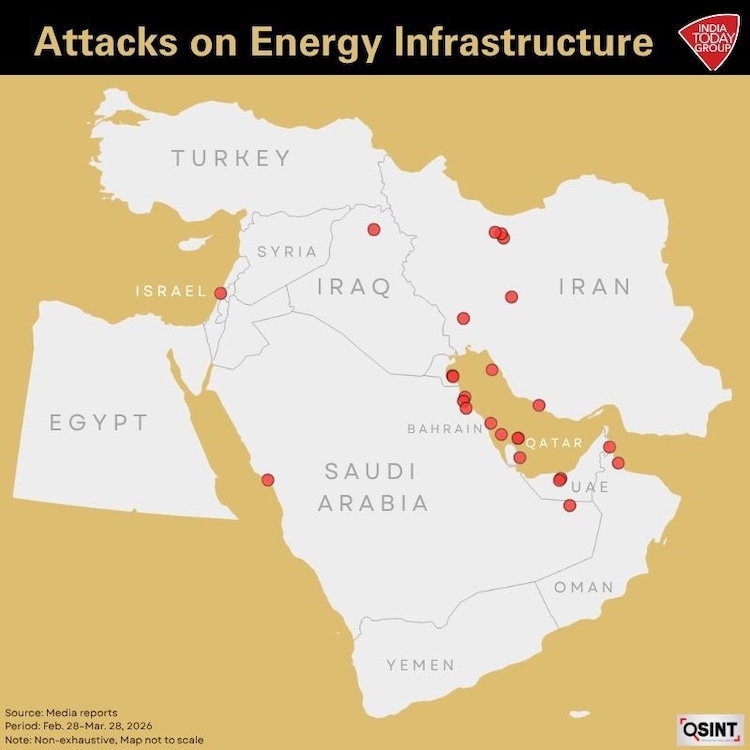
9 countries see energy sites hit in Iran war
Strikes on energy infrastructure have spanned nine countries since February 28. The pattern cuts across the entire Gulf energy chain, from upstream fields to export terminals.
Iran has absorbed some of the heaviest blows, including strikes on the South Pars gas field. Following this, Iranian state media reported that the IRGC had warned that energy infrastructure in Qatar, Saudi Arabia, and the UAE could be targeted.
That threat soon materialised. Tehran expanded strikes across West Asia, hitting multiple energy sites. Among the most significant was Qatar’s Ras Laffan, the world’s largest LNG hub. The damage was severe enough for authorities to describe it as a “direct threat” and declare force majeure.
Kharg Island, Iran’s primary crude export hub, has been in the news for some time amid concerns of a potential US ground invasion. While the island hosts critical oil infrastructure, it also contains significant military assets. On March 13, US forces struck targets on the island. President Donald Trump later claimed on Truth Social that American forces had “totally obliterated” Iranian military installations while deliberately avoiding energy infrastructure.
The messaging was calibrated, but the response was not. Iran’s foreign minister warned that Tehran would target American companies across the region if its energy facilities were attacked in the ongoing US–Israel war against the Islamic Republic.
However, the threat showed limited deterrence. Subsequent strikes expanded deeper into Iran’s core energy and industrial belt.
However, Iran has not held back on targeting energy infrastructure. From choking the Strait of Hormuz and attacking vessels to striking key energy sites, Tehran has steadily widened the conflict. It has also signalled risks to alternative export routes. The pattern suggests a deliberate strategy to impose economic and strategic costs, ensuring the US, Israel, and their allies feel the “heat” of the war beyond the battlefield.
Saudi Arabia’s network has also come under pressure, with attacks on Ras Tanura - home to one of the world's largest oil refineries and major export terminals operated by Saudi Aramco. Offshore fields such as Safaniya, Marjan, and Zuluf have also forced temporary shutdowns and output disruption following Iranian strikes.
In the UAE, strikes on Habshan and Fujairah exposed vulnerabilities in both processing and storage hubs.
Kuwait, Bahrain, and Oman have seen refinery and terminal hits, while a strike on Iraq’s Erbil region remains unconfirmed. Together, the incidents point to a sustained, region-wide targeting of critical energy infrastructure.
Other identified energy sites include the Tondgooyan Petrochemical Complex and Shahran Oil Depot, along with fuel depots and storage facilities around Tehran, Karaj, and Isfahan in Iran; the Safaniya, Marjan, Zuluf, and Shaybah oil fields in Saudi Arabia; the Habshan gas processing facility and Fujairah Oil Industry Zone in the UAE; the Mesaieed Industrial City in Qatar; the Mina Al Ahmadi and Mina Abdullah refineries in Kuwait; the Sohar refinery and Mina al Fahal terminal in Oman; the Bapco refinery in Sitra, Bahrain; the Lanaz refinery in Erbil, Iraq; and the Bazan refinery complex in Haifa, Israel.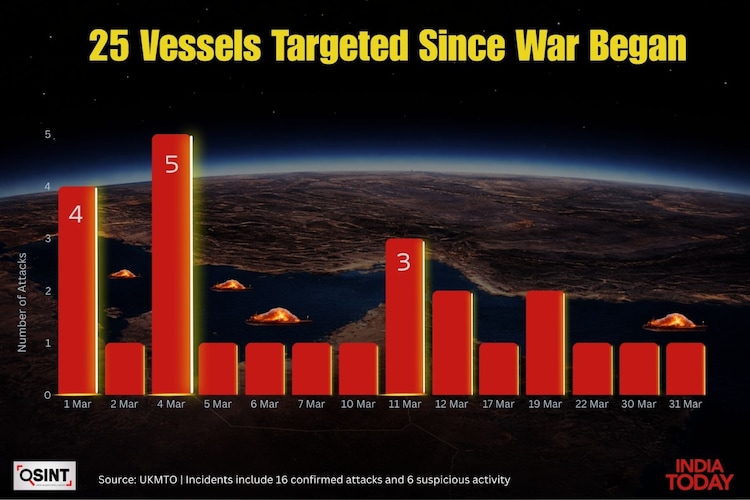
Iran targets routes bypassing Hormuz chokepoint
Rather than focusing solely on maritime disruption in Hormuz, Iran appears to be extending pressure onto midstream infrastructure feeding bypass routes. One such route, conceived as a strategic hedge against Iranian disruption, allows the UAE to safeguard a significant share of its exports outside the chokepoint - the Habshan-Fujairah - Abu Dhabi Crude Oil Pipeline (ADCOP), has reportedly been attacked.
A 380 km artery commissioned in 2012 at an estimated $3.3 billion, was designed to bypass the Strait of Hormuz by routing 1.5–1.8 million barrels per day of Abu Dhabi crude directly to the Gulf of Oman. However, reports using Soar Atlas satellite imagery from March 30 indicate that this insulation is no longer holding. Strikes were reported on Habshan and Sweihan pumping infrastructure.
By targeting inland pumping stations, the strikes demonstrate that rerouting oil does not remove vulnerability; it just relocates it.
India Today analysis identifies two more export routes, which can be used as fallback options, while the Strait of Hormuz remains constrained. So far, these corridors have not been directly targeted, but their strategic role as alternatives places them within a potential risk envelope.
The Kirkuk–Ceyhan pipeline links Iraq to Trkiye’s Mediterranean coast. It has a capacity of 1.6 million barrels per day, but currently carries around 200,000 barrels per day.
Saudi Arabia’s East–West pipeline is another key artery. It can move up to 7 million barrels per day and runs 1,200 kilometres to Yanbu on the Red Sea. This makes it Riyadh’s primary alternative to Hormuz.
However, both pipelines run across long, exposed land corridors. As the United States, Israel, and allied partners push to bypass a constrained Strait of Hormuz, these routes could increasingly fall within Tehran’s target set.
Hormuz turns perilous passage, 25 vessels struck
Maritime traffic through the Strait of Hormuz has come under sustained pressure since the conflict began, with threats extending well beyond isolated incidents. According to the United Kingdom Maritime Trade Operations (UKMTO), at least 25 maritime security incidents involving commercial vessels and offshore infrastructure have been recorded across the Arabian Gulf, Strait of Hormuz, and Gulf of Oman.
The pattern reflects more than sporadic disruption. Several energy-linked vessels were struck at critical moments of transit and transfer, pointing to deliberate targeting of oil flows. Tankers such as Hercules Star and MKD VYOM were hit by projectiles while underway, both reporting onboard fires.
More significantly, attacks were recorded during ship-to-ship transfer operations, where vessels are most exposed. Tankers Zefyros and SAVFESA Vishnu were struck mid-transfer, triggering fires and operational disruption. The most direct hit to cargo came aboard Sonangol Namibe, where an onboard explosion caused cargo hold damage and oil leakage, indicating active petroleum shipments were affected.