


Laugh with Cockroach Janta Party, then move on to the next joke
Cockroach Janta Party has taken over the Indian social media space. It is a joke, you should laugh with it and then move on.
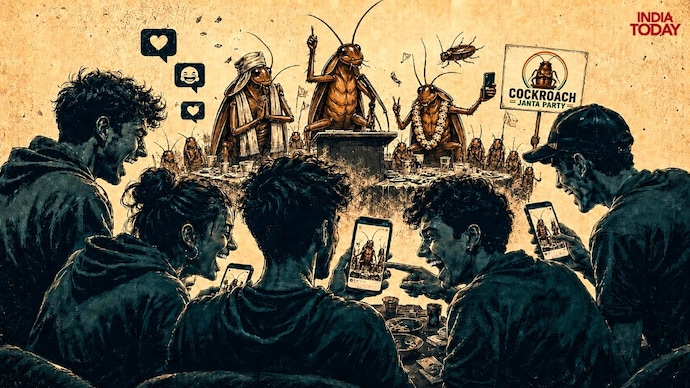
On its Instagram account, now banned in India, the Cockroach Janta Party surpassed BJP in number of followers in less than a week. (Illustration by: Ayushi Srivastava)
New Delhi,UPDATED: May 23, 2026 10:40 IST
One hundred years from now when historians look back at the early 21st century, they will find one defining feature of our age. Mass psychosis is what they will call it, a wriggling in our collective social conscience, a sigh that again and again threatens to turn into a scream that can remake the world. But each time it turns out to be nothing more than a joke played on our psyche. We have seen this countless times. We are now seeing it at the Cockroach Janta Party.
Started as a joke in response to disgraceful comments from the CJI, the Cockroach collective has generated enough attention and buzz to acquire some delusions. Its Instagram page, albeit blocked in India, now has millions of followers, more than what BJP has. Its creator — or should we say founder — is now going on television channels talking of changing Indian society and fighting for the rights of Gen Z. For a country fresh from the shock that Vijay Thalapathy delivered in Tamil Nadu, the Cockroach Party seems like the beginning of a Gen Z revolution. There is a talk that if rapper Balen can in Nepal then why not a few Gen Z cockroaches in India.
Also Read: The Cockroach Republic
Indeed, why not? The answer is plain to see. It’s all a joke. Deliberate maybe. Or plainly a joke that we have seen the 21st century play on the world countless times.
The reality is that we live in fractured times, a time when the contracts that used to hold the world together are coming apart at seams. Nothing is sacrosanct anymore. The contract between labour and capital, between voters and the elected, between politicians and their subjects, between companies and their employees, between the governed and their courts, even the social contracts between friends and families, everything is straining and fracturing.
When the world is in the middle of tragedy, the easiest way to deal with it is comedy. Because anything more requires a herculean effort, the kind that masses, we the people, have forgotten to take. We are too high on our reels, our screens, our Soma — as Aldous Huxley would have put it — of the 21st century digital world.
The world might be living through a tragedy, but things aren’t so uncomfortable that we need to get down from our sofas and armchairs and mount a revolution. The moment and the conditions for monumental changes do not exist yet and might not exist anytime soon. Instead, for now, the best that the youth, in its angst — and angst is real because we live in fractured times — can do is comedy and this time it is called Cockroach Janta Party.
It is not the only one. For the last 20-odd years we are seeing it again and again. The comedic change that the 21st century angst keeps bringing us. We saw it in the youth mobilisation that propelled Obama to his historic win in the US. Obama came out of the blue, riding the youth angst to the White House. Yes, We Can. Only we did not! Obama brought about the change that you can measure in zilch. Occupy Wall Street in 2011 lasted a few months. It sang and danced in front of the Bronze Bull and then dissolved. The Arabs hit the streets in the Spring Revolution. They are still waiting for that revolution after many a spring. They saw Gaddafi getting sodomised after he was pulled out of a drain pipe. But no revolution.
Arvind Kejriwal rode winds of change in India. He changed nothing in his mohallas and streets. In 2014, Ukrainians stood up for the Revolution of Dignity. Over 10 years later, they are now dying in a war led by their charismatic TV host, an outsider who won in 2019 promising change.
Comedy is also inherent in the election of Donald Trump. Twice the angst for change led the voters in the US into a mass psychosis in choosing a man who was arguably the best comic among all the candidates. The voters yearn for something, for a change, but the best they can do in their angst is opt for the most entertaining prospect.
And most of the time, the most entertaining prospect is an outsider, the one who would hopefully swamp the drain. Balen in Nepal. Peter Magyar in Hungary. Milei in Argentine. Meloni in Italy. Whenever there has been a candidate from outside the establishment, the voters have chosen them.
Even in India in 2014, the Modi government came to power promising to drain the swamp, to find a solution to the angst the youth of the country was feeling. That Cockroach Party now has more followers than BJP on Instagram is proof that the draining of swamp hasn’t happened, even with an outsider like Modi at helm.
The change requires effort. It requires a plan, which sometimes needs to be nurtured for years and decades. It requires thinking in terms of politics, a manner of thinking that our minds dulled with the noise and screens cannot conceive, let alone try. We know something is wrong. But we do not know what could be done to make it right.
The Cockroach Party, despite its seemingly great buzz, will fizzle out in a week or so. Or maybe in a couple of months. And even if it lasts beyond that, it would achieve exactly what similar online-driven movements have achieved — zero. Hum dekhenge. Sure, sugar. You can hope all you want but hope is, as they say, not a strategy.
It is the strategy that is missing in youth movements in the 21st century. Political changes need to shift the ground beneath our feet. Only then they have a chance at success in whatever good or bad they are trying to achieve. And you cannot shift the ground by swiping up and down on Instagram pages, or by hearting a tweet a million times.
In fact, political change is one of the greatest puzzles of the early 21st century. There is a meme that has become popular nowadays. The meme says, “nothing ever happens.” The reasons for that are many, and beyond the scope of this 1400-word piece. But I will give you one. When the youth thinks of change nowadays they don’t think in terms of politics. They think in terms of culture. And that is a wrong way to think about it.
Eric Hobsbawm, one of the best historians of the last 200 years, often turned his gaze to revolutions and political changes. “Taken by themselves, cultural revolt and cultural dissidence are symptoms, not revolutionary forces,” he once wrote. “Politically they are not very important.”
And this has been the case so far. Every time youth has tried to bring about a political change in the last 20 odd years, they have wrapped it in the language of culture. Their aims have been cultural and not political. In fact, politics is often an afterthought in their minds, and that too, with disgust.
Cultural dissidence is easy. Politics is difficult. Politics requires hitting the ground and doing leg work. It requires what Lalu and Mulayam did in their heydays. It requires what RSS and BJP leaders do nowadays.
Politics requires a careful calibration of power and alliances. One the biggest youth-driven movements in the last 75 years was the 1968 Protests. Even that did not impress Hobsbawm, who wrote: “The reason why 1968 was not a revolution, and never looked as though it would or could be, was that students alone, however numerous and mobilisable, could not make revolution alone.”
Instead, a political change comes only through a “united front of ordinary people and intellectuals.” This, according to Hobsbawm, was easier in the past. Writing in his book Fractured Times, he said “This is probably harder to achieve today than in the past. That is the dilemma of the twenty-first century.”
They might be the toast of town but in the coming days “cockroaches” would skitter away. They will go back to their reels, their chai-sutta, to the varied demands of their life. This too shall pass, to your heart’s content or discontent, depending on where you are currently placed in the society and what winds blow into your mind. Until then, enjoy the joke.
- Ends