


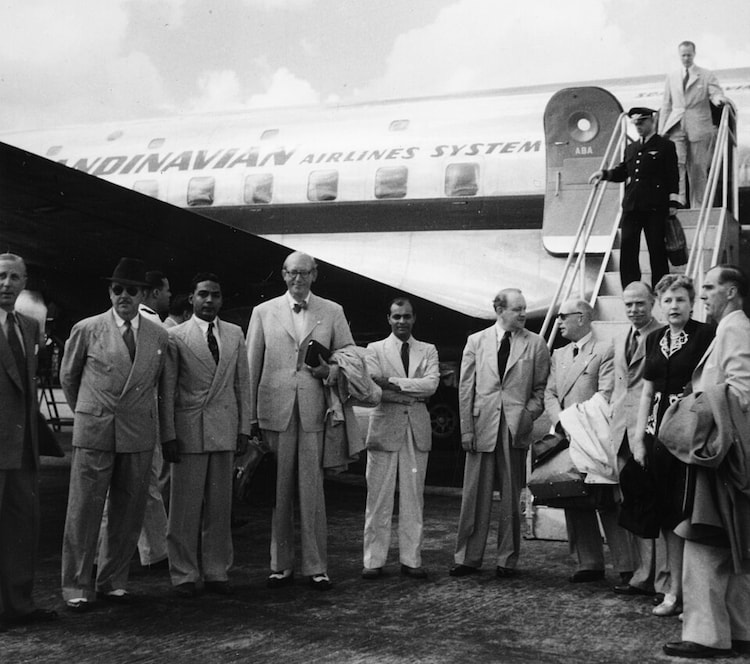
Calcutta was the OG aviation hub long before Dubai's rise
Dubai's aviation hub faces an existential threat from the war in the Middle East. But what many don't know is that before Dubai's rise, India's Calcutta (now Kolkata) was a major global aviation hub. Till the 1960s, Dum Dum Airport was served by almost every major airline to the Americas and continental Europe. Today, not a single direct flight connects to anywhere beyond Southeast Asia.
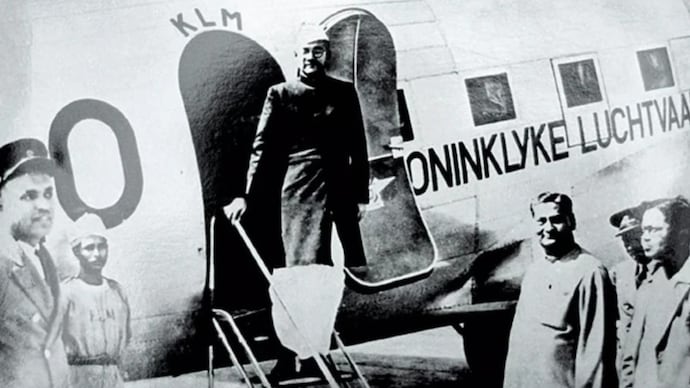
Netaji Subhas Chandra Bose was among the earliest Indian frequent flyers. This is an iconic image of Netaji getting off a KLM flight at the Calcutta Airport. (Image: Social Media)
New Delhi,UPDATED: May 11, 2026 12:25 IST
Lucknow-native, now a student in the UK's Manchester, Priyanshu Narayan was to travel home for his summer break. The 22-year-old had his tickets booked and bags packed for the trip in March. Then the war in the Middle East happened. Aviation hubs and the flight routes in the Middle East and elsewhere took a hit as drones and missiles zoomed past the skies. The flight he had booked from Manchester to New Delhi via Germany, got cancelled at the peak of the war.
"My family was worried and even advised me not to come home. Although I later succeeded in booking a ticket for a later date, I missed a week of the month-long summer break just waiting for an ideal flight route back home," Narayan tells India Today Digital. "That was an extra week of waiting, a lot of inconvenience, and a rude surprise."
The US and Israel's war on Iran has, among numerous things, sent global aviation into complete turmoil. Be it Doha's Hamad International Airport, Abu Dhabi's Abu Dhabi International Airport, and Tel Aviv's Ben Gurion Airport. But the worst hit was Dubai International Airport, one of the world's busiest international airports, and the most important aviation hub connecting 270 destinations. With the nerve-centre of aviation, Dubai, down, connections to and from Europe, Asia, the Americas, Australia and Africa, snapped. While the airport in Germany Narayan was to stop over at, it was not in the theatre of the war. But the ripple effects of cancellations across Middle Eastern hubs spread to Germany, which was not involved in the war.
Dubai is not just an airport but one of the world's biggest aviation hubs. These hubs, like Dubai, are giant transit points where passengers and goods from everywhere converge before dispersing onwards to everywhere.
While aviation hubs like Dubai or Singapore emerged in other parts of the world in the recent past, many might not know that India once had a global aviation hub in Calcutta (now Kolkata). Flights from London to Australia had a mandatory stopover in Calcutta and seaplanes took off as early as the 1920s. By the 1950s and the 1960s, all major carriers from Continental Europe and the Americas served the city.
The Dum Dum Airport, now the Netaji Subhas Chandra Bose International Airport (NSCBIA), saw its historical peak between the 1930s to the 1960s. It was served by KLM's Amsterdam Batavia service from 1924, Imperial Airways' London-Australia flights from 1933, and Air Orient's Paris Saigon route. The groundwork for Calcutta becoming a civil aviation hub in the 1960s, was laid in the 1920s for military, cargo, mail and leisure purposes.
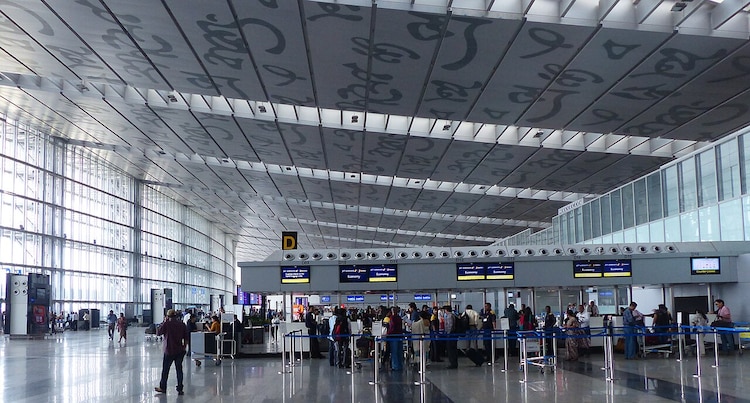
As of 2026, the Kolkata Airport has largely been reduced to a gateway to Southeast Asia. There are barely any direct long-haul flights beyond the region. Airports of Hyderabad, Ahmedabad and Bengaluru have caught up, while New Delhi and Mumbai remain at the top of India's aviation hierarchy. Kolkata-natives who are now settled in Europe and the US demand that Kolkata Airport should have more direct connections.
Copenhagen-based academic Angana Moitra tells India Today Digital that the absence of direct international flights to Kolkata has long forced her to transit through "8-hour layovers", with "huge expense" on onwards domestic tickets. Moitra adds that she has to pay "excess baggage fees" because of the difference in luggage allowances between the international and domestic sectors.
| Airport | Major International Destinations / Reach |
|---|---|
| Netaji Subhas Chandra Bose International Airport, Kolkata | Dhaka, Bangkok, Dubai, Singapore, Doha, Kuala Lumpur, Hanoi, Phuket |
| Indira Gandhi International Airport, New Delhi | London, New York City, Toronto, Paris, Frankfurt, Tokyo, Sydney, Gulf hubs, Central Asia, Africa |
| Chhatrapati Shivaji Maharaj International Airport, Mumbai | London, Dubai, New York City, Singapore, Hong Kong, Frankfurt, Doha, African destinations |
NO KOLKATA-EUROPE DIRECT FLIGHTS LEADS TO HIGH COST, EXHAUSTION, NOSTALGIA
Now, Kolkata Airport has no direct international flights to anywhere beyond Southeast Asia. "International travel to and from Kolkata has got exponentially difficult over the years, from sparse to no direct flights as of today," 46-year-old Kolkata-native Sabyasachi Ghosh, who is now a tech executive in Los Angeles, tells India Today Digital.
Moitra, a Kolkata-native now based in Copenhagen, tells India Today Digital that transiting through airports is "very taxing" for her. "Kolkata not having direct flights" makes international travel difficult "because layovers become exhausting, expensive, and complicated due to separate baggage rules and high onwards domestic costs", Moitra, an Assistant Professor and a postdoctoral researcher in Denmark, tells India Today Digital.
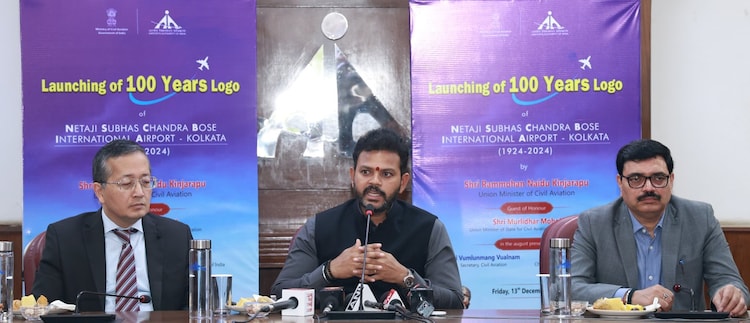
"Please give us more international flights. When I was young, Calcutta had direct flights to London and Paris. They have since stopped," said Saugata Roy, Trinamool MP from Dum Dum, during the centenary celebration of the NSCBIA in 2024, reported Kolkata-based The Telegraph.
Union Civil Aviation Minister Rammohan Naidu Kinjarapu, present at the celebrations, took Saugata Roy's appeal as a "challenge.
"I accept the challenge to bring more flights. The airport is now connected to 64 destinations. We will aim to raise the count to 100. I will use gentle persuasion with airlines," said Naidu, according to The Telegraph.
WHEN FLIGHTS LANDED ON THE HOOGHLY IN CALCUTTA AT THE DAWN OF INDIAN AVIATION
While the Trinamool MP Roy recalled the Calcutta Airport of the 1960s and 1970s, Kolkata joined the world's aviation as early as the 1920s during British rule, according to aviation, maritime and military historian, KS Nair.
"And why not," Nair says. "After all, in the early 20th century, Calcutta was, after London, the second-most important city in the British Empire, the only global superpower at that time. This was owing to its military and commercial importance."
"In the 1920s and 1930s, Imperial Airways, the ancestor of BOAC and British Airways, was the pioneering long-haul airline service to connect the far corners of the British Empire through air routes. The longest route it serviced was from London to Australia. The service had many different stops, because of the limited range of aircraft of that time. The service would stop in Europe, then often in Cairo in Egypt, and / or even some locations in Iran or Iraq, then Karachi, then Calcutta (which was the capital of India until effectively 1931), then on to Australia via Singapore and other British possessions through South-East Asia," Nair tells India Today Digital.
"It used to be a leisurely service and stretched for periods of 10 days and more. Good food. Nice wine. They would fly in the daytime and the passengers would be accommodated overnight in luxury hotels near the stopover points. In particular in that period, seaplanes were used for these services, because they were longer-ranging. They didn't need airfields to land, and could land on clear water bodies, such as lakes or calm rivers," Nair tells India Today Digital. "And many luxury hotels of that period were built close to water bodies."
This was an era when air traffic was limited. Flyers were a select few. Air travel was not for everyone. Ships were the only truly viable option for most people and cargo movement. And, the UK's and the US's military pursuits in eastern Asia and the Indo-China against Imperial Japan.
Starting in 1928, and throughout the 1930s, the leading British seaplane company Short Brothers built a flying boat aircraft specifically for these long-haul Imperial Airways services called the Short S.8 Calcutta, itself named after the city. "This reflects how important the city had become in the imperial aviation network," says military historian Nair.
Flying boats landed on the Hooghly at Bally and Dakshineswar as part of Imperial Airways and British Overseas Airways Corporation (BOAC)'s Britain to Australia route, according to Tanmoy Bhattacharjee, a Kolkata-based independent researcher, reported Kolkata-based news outlet, BanglaLive, in 2004.
An interesting anecdote is that, years before the British made an aerodrome in Dum Dum in the 1920s, and seven years after the Wright Brothers' aeroplane took to the skies in 1903, Calcutta was placed on the aviation map in 1910.
In 1910, Calcutta entered aviation history. Two aircraft took off from the golf course of Tollygunge Club. They circled over south Calcutta and then landed back on the same Tollygunge Club grounds. The rediscovery of Kolkata's forgotten 1910 history was made by aviation enthusiast Debasish Chakraverty around 2017-2018, according to a 2018 report in The Times of India.
DUMDUM CAME UP IN 1920s. HOW WWII AIDED CALCUTTA GROWTH AS AVIATION HUB
Years later, the Dum Dum airport was founded in 1924. This is where the NSCBIA is now.
By the late 1930s, Netaji Subhas Chandra Bose was among the earliest Indian frequent flyers at the airport, and the iconic image of him disembarking from a KLM flight is still widely seen as a defining visual of Calcutta’s early aviation era, reported The Telegraph. It was after Netaji's name that Dum Dum was later renamed Netaji Subhash Chandra Bose International Airport in 1995.
"Many pioneering flights passed through the [Calcutta] airport, including that of [American aviator] Amelia Earhart in 1937. In 1924, KLM began scheduled stops at Calcutta, as part of their Amsterdam to Batavia (Jakarta) flight. The same year, a Royal Air Force aircraft landed in Calcutta as part of the first round-the-world expedition by any air force," according to Kolkata Airport's official website.
In the 1920s and the 1930s, the British invested in several airstrips or aerodromes in the subcontinent to serve its needs.
During World War II, Calcutta, the Bengal Presidency, and the north-eastern states of India (at that time still collectively called Assam, and including a few princely states) became hugely important to the Allied war effort against Japan. China, at that time run by the Nationalist Party of Chiang Kai Shek, had been fighting Japan even before World War II officially started, and it was in the interest of the Allies to support China.
"After the Burma Road was cut by Japan, in the early part of the war, the only way to supply China was by air. For nearly four years, the Allies flew literally hundreds of flights out of Calcutta and North-Eastern India every day, taking supplies to China. The effort peaked at over a thousand flights on one landmark day, accomplished as a tribute to the US general who organised this massive operation. Calcutta would have been one of the biggest aviation hubs in the world at that time," military historian KS Nair tells India Today Digital.
Planes of the UK's Royal Air Force (RAF) landed and took off from Calcutta's Red Road too. It wasn't just a lack of airfields that brought the RAF to Red Road. Converting the boulevard into a runway and landing military planes there also served as a public morale-booster.
After a few years of rocky start by the Indian aviation sector, things started to change by the late 1950s. The Dum Dum airport entered its golden age in the early 1960s. The airport emerged one of Asia's busiest aviation gateways with global airlines like Aeroflot, Air France, Alitalia, Cathay Pacific, Japan Airlines, KLM, Lufthansa, Pan Am, Philippine Airlines, Qantas, SAS and Swissair operating through Calcutta.
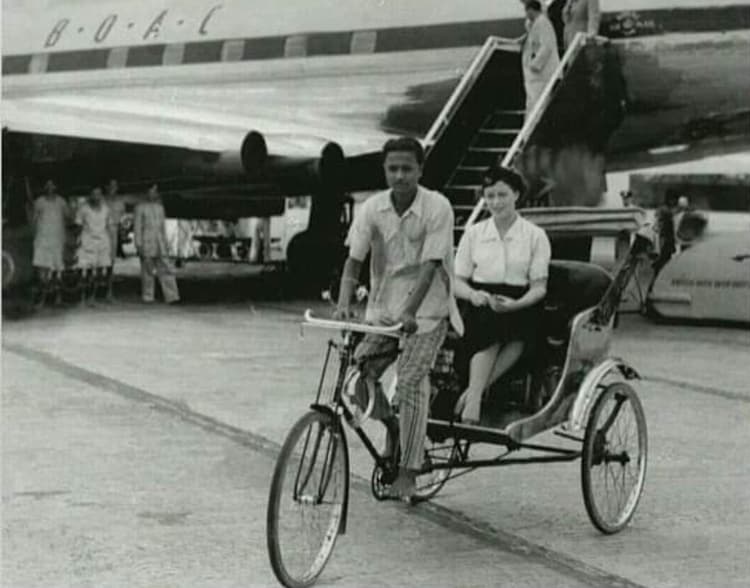
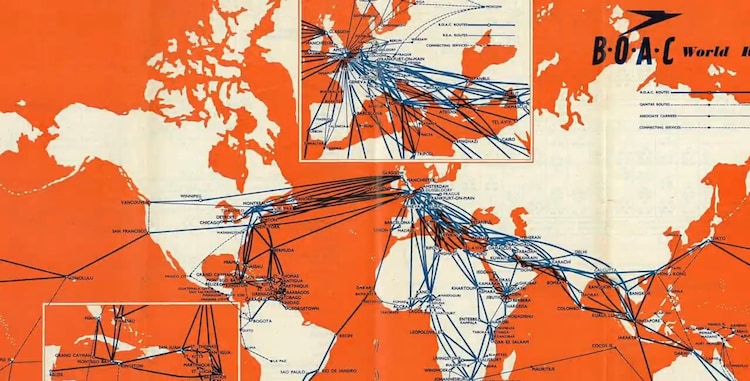
A Google search would throw up old posters of BOAC, with Calcutta as one of its destinations. At least, one of the posters was a bit appropriate. Snake charmer!
"In the early years after Independence, many of the major European and American carriers had one or two direct flights to Calcutta every week," says Nair.
The Dum Dum Airport even received the world's first jet-powered passenger aircraft, the de Havilland Comet, on the BOAC's route to London. Indian Airlines launched India’s first domestic jet service between Calcutta and Delhi in 1964 using Caravelle planes, according to reports.
HOW CALCUTTA AIRPORT STARTED TO DECLINE? WAS IT LINKED TO KOLKATA'S FINANCIAL HEALTH?
But, in the early 1970s, a slow yet significant decline of Netaji Subhas Chandra Bose International Airport began.
It was a mix of factors that stripped Kolkata Airport of its dominance. Some were internal, others were external. And, then came the big technology-driven disruption. The Jumbo Jet. Entering service in 1970, the Boeing 747 changed global aviation forever. The sectors which needed multiple stops now didn't need any, and they would accommodate more than 350 passengers in mixed-class configuration (and more in all-economy layouts).
The London-Sydney Kangaroo Route now needed just one stopover or none. Carriers like Qantas and BOAC started choosing Singapore and Bahrain for stopovers. In 1989, the first non-stop flight from London to Sydney was launched by Qantas, the Australian flag-carrier.
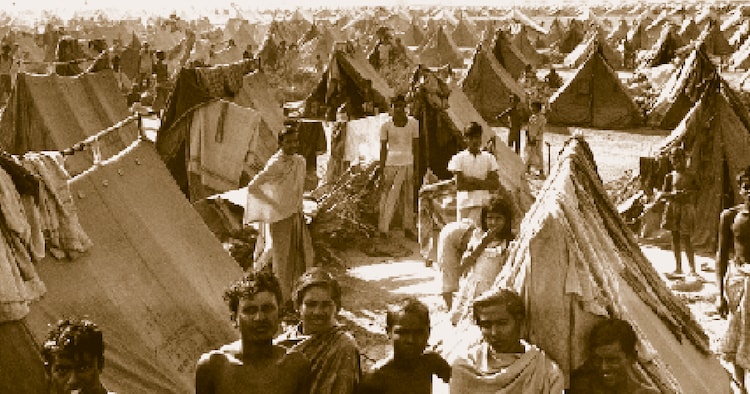
The rise of long-range aircraft did not just contribute to Kollata airport's downfall. The political climate in Calcutta during the late 1960s, the rise of Naxalism and the influx of refugees into the city before the Bangladesh Liberation War gradually pushed many global airlines away from the city, according to a report in SimpleFlying, a London-based aviation news publication.
In the Lok Sabha in 1971, Civil Aviation Minister Karan Singh said that "we cannot force an international airline to operate to any particular point" and that route decisions were based on commercial judgment. He informed the House that airlines such as Swissair, Alitalia and Lufthansa had already ceased operations from Calcutta, while others like BOAC, Aeroflot, Pan Am and Japan Airlines were still operating, though some were preparing to pull out of Calcutta. He also noted that there was a "move away from Calcutta towards Delhi".
"The depressing fact that international carriers don't very much care for Calcutta's 'beautifully designed' airport is made obvious from the situation there on some days, when there are yawning gaps between one flight and the next," reported India Today Magazine in 1983.
The report noted that only 12 international flights operated from the airport every week... which compared poorly with the 31 using Bombay and the 21 using New Delhi.
The 1983 India Today Magazine report argued that the decline of the airport was driven by a mix of technological change allowing aircraft to "overfly Calcutta", shifting airline preferences towards New Delhi and Bombay, and a lack of sufficient business demand to sustain regular international operations.
During the Left Front rule in West Bengal, prolonged industrial stagnation, labour concerns, and policy uncertainty led to declining private investment and business confidence in West Bengal. The overall economic momentum compared to faster growing states. This slowdown had a cascading effect on infrastructure, job creation and aviation demand.
"To be honest, the state of the Kolkata Airport, as of any city airport these days, is reflective of the city's economic health. Business interests are an important factor," military historian KS Nair tells India Today Digital.
EXORBITANT PRICES, LONG LAYOVERS, EXTRA-BAGGAGE CHARGE BURDEN FLYERS. THEY DEMAND DIRECT KOLKATA CONNECTIVITY
Los Angeles-based tech executive Ghosh admitted to having paid "exorbitant prices to avoid multiple connections, especially with kids or ageing parents".
"Ridiculous layovers push the total travel time from Los Angeles to Kolkata beyond 40 hours (yes, it's true). At times there's barely 50 minutes to sprint across terminals nearly a mile apart as if competing for an Olympic medal," Ghosh tells India Today Digital.
Though Kolkata Airport saw some upgrades after liberalisation in the 1990s, things never got back to what they were.
Today, the Delhi Airport handles over 75 million passengers annually, the Mumbai Airport serves around 55 million, while the Kolkata Airport remains much smaller at roughly 22 million passengers a year.
The weekly Air India Kolkata-London direct service, which served for a brief time during the Covid-19 pandemic, failed to take-off. The route was permanently suspended in March 2022, reported The Times of India.
"I can't say what happened exactly, but it could be a combination of neglect and lack of business. Airlines don't have enough business travel that is skewed towards bringing in profits and offsetting the rest given the extremely tight margins," Ghosh adds.
Copenhagen-based Moitra says she thinks "the Kolkata airport needs to do far better generally". She hopes if international flights to Europe start from Kolkata, "it will surely make the process easier" because passengers "will not always have to look for transit routes and spaces to store their luggage in".
While flyers using Netaji Subhas Chandra Bose International Airport today might not be fully aware of what the "Calcutta Airport" once was in its heyday, and what has become of it, one could only hope for more direct flights beyond Southeast Asia. The promise of the Union Aviation Minister in 2024 to scale up to 100 international flights must be a work in progress. Until then, Kolkata's aviation story feels like a city still waiting for its "poriborton".
- Ends