
International Day of Families 2026: Families hold us together in changing times
As loneliness, financial stress, and emotional distance grow across modern homes, the International Day of Families 2026 highlights why strong family bonds remain essential for child wellbeing, mental health and social stability in an increasingly unequal and uncertain world.
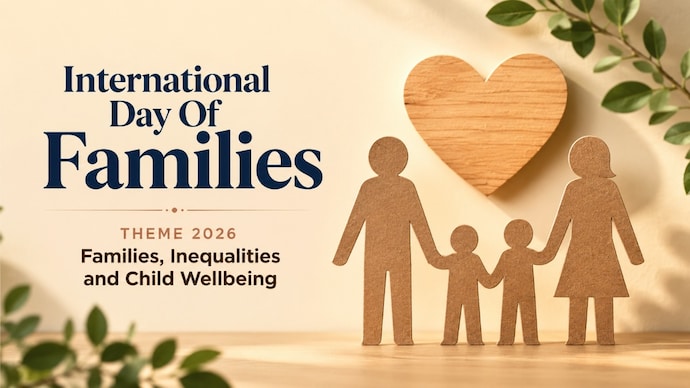

As the world faces conflict, inflation, loneliness and emotional exhaustion, the International Day of Families reminds us that the home remains the first and most important support system.
Every year on May 15, the world observes the International Day of Families, a United Nations initiative that highlights the importance of families in building strong and stable societies. This year, the theme – Families, Inequalities and Child Wellbeing, draws attention to a growing global concern about how economic stress, social inequality and emotional instability are directly affecting homes and children.
At a time when wars are displacing millions, inflation is rising, unemployment is creating uncertainty and mental health struggles are becoming more visible, the idea of family has become more important than ever.
Family is no longer just seen as a social unit. It is increasingly recognised as the first line of emotional support, security and survival.
BEYOND MONEY: THE CRISIS OF EMOTIONAL DISCONNECTION
The modern world is facing more than an economic crisis. It is also facing a crisis of emotional disconnect.
Technology has made people constantly available, yet many feel more isolated than ever. Fast-paced lifestyles, work pressure and individualism have changed the way relationships function. Communication within homes is weakening, patience is shrinking, and emotional support is often replaced by silence.
Conflicts today are not limited to international borders. They are visible inside households too, such as between couples, between parents and children, and across generations.
As trust declines and loneliness rises, the family becomes one of the few spaces where emotional stability can still be built.
WHY FAMILY SHAPES THE FUTURE OF CHILDREN
A child’s first understanding of the world begins at home.
Family is where children first learn empathy, cooperation, discipline, respect and emotional safety. The way a home functions often shapes how a child builds confidence, relationships and resilience later in life.
When families are stable, children grow with strong emotional foundations. When families are under pressure, the impact is often seen first in a child's mental wellbeing. This is why the UN’s focus this year connects family wellbeing directly with child wellbeing. Social development cannot happen without emotionally healthy homes.
JOINT FAMILIES AND THE RETURN OF SHARED SUPPORT
In India, where rapid urbanisation is pushing more families toward smaller and isolated living arrangements, this raises an important question: are homes becoming emotionally smaller too?
Experts suggest that whether it is a joint family or a nuclear one, emotional availability matters more than physical presence. Children thrive not simply in bigger homes, but in safer and more supportive ones.
Shared responsibilities, emotional support and financial cooperation make such structures stronger during difficult times.
When multiple generations live together, crises are easier to manage. Children grow up with stronger support systems and elderly family members remain socially connected.
MENTAL HEALTH AND THE LONELINESS INSIDE MODERN HOMES
Urban life has created a strange contradiction. People live close to thousands of others yet feel deeply alone.
The World Health Organization’s 2025 report on social connection found that one in six people worldwide experience loneliness, with adolescents and young adults among the most affected. WHO warns that weak social bonds are directly linked to depression, anxiety and even premature death.
Many young professionals in metro cities live independently but struggle with anxiety, stress and emotional exhaustion. Elderly parents are often left alone. Children spend more time on screens than on conversations. Relationships inside homes become functional rather than emotional. And this growing emotional distance inside families is no longer a personal problems, they reflect a larger social shift – the weakening of family bonds.
GLOBAL CONFLICTS HURT FAMILIES FIRST
From the Russia-Ukraine war to continuing instability in West Asia, global crises affect families before they affect statistics.
Displacement, financial collapse, orphaned children and unsafe living conditions all begin at the household level. Women and children often face the highest vulnerability during such disruptions.
Climate change, migration and economic inequality also place the greatest pressure on families, especially those already struggling with limited resources.
This is why family-focused public policy is becoming central to sustainable development discussions across the world.
Strong economies alone cannot create stable societies. Strong families can.
INDIA’S FAMILY VALUES AND THE CHANGING SOCIAL REALITY
India has traditionally viewed family as more than a living arrangement. It has been seen as a cultural institution built on responsibility, sacrifice and shared identity.
From the Ramayana to the Mahabharata, family relationships have shaped some of the country’s deepest moral narratives.
The idea of Vasudhaiva Kutumbakam – the world is one family, reflects how deeply family values are rooted in Indian thought.
However, changing lifestyles and consumer-driven culture are challenging this structure. Relationships are increasingly measured by convenience and personal gain. Expectations are growing, while patience is declining.
The strength of a family, however, has never depended on wealth, it depends on trust. Without trust, the comfort feels empty. With trust, even difficult times become manageable.
WHAT FAMILIES NEED NOW
The answer may not lie in grand reforms, but in small habits.
Shared meals, regular conversations, respect for elders, emotional openness and value-based parenting can rebuild connections inside homes.
Children need character building as much as career building. Young people need trust as much as advice. Families need cooperation more than competition.
The International Day of Families is not only a symbolic observance. It is a reminder that the future of society begins inside homes.
As inequality grows and the world becomes more uncertain, the strongest safety net may still be the oldest one – a family.
Written By: Vidhya Das