
The sound of civilisation: How 25 instruments tell the story of the world
From ancient bagpipes to modern synthesisers, we trace the origins of 25 musical instruments across continents. It explores how culture, craftsmanship, and technology shaped global music, revealing a timeline that connects tradition with modern sound.
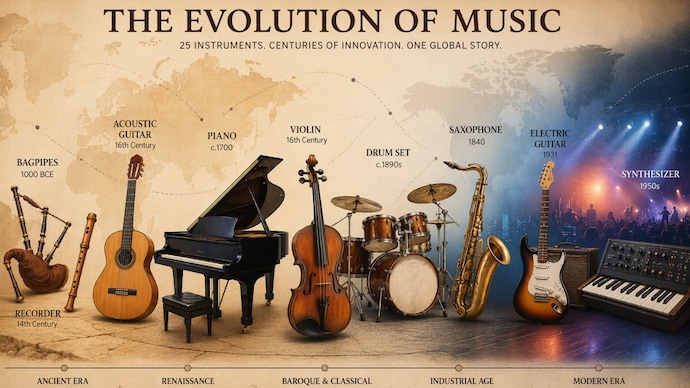

Before Spotify playlists, before concerts, before even written history, there was sound. A stretched string. A hollow drum. A breath through wood. What if the instruments we listen to today were not just tools of music, but time machines? Each one carries the imprint of a place, a culture, and a moment in history. From the royal courts of Europe to the spiritual traditions of India and the rhythmic roots of Africa, the evolution of musical instruments is nothing less than the evolution of human expression itself.
INDIAN CLASSICAL TRADITIONS AND THE SPIRITUAL SOUND OF THE SITAR
While global music evolved through innovation and technology, India developed a deeply philosophical relationship with sound.
The sitar, dating back to the 16th century, is not just an instrument but a medium of spiritual expression. Rooted in the concept of Naad Brahma the idea that “sound is divine” Indian classical music treats every note as a pathway to meditation.
Unlike Western music, which often focuses on harmony and composition, Indian classical music is built on ragas, melodic frameworks that evoke specific emotions, times of day, and even seasons. The sitar, with its resonant strings and intricate structure, allows musicians to explore these emotional landscapes in depth.
Globally, the sitar gained prominence through icons like Ravi Shankar, who introduced Indian classical music to Western audiences, influencing even bands like The Beatles. This marked one of the earliest moments of true global music fusion.
In this sense, India’s contribution is not just an instrument, but an entirely different philosophy of music, one that prioritizes introspection over performance.
THE EUROPEAN ROOTS OF CLASSICAL SOUND
The foundation of many modern instruments can be traced back to Europe’s artistic boom between the 15th and 18th centuries.
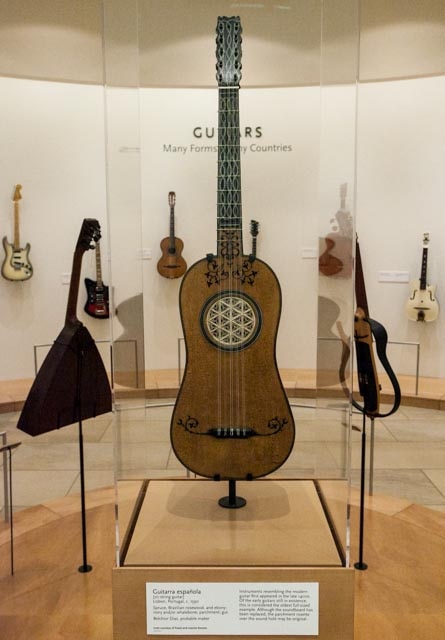
In Spain, the acoustic guitar emerged in the 16th century, simple yet expressive, designed for storytelling through strings. Meanwhile, Italy became a powerhouse of innovation, giving the world the violin and cello, instruments that defined orchestral music.
The biggest breakthrough came around 1700, when Bartolomeo Cristofori invented the piano. For the first time, musicians could control how softly or loudly a note was played. Emotion was no longer fixed, it became dynamic.
Germany and France also played key roles, contributing instruments like the clarinet, flute, oboe, and trombone, each adding new textures to the growing soundscape.
THE RISE OF WIND, BRASS AND MUSICAL COMPLEXITY
As music evolved, so did the need for richer, more layered sound. The saxophone, invented in Belgium in 1840, bridged the gap between brass and woodwind, later becoming central to jazz. The valved trumpet from Germany introduced precision in pitch, while the French horn brought depth and resonance.
Instruments like the accordion and harmonica made music portable, taking it from concert halls to streets, cafes, and everyday life. Music was no longer elite. It was becoming democratic.
AMERICA AND THE BIRTH OF MODERN SOUND
The late 19th and early 20th centuries marked a turning point. In the United States, the drum set was born in the 1890s, allowing one musician to control rhythm entirely. It was efficient, practical, and revolutionary.
Soon after, the electric guitar (1931) and electric bass (1930s) transformed music forever. Amplification meant sound could reach thousands, not just dozens. Genres like rock, blues, and pop would not exist without this shift.
The invention of the synthesiser in the 1950s pushed boundaries even further. Music was no longer limited to physical instruments. It could now be created electronically, opening the door to modern digital production.
INDIGENOUS AND GLOBAL INSTRUMENTS: THE OLDER VOICES
While Europe and America drove modernisation, many instruments have much older, deeper roots.
In India, the sitar dates back to the 16th century, embodying centuries of spiritual and classical tradition. In Guatemala, the marimba reflects indigenous craftsmanship and rhythm.
The xylophone, with origins in Africa as early as the 9th century, highlights how rhythm has always been central to human culture. Even older are the bagpipes, tracing back to around 1000 BCE, proving that music predates modern civilisation itself.
EVEN TODAY, MODERN MUSIC IS BUILT ON THESE FOUNDATIONS
Digital beats mimic drum patterns. Software instruments replicate piano keys. Electric guitars still dominate global music charts. The past is not gone, it is embedded in every track we hear.
For media and storytelling, this is powerful. It shows that music is not just entertainment, it is history, technology, and identity combined.
MORE THAN JUST SOUND
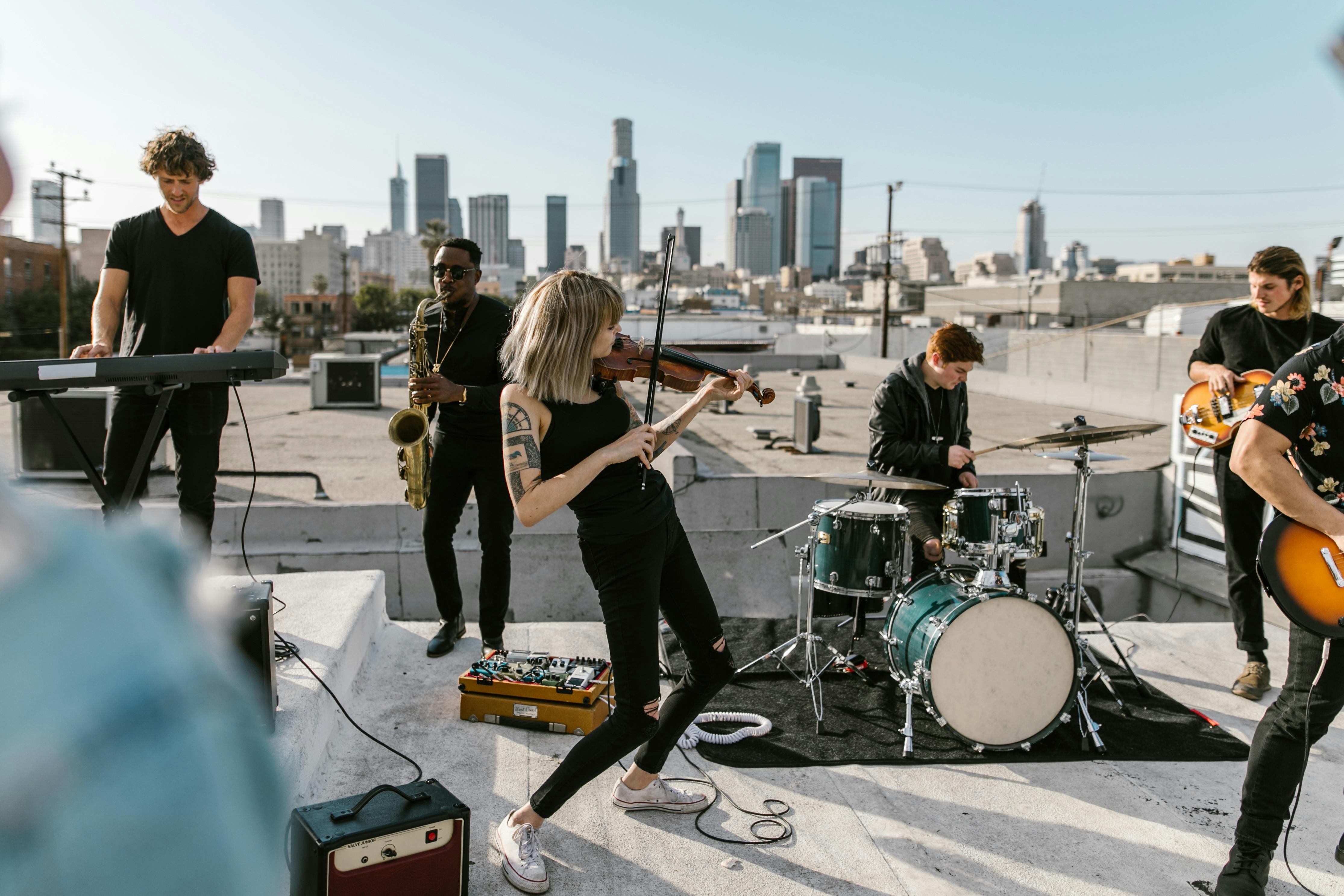
These 25 instruments are more than objects. They are cultural markers. They tell us where we came from, how we evolved, and how we connected across borders without a shared language. From wooden strings in Spain to electronic circuits in America, the journey of musical instruments mirrors the journey of humanity itself.
Because in the end, music is not just something we hear. It is something we inherit.