
Wrinkle-free careers: The curious rise of resume botox
Professionals are trimming resumes to get past AI-led applicant tracking systems and avoid being seen as overqualified. The trend reflects rising concern over age bias and the limits of algorithm-driven hiring.

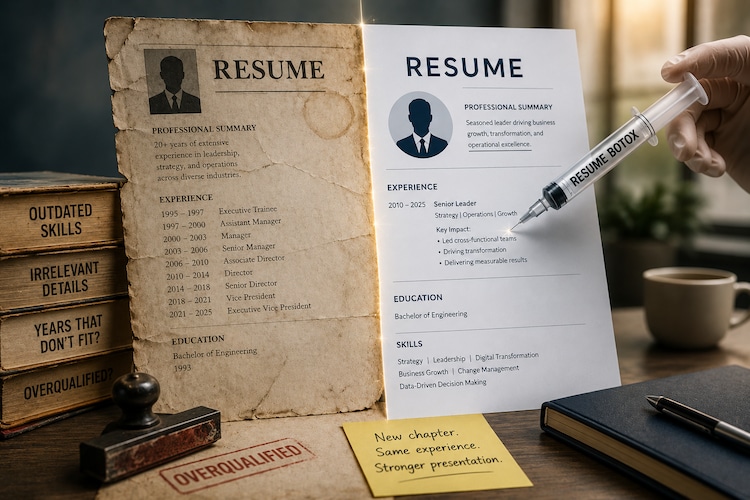
The curious rise of resume botox (AI generated image)

New Delhi,UPDATED: Jun 2, 2026 11:48 IST
Imagine this: You have just completed your twentieth year in your profession.
It is a milestone few people ever reach. Your resume tells the story of two decades of achievements, promotions, leadership roles, and hard-earned expertise. Confident in what you bring to the table, you decide it is time for the next chapter of your career.
So you begin applying for jobs. One application becomes fifty. Fifty becomes hundreds.
Yet the responses never come. No interview invitations. No recruiter calls. No follow-up emails. Just silence. Meanwhile, there is another candidate. Let's call her Priya.
She has reached a similar career milestone. She starts applying too, and, almost immediately, interview invitations begin to arrive. Before long, she secures the very role you had hoped to land.
So what happened? Was your resume weak? Was your experience irrelevant? Not necessarily.
The reality may be far stranger and far more unsettling.
Your resume may have been rejected before a human being ever laid eyes on it.
Welcome to the age of Applicant Tracking Systems (ATS), where artificial intelligence often determines which resumes deserve a recruiter's attention and which disappear into the digital void. In this new hiring landscape, professionals are increasingly embracing a controversial survival strategy known as "Resume Botox."
As AI-driven Applicant Tracking Systems become the gatekeepers of modern recruitment, many professionals are quietly turning to Resume Botox by strategically trimming their work history, removing graduation dates, and softening senior job titles to appear younger and less overqualified.
The trend reflects growing concerns about age bias in hiring, where decades of experience can sometimes become a disadvantage rather than an asset.
In a job market increasingly shaped by algorithms, experience is no longer viewed solely as a badge of credibility. For some professionals, it has become a liability.
As workers quietly edit away years of their careers in an effort to remain visible in crowded applicant pools, Resume Botox exposes an uncomfortable truth about the modern hiring process: sometimes, staying competitive means learning how to look younger on paper.
THE AGE OF RESUME BOTOX
The term may sound cosmetic, and in many ways it is.
Just as Botox reduces visible signs of ageing, Resume Botox refers to the practice of making a resume appear professionally younger. Candidates strategically trim, soften, or remove details that could make them appear "too experienced," "too senior," or overqualified for a role.
"Resume Botox refers to the practice of subtly modifying and polishing a CV to make it appear more impressive and relevant before presenting it to hiring stakeholders. This is certainly an emerging trend in India," said Preksha Yadav, Manager, Operations & Client Servicing.

The process is often subtle but deliberate. Candidates shorten their visible work history, frequently highlighting only the last 10 to 15 years of experience rather than their entire career. Graduation dates quietly disappear. Senior leadership titles are toned down to avoid triggering the "overqualified" label. Outdated software skills and ageing certifications are removed to create a more contemporary profile.
In short, the resume receives a makeover. Not to deceive, but to survive.
For many professionals over 40, the fear is simple: too much experience is no longer viewed as an advantage. Instead, it risks becoming a red flag in a hiring ecosystem increasingly shaped by algorithms and assumptions.
THE RISE OF THE TREND IN INDIA
If Resume Botox sounds like a phenomenon confined to Western job markets, think again. The trend is increasingly finding its place in India as well.
"It's happening everywhere in the US, and it's absolutely catching on in India now. We interview thousands of candidates every month, and we're seeing this constantly," said Anil Agarwal, Co-founder and CEO, InCruiter.
While the term itself may be relatively new, the behaviour behind it is not. As more organisations adopt ATS-based hiring systems, job seekers are becoming increasingly strategic about how they present their skills, experience, and career progression.
"Candidates in India have long tailored their resumes to improve relevance for specific opportunities. As ATS adoption becomes more widespread, job seekers are becoming increasingly intentional about how they present their skills, experience, and career progression. However, the focus remains on improving role fit rather than concealing age or experience," said Mr Pasupathi S, Chief Operating Officer, HirePro.
WRITING RESUMES FOR ROBOTS
The rise of Resume Botox is closely linked to the growing dominance of AI-driven hiring systems. Today, resumes are often screened by Applicant Tracking Systems long before they reach a recruiter.
These systems scan applications for keywords, preferred formats, and candidate profiles that match an organisation's hiring criteria.
As a result, the way people write resumes has fundamentally changed.
"AI-driven hiring systems primarily identify and match keywords and skills from job descriptions with candidates’ resumes. As a result, resumes that clearly reflect the required skills are more likely to get shortlisted," says Preksha Yadav, Manager, Operations & Client Servicing.
Candidates are no longer writing solely for human recruiters. Increasingly, they are writing for machines.
Every keyword matters. Every section is optimised. Every date can become a potential risk.

According to Monster's 2026 State of Resumes Report, nearly 77 per cent of job seekers worry that their applications are filtered out before a recruiter ever sees them. The concern is particularly pronounced among older professionals who fear that lengthy work histories may trigger assumptions about salary expectations, adaptability, or cultural fit.
Ironically, the very thing professionals spend decades building, experience, is now being carefully edited down to remain employable.
Although the phrase "Resume Botox" first emerged years ago, it has entered mainstream career conversations in 2025 and 2026 as concerns about age discrimination and algorithmic hiring continue to grow.
THE FINE LINE BETWEEN STRATEGY AND FRAUD
This raises an important question: where does smart resume strategy end and dishonesty begin?
Career coaches and hiring experts generally agree that omitting graduation dates, shortening older work histories, or removing irrelevant experience is acceptable. These choices are considered strategic ways of directing attention toward recent and relevant accomplishments.
While highlighting the most relevant experience and streamlining older career history can be both legitimate and effective, manipulation is a different matter altogether.
"A resume should be curated, not manipulated. Highlighting the most relevant experience and streamlining older career history is a legitimate and often effective strategy," said Mr Pasupathi S, Chief Operating Officer, HirePro.
Fabricating job titles, altering employment dates, or inventing qualifications crosses a clear ethical boundary. At that point, Resume Botox stops being optimisation and becomes fraud.
Agarwal points to another dimension of the problem. Some candidates attempt to conceal employment gaps or downplay professional setbacks in an effort to strengthen their profiles.
"It always backfires. Always. I've seen hundreds of cases where candidates hide employment gaps or trim down failures from their resume, and it catches up with them. Either during the interview, when a simple follow-up question exposes them, or after they're hired and they can't do the job they claimed they could do. Companies have terminated people for resume fraud months into employment," says Mr Anil Agarwal, Co-founder and CEO, InCruiter.

This distinction matters because Resume Botox is ultimately less about lying and more about visibility. Many candidates believe they are simply adapting to a system that already judges them through invisible filters.
And perhaps that is the larger question.
If experienced professionals feel compelled to erase parts of their careers simply to get noticed, what does that say about the hiring process itself?
HIDING EXPERIENCE TO STAY RELEVANT
Resume Botox may sound like just another workplace buzzword, but it reflects a deeper anxiety shaping today's job market.
In an era where algorithms increasingly act as the first gatekeepers of opportunity, professionals are competing not only on talent and expertise but also on perception.
For many candidates, trimming a resume is not an act of vanity. It is an act of survival. It is an attempt to ensure that years of hard-earned experience do not become grounds for rejection before a conversation even begins.
Yet the rise of Resume Botox exposes a troubling contradiction at the heart of modern hiring. Experience is celebrated in theory but often penalised in practice.
And if professionals are increasingly hiding parts of their careers to remain employable, perhaps the real problem is not the resume at all, but the system reading it.
- Ends