
With fiscal machinery going nowhere, new government's priority is to stabilise economy
With the fiscal machinery going nowhere, the new Government's priority is to stabilise the economy - the immediate needs being the budget and the IMF loan.

ISSUE DATE: Jul 15, 1991 | UPDATED: Sep 11, 2013 10:41 IST


Two months later, the SJP government skips presentation of the Union budget, under pressure from the Congress(I) on whose support it depended. Instead it prefers to settle for an ad hoc vote-on-account designed to keep the fiscal machinery going till end-July. And Finance Ministry mandarins hope that a new government will take charge, take quick decisions and rapidly put the economy on the road to recovery. They also hope that the new Government will immediately address two crucial and pressing needs of the Indian economy: present the budget, and go to the Washington-based lending agency, IMF, for another, larger bail-out, as the balance of payments (bop) position has worsened considerably ever since the last loan. "The time for playing games," says a senior Finance Ministry official, "is over."
The fact is, the fiscal machinery is going nowhere. P.V. Narasimha Rao's Government has barely taken charge. And it is already confronted with a host of problems. There is still a lobby within the Finance Ministry which strongly favours another vote-on-account to last the remainder of the 1991-92 financial year. And finally, though the Government has been repeatedly harping on how it will ask the IMF for as much as $4 billion more in loans, the agency itself is yet to make a firm commitment on any amount. On the other hand, the IMF has been insisting on India adopting its four-D principle of conditionality - deflate, devalue, denationalise and deregulate - before final talks on a loan actually get going.
That was the bad news. The good news is that the brand-new Congress(I) Government was talking about mending India's economy even before it made the grade. And though the champion of liberalisation, Rajiv Gandhi, isn't there any longer to lead the show, there are enough people within the party who realise that the most important challenge facing the new Government is to stabilise the sluggish economy and restore it to the halcyon days of the Rajiv regime's first couple of years.
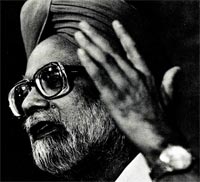
Prime Minister Narasimha Rao has categorically said that the economy is his government's first priority. And Dr Manmohan Singh, his solid, no-nonsense finance minister - who, among other appointments, has held positions as Reserve Bank of India, governor and economic adviser to former prime minister Chandra Shekhar - has said often that India needs an economic fix, and soon. This feeling is liberally echoed by other senior Finance Ministry bureaucrats. Says Bimal Jalan, chairman of the Economic Advisory Council in the Planning Commission, a former finance secretary and a contender for the post this time around: "If we don't take swift action, and by swift I mean in the next four weeks, the country will have to pay a very heavy price." He goes on to add: "There are no soft options left."
| Instead of hoodwinking the IMF with cosmetic changes, the economy needs restructuring. But Manmohan Singh may find it hard to administer the bitter medicine. |