
From the Editor-in-Chief
As West Bengal and Tamil Nadu head to the polls, they may well be two of India's most consequential state elections in years

ISSUE DATE: Apr 27, 2026 | UPDATED: Apr 19, 2026 12:30 IST
Assam, Kerala and Puducherry have already voted. But the two keystone states where elections are pending—West Bengal and Tamil Nadu—are seeing heightened anticipation, as they are more than just routine democratic exercises. In neither of these two states are the poll campaigns confined to local issues. Themes of urgent national and federal importance, such as the delimitation of Lok Sabha constituencies and the devolution of central finances, echo through the heated slogans. Interest outside the two states is much wider than usual as well. This is partly due to the personalities in the fray. Both incumbent chief ministers—Mamata Banerjee and M.K. Stalin—are heavyweight leaders who have in the past withstood the Bharatiya Janata Party (BJP) juggernaut. Each is facing a momentous referendum on their governance record, and thus their future. With 42 and 39 Lok Sabha seats, respectively, Bengal and Tamil Nadu also have the electoral weight to influence the course of national politics. That’s why planting their flag on these hitherto unattained territories is a cardinal objective for the BJP. As of mid-April 2026, both remain outside its grasp.
Anti-incumbency is the silent undertow in both states. Both have exhibited a heightened awareness of the threat posed by voters wanting change. The Trinamool Congress (TMC) has governed Bengal for 15 years with a chequered record. Its response has been a surgical purge of its MLAs, covering 40 per cent of its current pool. In a House of 294, the TMC presently has 224 seats. Of these, it has dropped 74 sitting MLAs outright and shifted another 15. The Dravida Munnetra Kazhagam (DMK) has returned to power only once in the six terms it ruled Tamil Nadu, that too way back in 1971. The DMK, too, has gone big on signalling change. In a House of 234, it holds 133 seats and has fielded 60-odd new faces across the 164 seats it is contesting. Almost 45 per cent of its sitting MLAs are not being renominated in their present seats.
But if that’s an implicit acknowledgement of inner vulnerabilities, none of that shows up in their high-voltage campaigns, where they project strength and confidence. The presence of the BJP in the two states is allowing both leaders to frame this as a valorous fight against ‘Delhi durbar’ and highlighting regional identity and pride. As Mamata expresses it, “A total of 19 states and the Centre have come together against me.” Neither leader is short on rhetorical ammunition as recent events have furnished them with plenty. In Bengal, where the race seems to be closer, the poll-eve Special Intensive Revision (SIR) reduced the electoral rolls by nearly 11 per cent, from 76.6 million to 68.3 million. For a party that’s said to begin every race with a 30 per cent headstart, a reference to Bengal’s Muslim population, the SIR is widely seen to have chipped away at that structural advantage: data shows Muslims as a key bloc disproportionately affected by voter deletions. The state has 74 constituencies where Muslims are between 40 and 90 per cent: the TMC won 71 of these in 2021. Tamil Nadu had a higher rate of deletions: 15 per cent, shrinking its electorate from 64.1 million to 54.4 million. Tight ground monitoring by DMK cadre rendered it a non-issue. But right on the eve of voting, Stalin has been handed another potent weapon with which to consolidate regional sentiment: the impending delimitation of Lok Sabha constituencies.
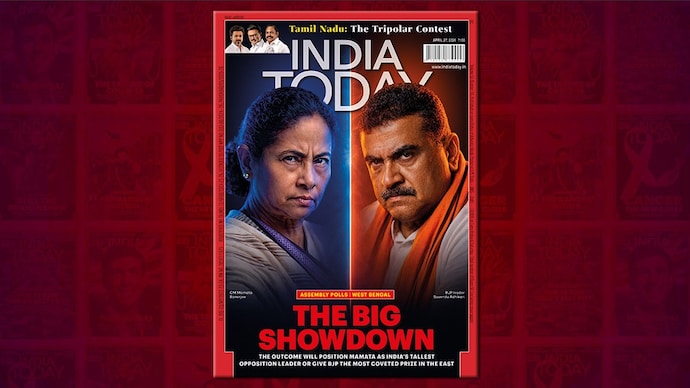
The BJP is deploying two distinct strategies in the two distinct theatres. In Bengal, it combines thunderous public oratory, led by Mamata’s old nemesis, Suvendu Adhikari, with a quieter, more lethal ground operation by the RSS cadre engaged in micro-level mobilisation. The tone against Mamata is carefully calibrated, as she is a past master at converting personal attacks into political sympathy. In Tamil Nadu, the party is being even more self-effacing as the near-silent partner of the AIADMK, which it does not wish to taint too much by association. The hope here is that a tactfully assembled Opposition front prises away entire OBC vote blocs. There are wild cards, too. Actor Vijay’s political debut is generating a youth surge that neither major alliance can fully account for. Add to that angry farmers, who nurse the grievance that the DMK regime has fulfilled only 10 out of over 80 promises made in 2021. That could quietly bleed votes at the margins. In elections of this scale and complexity, margins are everything. So, the race may be closer than it appears at first sight.
The stakes extend well beyond these two states. A fourth consecutive victory would propel Mamata Banerjee into the first rank of national Opposition leadership with a tailwind few can match. A Stalin retention would reinforce the INDIA bloc’s southern anchor and give the Congress its most credible regional partner. For the BJP, a breakthrough in either state would fundamentally alter the political geography of a country it has long dominated everywhere except here.
Our cover this week, assembled by Team India Today with granular state-level reporting, takes you inside both campaigns—the strategy, the arithmetic, the personalities and the fault lines. These may well be two of India’s most consequential state elections in years.
- Ends