
Decision to raise bus fares leads to violence in Calcutta
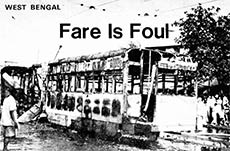
The city's professionally skilled fire-bugs were out on the streets to burn down-partially or totally-31 buses and five tramcars in a matter of five hours after the state Youth Congress(I) had given a call for boycott of buses.

ISSUE DATE: Feb 28, 1981 | UPDATED: Sep 26, 2014 12:30 IST


The numbers were small, but the vandalism was consistent with the masochistic character of Calcutta's violent street politics which took a tally of at least a hundred public vehicles during the food movement of 1966, the anti-Congress movements of 1967 and 1970, and the Naxalite troubles of 1970-71. However, the recent spree of arson was triggered by a decision of the Marxist Chief Minister, Jyoti Basu, last month to raise bus fares by five paise at every stage to cover the increased diesel cost, and to push up tram fares simultaneously. Last year, the state-owned Calcutta Tramways Company suffered a loss of Rs 4.18 crore.
In Need:Basu himself had little choice in the matter because private bus operators, who ply 55 per cent of the city's buses, had threatened to go on strike if the fare hike was not granted. And the public sector Calcutta State Transport Corporation, reeling under poor labour relations and an annual loss of Rs 15 crore, was badly in need of improving its economy.
However, the burning incidents were far from being a spontaneous outburst of public wrath. Spread over east and north Calcutta, where the Congress(I) is well entrenched, the attacks betray a premeditated pattern. At least on one occasion, the ebullient, curly-haired state Congress(I) president, Ajit Panja, and the tough Youth Congress(I) chief, Somen Mitra, were present when buses were being set on fire.
Behind the agitation lies a growing anxiety of the state Congress(I) leadership to dislodge the Marxist-dominated Left Front from power, at least a year before the next Assembly elections are due in June, 1982. If Panja's calculations come true, a year of President's Rule, and what he mystically calls "the Centre's blessings", will shepherd his party to victory.
Infighting:At no time in the past was the PCC (I) as riven with infighting as it is now. The 46-member executive committee, whose members were handpicked last year almost entirely by the weighty Union Energy Minister, ABA. Ghani Khan Chaudhuri, has never sat in full strength as members carry vendetta against each other which can be traced to the earlier Congress regime of Siddhartha Sankar Ray.
In fact, the two predominant factions in the state Congress(I) are fighting, in proxy, the main battle in Delhi between the two Bengal ministers-Khan Chaudhuri and Pranab Mukherjee, the Commerce Minister. Panja is Khan Chaudhuri's trusted lieutenant, and Pranab Mukherjee flexes his political muscle in Calcutta through Subrata Mukherjee, the mercurial youth leader.
Panja has very little hold over the organisation. He largely operates through Somen Mitra who is an undisputed dada of central Calcutta and has an uncanny power to rustle up backstreet goons at short notice. In fact, for a month prior to the burning of buses, the pro-Mitra and pro-Mukherjee factions were up in arms against each other on Calcutta streets.