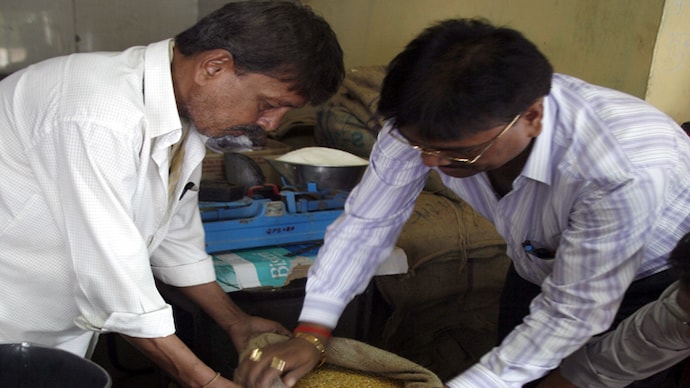
In an odd coincidence, Article 123 of the Constitution finds an echo in the 3-2-1 prices in the Food Security Bill. For the record, Article 123 is for ordinances where "immediate action" is necessary. Legislation ought to be through Parliament, but having failed to muster support for the bill there, the Government reportedly wishes to push it through an ordinance. This violates the spirit of the Constitution. We have been told there's a remarkable improvement in poverty numbers. Bibek DebroyIn 2009-10, 33.8 per cent of rural India and 20.9 per cent of urban India were poor. We've also been told 2009-10 was a bad year, which is why a fresh National Sample Survey (NSS) was commissioned for 2011-12, whose results aren't out. In other words, today's poverty numbers are lower. Even if there is a case for subsidising the poor, it can't be 75 per cent of rural and 50 per cent of urban India, as the bill wants. Presumably, the Government will only bear subsidy costs up to what nss determines as headcount ratios via the Planning Commission, with the rest left to be borne by the states.Ruralurban is a convenient Census category. Do they explain developmentdeprivation? Do geographical location and community characteristics (ethnicity, caste, religion, gender) help identify poverty, a household-level trait? They don't. India's development trajectory since 1991 has been one of urbanisation. If "rural" is poor, it's because physical and social infrastructure doesn't exist in that area. Much of this falls under public expenditure. Thus, whatever is spent as a result of the bill represents opportunity cost of resources that won't be spent on other things.A ration shop in Mumbai.Direct costs of food subsidy will be Rs 125,000 crore a year. It's also a direct cost of consumption subsidy. There are indirect costs-bureaucracy, grievance redressal, FCI and PDS machinery and hikes in the minimum support prices (MSP). Add inclusion of those who don't have BPL cards now. That's Rs 100,000 crore more. We end up spending 2 per cent of GDP on the bill. To put it in context, public expenditure on health is just over 1 per cent of GDP. Couldn't we have made better use of that 2 per cent? There is a trade-off between static and dynamic objectives of poverty alleviation. No one is voluntarily poor. There is a case for enabling people to get out of poverty by providing public goods and services. There is no case for subsidising. But we won't identify the poor, thus alienating those who are no longer identified as poor.The sole exception to the subsidy-elimination principle is for children, pregnant and lactating women, and the disabled and aged. For the first two, the bill mentions anganwadis and mid-day meal schemes. No one will object to those, as they are self-identified. Disabled and aged shouldn't be difficult to pinpoint either. What, then, is special about "food", determined as rice, wheat and millets for the purposes of the bill? NSS data shows even poor people are moving away from foodgrain to fruits, vegetables, milk and animal proteins. That's fine. Why clutter consumption decisions by harping on three grains? Let's not forget, this is legislation, not an executive decision. One wisdom of the day was to give people unconditional cash transfers. If one accepts this logic, as one should, why is the same government messing around with subsidised grain prices at Rs 3 for rice, Rs 2 for wheat and Re 1 for millet? Notice that MSPs are no longer support prices but procurement prices, which will be hiked to assuage farmers.We drive a wedge between artificially low consumption prices and artificially high procurement costs, contributing to a fiscal burden. More importantly, we mess up price signals for agriculture, providing a disincentive to the desirable commercialisation, diversification and movement away from foodgrain. There are several studies on PDS and FCI inefficiency. We don't have enough godowns. Grains rot in the open or are eaten by rats. Grains distributed through pds at low prices are leaked back and procured by FCI at higher prices or siphoned off to Nepal and Bangladesh. There are bogus ration cards. There are 500,000 ration shops.Ask yourself-how accessible are they in far-flung parts? Read surveys on corruption about public goods and services. PDS will be at the top. But such legislation is framed by people in Delhi, who neither read nor know. Their mindset belongs to the days of the Bengal famine that led to rationing. We are happy at providing a legislative solution to hunger. If things go wrong, states are to blame. The bill is just an ordinance, it is not meant to be ordnance.- The author is a professor at the Centre for Policy Research, New Delhi.Published By: AtMigration Published On: Nov 30, 1999 00:00 IST--- ENDS ---