
Rajni Ki Baraat review: Think twice before attending this baraat
Rajni Ki Baraat follows a Darbhanga girl fighting patriarchy for love. The film's bold climax and Ulka Gupta's restrained performance stand out, but you can't move beyond the uneven writing and forgettable music.
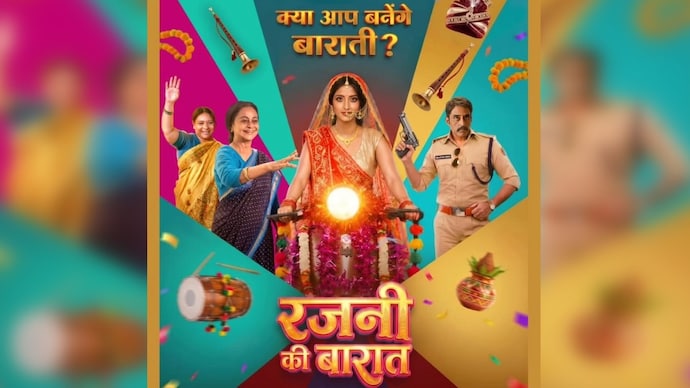

How often have you seen love stories set against the backdrop of Bihar? Long prominent in mainstream cinema for its politics, power struggles, and violence, this time, Bihar has found a refreshing new cinematic taste with the latest release, Rajni Ki Baraat.
Set in the dusty lanes of the heartland of India, the film portrays Darbhanga as a deeply patriarchal city. Rajni Ki Baraat begins like yet another small-town love story you think you have already seen five times before. But just when you settle into its familiar rhythm of romance, family drama, and social barriers, the film quietly swerves into something unexpectedly bold.
The story begins with Rajni Jha (Ulka Gupta), a college teacher still emotionally attached to her late father. Her prized possession is his old scooter, which she rides around town like an emotional support vehicle (which, by the way, has a strong connection in the climax).
She lives with her constantly complaining mother (Sunita Rajwar) and supportive grandmother (Zarina Wahab), while trying to navigate life in a society where women are expected to quietly accept whatever fate, family and patriarchy serve on a steel plate.
Chased daily by her mother to look for prospects, Rajni hides her love story from the family. Because no small-town love story is complete without over-the-top drama, her love interest Rajjan (Kanishk Vijay) follows the orders of his father, Malkhan Singh (Ashwath Bhatt), a police officer and obsessed with money, and decides to marry someone else against his wishes.
That is exactly where the emotional roller coaster begins. Rajni fights for her love, even as Rajjan completely surrenders to his father’s demands. After nearly two hours of watching the drama, it is in the film's final act that the makers decide to justify its title.
In a powerful, defiant climax, against all societal odds, Rajni decides to take charge of her own fate and lead her own baraat.
Other than the theme, what drives the film are the dialogues. But, in this film, the makers failed to go heavy on dialogue, deliver punch, humour, and emotional weight. Instead, what we are left with is some cringe-worthy humour, loosely-written dialogues and characters struggling to deliver what was written for them.
No love story is complete without soulful music, but the songs in Rajni Ki Baraat make you feel less emotionally moved and more spiritually evacuated. With lyrics like, “Pyaar ka popat kare tai tai, udh gaya phur phur he is on the fly,” the soundtrack sounds like someone started writing poetry, got distracted midway, and decided on nursery rhymes.
Given actors like Ashwath Bhatt and Zareena Wahab, who have a great body of work, their roles look poorly woven as they fail to deliver. Director Aditya Aman deserves great credit for allowing the world of Mithila to breathe naturally in the story, but we wish his characters could also breathe some acting.
The only saving grace in this 'gaon ki love story' (village love story) is Ulka Gupta. She carries the film with confidence and restraint. Someone who understands Rajni’s emotional contradictions plays her without unnecessary melodrama. However, much like The Kerala Story 2, this too continues her unfortunate "bad film, good actor" streak.
Rajni ki Baraat is not the baraat which would make you excitedly wait to dance in it. It feels like a film with its heart absolutely in the right place, even if its execution occasionally forgets the route to the venue.
Rajni Ki Baraat released in theatres on May 29.