

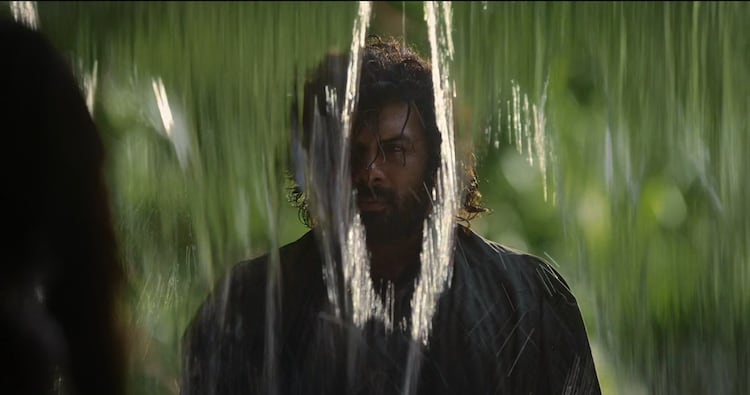
Kathanar: Is Anushka Shetty's Nila actually Kalyani Priyadarshan's Neeli from Lokah?
The trailer of Kathanar has sparked debate over Anushka Shetty's limited presence. The theory is also gaining ground that Anushka's Nila could be Kalyani Priyadarshan's Neeli from Lokah, and that the two characters are based on the same folklore.
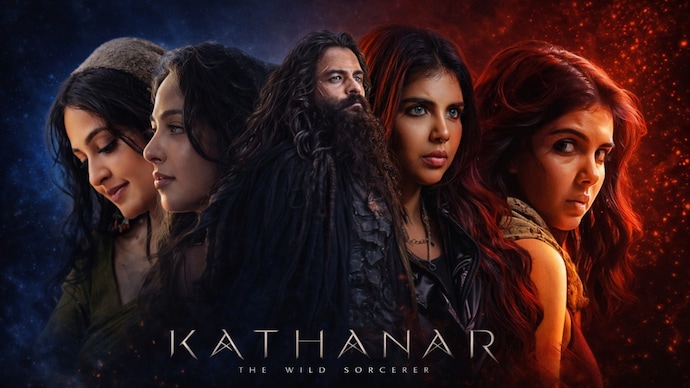
Is Anushka Shetty’s Nila in Kathanar actually Kalyani Priyadarshan’s Neeli from Lokah?
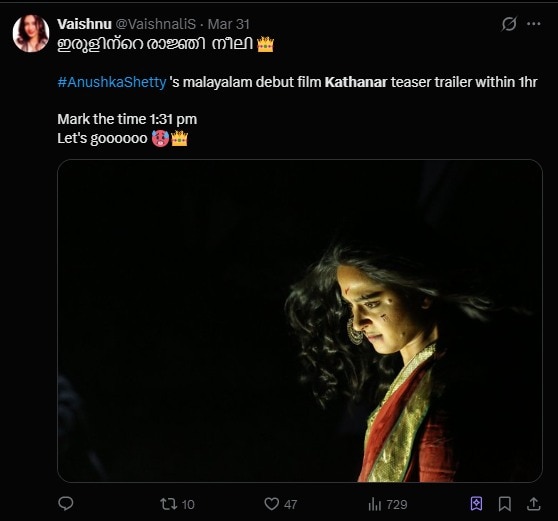
The trailer for the upcoming Malayalam film, Kathanar: The Wild Sorcerer, is out, and most of the country has been talking about the visual effects, the scale, the ambition. Some fans, however, have expressed dissatisfaction with Anushka Shetty’s character, as the trailer shows her in just two shots.
But look closely at her character, introduced as Nila a while ago, and if you know a bit about Kerala’s ancient folklore, it starts to feel less like underutilisation and more like a conscious decision to not reveal Anushka's protagonist too much.
For, after watching the trailer, an interesting question begins to form in your mind: Is Anushka Shetty’s Nila actually Kalyani Priyadarshan’s Neeli from the Malayalam blockbuster, Lokah? Is there a connection between these two characters? And if that’s the case, what does that really mean?
Lokah- Kathanar connection
For audiences in Kerala, Kalliyankattu Neeli or Kadamattathu Kathanar is not new. There has already been enough content around her, from the 1979 Malayalam horror film Kalliyankattu Neeli to the television series Kadamattathu Kathanar, along with oral retellings that have been passed down through generations.
But for most people outside Kerala, the first real encounter with Neeli came through Lokah Chapter 1: Chandra—the Malayalam superhero film that turned into a quiet sensation. In it, an old man named Verghese Kurien narrates a haunting legend to his granddaughter. It is the story of a tribal girl whose village is destroyed by a king enforcing caste laws. After losing her parents, she develops supernatural powers, seeks revenge, and eventually becomes a feared entity, Neeli.
The film then introduces Kathanar, a man believed to know Neeli’s weakness, someone capable of killing her by stabbing her in the chest. But just when it seems like a classic confrontation, the narrative flips. Instead of destroying her, Kathanar, played by Sunny Wayne, recruits her to serve Moothon.
This flashback episode has received a lot of love for its visuals and performances. At the same time, it has left audiences with bigger questions: What exactly is the connection between Kathanar and Neeli?
And here’s where things get more interesting.
Kathanar and Neeli are not just two characters who happen to share screen space in a film. Their story is rooted in one of the oldest and most debated strands of Kerala folklore—a confrontation between a powerful yakshi and an even more powerful priest-sorcerer, a tale that has been told and retold through generations.
Who is Neeli?
The folklore of Kalliyankattu Neeli has several versions, but the core is consistent. She was once a woman named Alli, daughter of a devadasi, who married a temple priest named Nambi. One widely known literary retelling comes from CV Raman Pillai's 1891 novel Marthandavarma, where she is killed at Panchavankadu and rises again for supernatural vengeance. The story has survived and evolved across centuries, picking up new details along the way, but the betrayal at its centre has never changed.
Kathanar- Neeli connection
Kadamattathu Kathanar — also known as Kadamattathachan, Father of Kadamattom — was a real 9th-century priest at Kadamattom Church in Ernakulam, one of Kerala's oldest churches. Legend says he was abducted by forest-dwelling tribes as a young man and initiated into the occult before returning to his priestly life. He is credited with using those powers for good: exorcising spirits, healing the sick, protecting travellers.
His encounter with Neeli is described in the famous folklore collection Aithihyamala. Neeli had been terrorising a stretch of forest between Thiruvananthapuram and Padmanabhapuram. No sorcerer could stop her. When Kathanar arrived, she approached him in her beautiful human form and asked for a pinch of lime, her usual trick to lure men into the forest. He held out an iron nail with lime at its tip. She took it. At that moment, he drove the nail into her head through a powerful mantra, and she followed him like a slave, unaware of what had been done to her.
The nail was later accidentally pulled out by an old woman who found it while combing Neeli's hair. Neeli escaped. Kathanar chased her all the way to a place called Maannaanam, where he bound her with another mantra and made her a deal: stop harming people and you can stay here. She agreed. She has been at the Panayannaarkaavil temple ever since — and remarkably, she is worshipped there today as a protective mother goddess, with devotees offering her black glass bangles.
That "nail driving into your head" line that Naslen delivers in Lokah? Now you know exactly where that comes from.
Neeli-Nila Connection
Here is where it gets interesting for Kathanar: The Wild Sorcerer. Anushka's character is introduced as Nila — not Neeli. But the names are close enough, and the casting is deliberate, so that audiences familiar with the folklore don't treat this as a coincidence.
Anushka Shetty, who carries enormous pan-India weight as Devasena from the Baahubali films, is not going to appear in two shots and disappear. That would be a waste of both the casting and the opportunity.
The most likely reading is this: Nila is either an earlier form of Neeli, perhaps before her transformation — or a different legend that converges with hers through the larger Kathanar lore.
Kerala's oral tradition has always had multiple names for the same spirit across different regions, and Nila is a name that carries strong feminine and celestial connotations in South Indian traditions (it means moonlight). It would not be a stretch for a filmmaker to use Nila as the human name before the yakshi transformation.
What Lokah Chapter 1: Chandra did with Kalyani Priyadarshan’s character was to tell Neeli’s origin story and her eventual recruitment by Kathanar. Kathanar: The Wild Sorcerer, on the other hand, seems to be approaching the same story from Kathanar’s side.
Which is where Anushka Shetty’s Nila becomes interesting. She could very well be the same legend seen from within that encounter, the confrontation that has always existed in oral retellings, now being explored with scale and perspective.
There is also a telling detail in the trailer: the line, “Not the tale you know.” That alone suggests this isn’t a straightforward adaptation. Importantly, the line could hint at the fact that Kathanar looks at the story differently from Lokah.
The choice of the name Nila, and the way the character is being held back, could point to a reinterpretation — either an unexplored version of the same story or a deliberate spin on what audiences think they already know.
And that is exactly what makes this connection worth paying attention to.
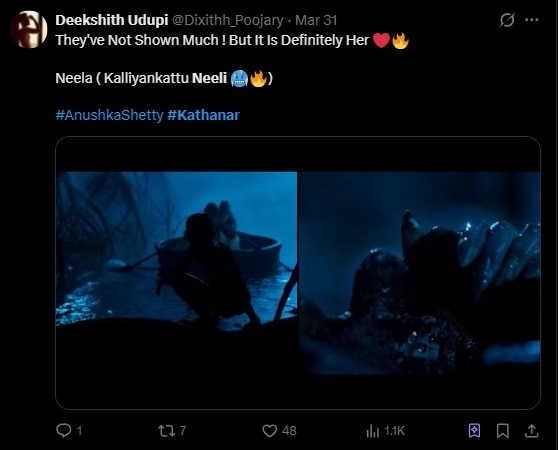
The internet, too, is buzzing with similar theories, with several posts hinting at the possibility of a two-sided character — someone who appears gentle on the surface but carries something far darker within. Some even point towards the classic trope of an evil spirit disguised in beauty, which aligns closely with how Neeli has often been described.
In Conclusion
Whether these two films are officially in the same cinematic universe or simply drawing from the same deep well of Kerala folklore, the conversation they are having with each other is remarkable. Lokah introduced Neeli as a misunderstood vigilante, gave her a superhero arc, and ended with the revelation of her immortality. Kathanar is now arriving with the priest-sorcerer who, in the original legend, was the only one who could face her.
India has always had this — centuries-old stories sitting quietly in temples and oral traditions, waiting for someone with a big enough budget, ambition and a deep enough respect for the source material to finally bring them to life. If the filmmakers have done their homework, Anushka's Nila would not be a decorative casting choice. She will be the heart of it.
- Ends