
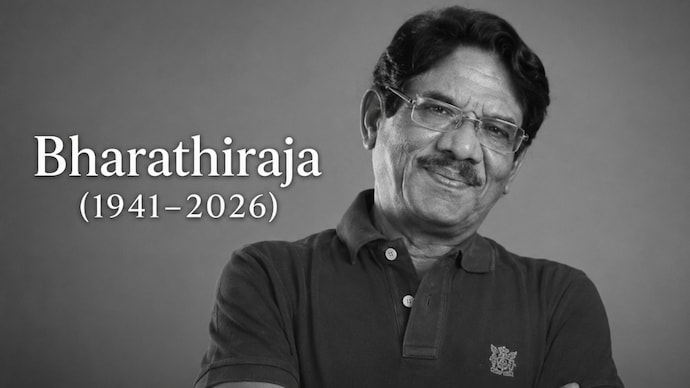
Bharathiraja: The director who took Tamil Cinema out of studio and into the soil
Bharathiraja, the filmmaker who took Tamil cinema out of the studio and into real villages, died in Chennai on June 10, 2026, after a prolonged illness. His films reshaped the industry's visual and emotional language, making village life central to modern Tamil cinema.

When Bharathiraja arrived on set for his debut film 16 Vayathinile in 1977, he did something few mainstream Tamil directors had attempted on such a scale: he moved filmmaking out of the studio and into real villages. When the old era was dominated by films shot inside studios and urban-centric stories, Bharathiraja directed village-themed films that inspired Tamil cinema to capture live locations, and a wave of village films started after 16 Vayathinile, his debut film.
He was 35 and relatively unknown, directing a cast that included rising actors Kamal Haasan and Rajinikanth, alongside teenage star Sridevi. None of them had any idea they were making history.
Bharathiraja died on June 10, 2026, in Chennai, following a prolonged illness. He was 84. He is survived by his wife Chandraleela, whom he married in 1974, and his daughter Janani. His son, actor-director Manoj Bharathiraja, predeceased him in March 2025.
Born Chinnasamy Periyamaya Thevar on July 17, 1941, in Theni Allinagaram in what was then Madurai District, Bharathiraja grew up in the kind of Tamil Nadu that Tamil cinema had largely refused to acknowledge existed. The industry's imagination was Madras-centric – its heroes wore suits, its songs were shot against painted backdrops, and its heroines were defined by fair-skinned ideals borrowed from the north.
He also changed the visual language of Tamil films by depicting male leads without heavy cosmetics, and casting dusky-looking women in central roles – a quiet radicalism that the industry took decades to fully absorb.
16 Vayathinile was, by his own account, not supposed to be a commercial film at all. Bharathiraja said it was meant to be a black-and-white art film produced with the help of the National Film Development Corporation but turned out to be a commercially successful colour film and a starting point for several important careers. No distributor was willing to buy the film, and it was written off by the media as an experimental film that would fail. It ran for 175 days.
What Bharathiraja had understood – before almost anyone else – was that Tamil soil itself was cinematic. The red earth of Theni, the banana groves, the village square, the harvest festival, the caste tensions simmering under everyday rural life: all of it was material, and none of it needed a studio set to become beautiful. His camera found drama in geography. His films smelled of the land. And, with him, we were transported to the heartlands of Tamil Nadu, enjoying and cherishing the slow village life.
Over a career spanning nearly five decades, Bharathiraja directed more than 30 films. He won six National Film Awards — more than almost any other director of his generation – along with two Tamil Nadu State Film Awards and a Padma Shri in 2004. Films like Ninaithale Inikkum (1979), Alaigal Oivathillai (1981), Muthal Mariyathai (1985), and Karuththamma (1994) formed a sustained body of work that treated village life not as picturesque backdrop but as moral and emotional subject — complete with its dignities, its cruelties, and its unresolvable contradictions.
His partnership with composer Ilaiyaraaja – forged on the set of 16 Vayathinile – became one of the most generative collaborations in Indian cinema. Together, they built a new sonic and visual language for the Tamil film that drew from Carnatic tradition, folk music, and the rhythms of the countryside rather than the playback conventions. Five decades later, their work still echoes in people's hearts, creating the same magic it did the first time.
He was known affectionately throughout the industry as "Iyakkunar Imayam" – the pinnacle among directors. The name was earned not just by the scale of his achievement but by its permanence. He broke existing conventions and helped establish village cinema as a major genre.
For generations of Tamil audiences, Bharathiraja was not just a filmmaker but a familiar presence. His films often opened with his hands folded in greeting, addressing viewers with his trademark "En Iniya Tamil Makkale" (My beloved Tamil people). The gesture became more than a title-card ritual; it was an introduction from a storyteller who saw cinema as a conversation with his audience.
In an industry built on distance and stardom, Bharathiraja's greeting felt personal, as though a man from the village was inviting viewers into another story from the soil he knew so well.
Every Tamil director who has since pointed a camera at a paddy field, a rural festival, or a sunlit village morning owes something to Bharathiraja's decision to pack up the studio lights and step outside.
Bharathiraja leaves behind a cinema that looks, sounds, and breathes differently because he made it so.