
Why Ram Charan's Peddi is radical for Telugu cinema and where it falls short
Ram Charan's Peddi is the kind of ambitious, larger-than-life film Telugu cinema rarely entrusts to a star at the peak of his popularity. While the actor delivers a committed performance, the film's writing fails to do justice to the risk he took.
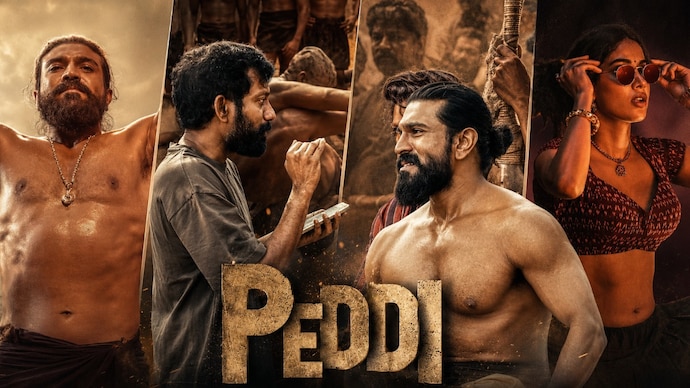

Mainstream Telugu cinema has spent years building heroes larger than life. More often than not, the heroes arrive as saviours, protectors, messiahs and demigods. Even when films speak about marginalised communities, the story is usually told through the eyes of an exceptional man who stands above them and fights on their behalf.
Peddi attempts something rare. It places one of Telugu cinema's biggest stars inside the community itself - not as a rescuer, but as someone shaped by the same deprivation, indignity and neglect. That one thing itself makes Peddi a surprisingly radical film for Telugu mainstream cinema. And seeing Ram Charan at the centre of it all does help.
Director SS Rajamouli once described Ram Charan as a "blank canvas" - the highest compliment an artist could receive. The spirit of it was simple: walk onto a set, surrender to the director's vision. Let him paint whatever he wants. For a filmmaker, it is an extraordinary gift. For an actor, it can sometimes become a risk.
Peddi arrives carrying far more than the expectations of a major release. It is Ram Charan's comeback attempt after the global success of RRR. What makes it interesting is not its story or scale, but the fact that a star like Charan chose it.
At a time when most leading men were chasing mythology and fantasy spectacles, he backed a story about a marginalised community fighting for something as basic as a name and identity for their village. What makes Ram Charan’s choice bold and different, and most importantly, has Peddi justified that faith?
The Telugu hero problem
To understand why Peddi feels unusual, one must understand the environment it emerges from. Mainstream Telugu cinema is built around celebration, emotion, escapism and heroism. That formula has produced some of Indian cinema's biggest commercial successes, but it has also created unwritten rules.
The hero can suffer, but only to a point. He can face obstacles, but rarely genuine defeat. He cannot appear small. Stars and fans have become deeply protective of screen images, and directors know it. As a result, stories demanding real vulnerability are routinely softened before they reach audiences.
Even socially conscious films operate within familiar frameworks. The struggles of marginalised communities are typically filtered through a heroic outsider who arrives to solve problems on their behalf. The hero sympathises with the oppressed but rarely belongs to them.
That is important to observe because mainstream Telugu cinema has traditionally been more comfortable with saviours than sufferers. When stories deal with poverty, caste or social injustice, the protagonist is often someone exceptional who arrives to fight on behalf of the marginalised. The community's pain becomes the backdrop for the hero's rise. What makes Peddi interesting on paper is that it appears to reverse that equation. Peddi is not meant to rescue the community from the outside. He is one of them. Their struggle is his struggle.
That is what makes Peddi unusual. It asks one of Telugu cinema's biggest stars not merely to play a man from the margins, but to embrace vulnerability in ways mainstream heroes seldom do.
Peddi may not fully succeed in escaping the gravitational pull of hero worship - it's still time for that - but its starting point remains unusual. The fight is not for a kingdom, a dynasty or a cosmic destiny. It is for recognition, dignity and identity. Those are remarkably grounded stakes for a contemporary Telugu tentpole.
In many ways, the path towards this began with Rangasthalam. Released in 2018, it saw Charan play a partially deaf villager caught in a deeply rooted political conflict — vulnerable, ordinary, often powerless. It became both a critical and commercial success, proving audiences would embrace a major star who stepped away from conventional heroism. Years later, as peers gravitated towards mythology and increasingly larger-than-life narratives, Charan chose differently again.
Ram Charan gives everything
Whatever one thinks of Peddi as a film, there should be little debate about Ram Charan's commitment. The transformation is substantial. It extends beyond appearance into body language, movement and physicality. The sports sequences carry a sense of genuine effort from the actor. The emotional moments reveal an actor inhabiting the life of someone shaped by systemic neglect rather than simply performing heroism.
There is also a willingness to look damaged. One of the film's defining moments involves Peddi sacrificing his own leg for his community. Within mainstream Telugu cinema, where heroes emerge from impossible situations untouched, the decision carries unusual weight. Many stars would have hesitated at the idea. What makes it more remarkable is the timing — after RRR's global visibility, Charan could have pursued any safer option the pan-Indian landscape offered. Instead, he placed his trust in a director making only his second feature film. It was a gamble not just in performance, but in career strategy.
Charan's gamble becomes clearer when viewed within the larger landscape of Telugu stardom. A post-RRR Ram Charan could easily have pursued safer territory: mythology, historical grandeur or another larger-than-life action vehicle. Instead, he chose a film centred on labourers, caste realities and a village fighting for recognition. Whether Peddi ultimately works or not, the decision itself pushes against the direction in which mainstream Telugu cinema has increasingly been moving.
The commitment is visible throughout. The physical preparation is evident. The sports training shows. More importantly, there is a genuine attempt to understand the emotional weight carried by a man fighting not for personal glory but for the dignity of an entire community.
Perhaps that is why the film's shortcomings feel particularly disappointing. The tragedy of Peddi is not that Charan failed the material. It is that the material rarely rises to meet him. The actor commits wholeheartedly. The screenplay struggles to justify the faith he placed in it.
How the film failed the actor
Peddi begins with genuine promise. A man revered by an entire community from a forgotten labourer's settlement. He comes from a place which faced generations of neglect to a level where a railway station became a symbol of dignity. These are powerful ideas. Unfortunately, the director failed to build a strong screenplay around them.
From the moment Peddi enters the story, he is already exceptional. He dominates every challenge placed before him. Every obstacle exists largely to showcase his abilities rather than test them. As a result, the journey never acquires dramatic weight. A hero becomes memorable not simply because he wins, but because we understand what it cost him.
Ironically, this is also where Peddi abandons the very quality that initially made it feel radical. The more the film progresses, the more it retreats into familiar Telugu star-making machinery. Instead of trusting the inherent power of its community's struggle, it repeatedly falls back on showcasing the hero's exceptionalism. The film begins by challenging convention and gradually becomes consumed by it.
Peddi does not often allow those costs to register.
When an actor is fully committed to a subject, why was he treated like a generic mass commercial hero? The risk the actor took, the director unfortunately could not. As Rajamouli himself has observed, when you take a unique story, you have to work extra hard, the audience's tolerance for such stories is extremely low. Not because of their mindset but because it is the director's responsibility to convince them of his vision.
However, the film's biggest failure lies elsewhere. The romantic track involving Janhvi Kapoor's Achiyamma does not disappoint. It actively undermines the film's moral centre. There is a sequence in which Peddi enters Achiyamma's room uninvited and forcibly kisses her. When she later confronts him, her anger is entirely justified. She questions his behaviour and challenges the violation of her consent. At that moment, the film has an opportunity to interrogate its protagonist. Instead, it chooses to validate him.
The problem is not just that the character behaves poorly. Great films are filled with flawed protagonists. The problem is also that the screenplay refuses to acknowledge those flaws as flaws. Dialogues such as "I will touch her once because neither she nor her father will allow me to marry her" are not presented as moral failures. They are treated as extensions of his charm. At one point, Peddi claims he does not identify women by their faces but by their midriff and rather than exposing the limits of his worldview, the film normalises it.
The contradiction becomes impossible to ignore because the film establishes a different moral standard for everyone else. Similar behaviour from antagonistic characters is treated as unacceptable, yet the hero is repeatedly exempted from the same scrutiny. That is not complexity. It is inconsistent.
One of Peddi's defining traits is his impulsive philosophy: if something must be done, do it now. This mindset fuels some of the film's strongest moments, particularly the sacrifices he makes for his community. But the same philosophy is applied to the romantic track without reflection or consequence. What works in a story about resistance becomes deeply problematic in a story about relationships. The result is a protagonist simultaneously presented as a champion of dignity and as someone whose behaviour is rarely held accountable.
What makes this even more surprising is that Buchi Babu Sana's debut film, Uppena, among many things, was built around questions of masculinity, consent and what it truly means to be a man. At its core, the film challenged the idea that manhood is tied to sexual conquest or physical possession. That is why some of the choices in Peddi feel particularly disappointing.
The Responsibility
It would be easy to place the entire burden only on director Buchi Babu Sana. A significant portion does belong to him. Yet films of this scale are collaborative creations. Problematic moments do not survive by accident. They pass through writing, narration, rehearsals, shooting, editing and dubbing. They remain because multiple creative voices allow them to remain.
Buchi Babu deserves criticism for writing and staging moments that undermine the very themes his film is exploring. For a story built around dignity, recognition and social justice, the screenplay repeatedly fails to apply the same standards to its own protagonist. At the same time, actors are not passive participants.
Ram Charan's commitment is undeniable. Few stars of his stature would have embraced such a demanding physical and emotional transformation. But influence and responsibility often travel together. When problematic ideas survive to the final cut, accountability extends beyond a single department. The uncomfortable reality is that films reflect collective decisions. Their strengths are shared. So are their shortcomings.
That is especially unfortunate because Peddi represents a kind of film Telugu cinema arguably needs more of. Not necessarily films that are socially conscious, but films willing to challenge the boundaries of what a Telugu superstar can be. The industry's future cannot rest entirely on making heroes bigger. It must also occasionally allow them to become smaller, more vulnerable and more human. Peddi understands this instinctively. The screenplay simply lacks the confidence to follow the idea all the way through.
What survives the disappointment
The frustrating thing about Peddi is not that it fails, it is a largely entertaining and engaging film. What lingers is the sense of what it might have become. There is a powerful film hidden within those ideas. Ram Charan clearly saw it. His performance suggests an actor who recognised the possibilities and committed himself fully to chasing them. In the film's strongest moments, when Peddi is allowed to exist as a product of his circumstances rather than a vehicle for hero worship, one catches genuine glimpses of something affecting.
That is why Peddi remains worth discussing despite its flaws. A film's scale is often mistaken for its ambition, especially in the Indian film industry, but Peddi attempts a different kind of ambition altogether. It asks whether one of Telugu cinema's biggest stars can belong to the margins rather than stand above them. Whether a mass hero can fight for dignity instead of destiny. Or whether vulnerability can be as compelling as invincibility.
The film ultimately lacks the conviction to fully answer those questions. Yet the fact that it asks them at all makes Peddi one of the more radical mainstream Telugu films in recent memory. The screenplay falls short of its own promise. The ambition behind it does not.