
Aakhri Sawal review: Sanjay Dutt's bold ideological film falters in dramatic excess
Sanjay Dutt and Namashi Chakraborty deliver compelling face-offs in Aakhri Sawal that earnestly distinguish constructive discussion from adversarial debate and shines a light on RSS's unsung contributions. Is the film on opposing ideologies worth your time? Here is our review.

Cast & Crew

Sanjay Dutt
Actor
Sanjay Dutt and Namashi Chakraborty deliver compelling face-offs in director Abhijeet Mohan Warang's Aakhri Sawal that earnestly distinguishes constructive Samvaad from adversarial Vivaad and shines a light on RSS’s unsung contributions. Yet, excessive melodramatic flourishes and caricatured portrayals turn a potentially nuanced ideological debate into a familiar good-versus-bad spectacle.
In an era of polarised discourse, Aakhri Sawal arrives as a timely attempt to interrogate the fault lines of Indian political thought. Sanjay Dutt’s Professor Gopal Nadkarni tells his former student Vicky Hegde (Namashi Chakraborty) that Western-style debate is “Vivaad,” while Indian civilisation has long championed “Samvaad” – constructive discussion.
This distinction forms the philosophical spine of the film, which ambitiously weaves campus ideology, media spectacle, and RSS legacy into one narrative. Yet, despite sincere performances and noble intent, the execution often dilutes its own depth.
The story centres on brilliant yet volatile scholar Vicky Hegde, who publicly accuses his revered mentor, Professor Gopal Nadkarni, of institutional bias after his thesis on the RSS faces rejection. What begins as an academic disagreement spirals into a national controversy, culminating in a prolonged televised debate that draws in politicians, journalists, and social media outrage.
Director Warang and writer Utkarsh Naithani use this confrontation to touch upon sensitive historical points: Mahatma Gandhi’s assassination, RSS’s role during the Emergency, the Babri Masjid demolition, the organisation’s relief work during the tsunami, and the tragic death of a Kerala RSS worker.
The film deserves credit for attempting balance. It highlights lesser-known humanitarian efforts of RSS volunteers as the organisation marks its centenary, while also calling out militant fringes and hate speech without questioning faith itself.
Dutt’s monologues and flashbacks featuring figures like MS Golwalkar and Keshav Baliram Hedgewar convey the philosophy of nation-building, discipline, and selfless service. The distinction between adversarial debate and dialogue rooted in mutual respect lands as one of the more thoughtful elements, especially relevant in today’s campus and digital ecosystem.
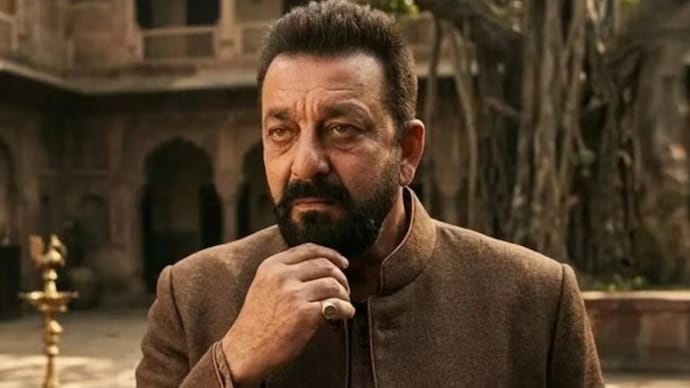
Performances elevate the material significantly. Sanjay Dutt brings commanding presence to Prof Nadkarni – calm on the surface yet emotionally layered, a mentor who holds the moral high ground while revealing human vulnerabilities. Namashi Chakraborty matches him effectively as the fiery Vicky, building on his recent work to deliver intense face-offs that crackle with ideological tension.
Amit Sadh, as news anchor Aditya Rao, shines in limited but grounded sequences, particularly his emotionally charged reunion with his former mentor. Sameera Reddy as left-leaning Professor Pallavi Menon offers a credible counterpoint in left vs right exchanges, though her scenes occasionally suffer from tonal inconsistency. Tridha Choudhury as Saara adds warmth and support, while Mrinal Kulkarni brings subtle emotional depth as Prabha Nadkarni. Even Neetu Chandra’s journalist Kavya Rawat, despite limited screen time, hints at stronger potential.
Where Aakhri Sawal stumbles is in its Bollywoodisation of a serious subject. The constant melodramatic background score transforms potentially hard-hitting confrontations into soap-opera territory, undercutting tension. Opposing characters sometimes veer into caricatures – manipulative, corrupt, or villainous – reducing nuanced ideological conflict to a simplified good-versus-bad framework reminiscent of earlier films tackling similar themes.
The decision to stretch a core five-question debate into nearly an hour-long sequence tests patience, as the narrative jumps between student-teacher dynamics, historical controversies, social media frenzy, and campus politics. This ambitious merging dilutes the emotional core and philosophical promise.
Warang shows clear intent to foster constructive reflection rather than division. The film avoids outright vilification of any belief system and makes space for RSS contributions alongside critique of excesses. Yet the execution often prioritises spectacle and dramatic flourishes over sustained tension or deeper character exploration.
Flashbacks and monologues convey legacy effectively in parts, but the back-and-forth structure and daily-soap scoring prevent full immersion. In trying to cover multiple layers – ideological conflict, organisational history, media influence, and the need for objective reasoning in polarised times – the story occasionally loses grip on its central human drama.
Ultimately, Aakhri Sawal serves as an accessible entry point for viewers less familiar with these debates and the 100-year journey of a major ideological force in modern India. Its ensemble cast, led by Dutt’s impactful turn and Chakraborty’s committed intensity, ensures it remains watchable. With tighter pacing, more restrained scoring, and less caricatured portrayals, it could have sparked richer post-screening conversations.
As it stands, the film’s soul – the call for Samvaad amid Vivaad – shines through in flashes but gets somewhat lost in dramatic amplification. It is a film of earnest ambition that partially succeeds in illuminating hidden aspects of national discourse while revealing the challenges of balancing legacy, controversy, and cinematic engagement.
For those seeking a conversation starter on India’s contested histories and the value of constructive dialogue, Aakhri Sawal offers enough substance to warrant a viewing, even if its dramatic choices prevent it from reaching its full potential.
Aakhri Sawal theatrically releases on May 15, 2026.