
Passenger review: Andre Ovredal's road horror never fully reaches its destination
Passenger movie review: Andre Ovredal's Passenger follows a newly engaged couple whose van-life trip turns sinister after they stop at a highway accident. The film finds its strongest note in Maddie's growing need for stability, even as the horror leans on familiar scares.

There comes a point in almost every working adult’s life when the idea of quitting your job, buying a fancy van, and disappearing into the mountains with your partner sounds deeply romantic. No deadlines, no office politics; just sunsets, highways, coffee in paper cups, and the illusion of freedom. Instagram travel reels have further sold the van-life fantasy beautifully. But what social media never tells you is that highways at night are terrifying, with unknown roads and strange people. And if horror films have taught us anything, it’s this: never stop on a lonely road in the dark.
Andre Ovredal’s Passenger takes that fear and turns it into a supernatural horror story that feels both familiar and occasionally intriguing. The filmmaker behind The Autopsy of Jane Doe and Scary Stories to Tell in the Dark clearly understands the atmosphere and tension, which makes the film’s shortcomings slightly more disappointing.
Jacob Scipio and Lou Llobell play Tyler and Maddie, a couple living the van-life dream across America. Somewhere between gas stations and roadside diners, Tyler decides to propose. She says yes, of course. Horror films love happy couples because peace never lasts beyond the first 15 minutes.
Soon after, the duo witness a horrific accident on a deserted highway. And because decent human beings in films are cursed with morality, they stop to help. That one decision changes everything!
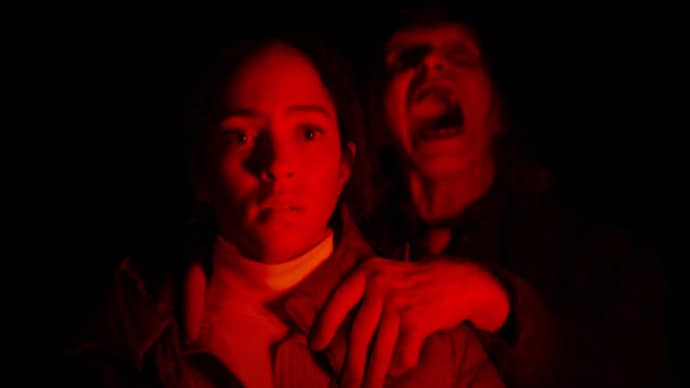
Maddie senses moving silhouettes, soft footsteps, negative energy, and an eerie, strange figure following them like a shadow. Their van suddenly feels less like a home and more like a suffocating chamber. Then comes the creepy three-nailed scratch mark that refuses to leave either the vehicle or the couple alone. From there, Passenger goes full horror mode with jump scares, ominous sounds, screeching music cues, and the classic 'something moved behind you' trick modern horror cinema refuses to let go.
To be fair, the film does manage to get a few reactions out of you. Federico Verardi’s cinematography does a lot of heavy lifting here. Empty highways lit only by headlights and isolated pit stops often become scarier than the demon itself. The problem is that Passenger relies so heavily on jolting viewers in the moment that it forgets to leave behind any real fear. Once the scare passes, so does the impact — and that becomes the film’s biggest issue.
Because underneath all the horror cliches lies a genuinely interesting idea. During one of their van meetups, Tyler and Maddie meet Diane, played by Melissa Leo, who tells them, “People don’t take trips, trips take people.” And it perfectly captures what the film is trying to say. The road changes you...freedom sounds exciting until you realise you have to find a safe place to sleep every night.
Maddie slowly begins questioning the life they once romanticised together. Having grown up in foster homes, she no longer wants uncertainty packaged as adventure. She wants stability; a home, a future and maybe children. Oddly enough, those emotional conflicts work far better than the horror portions themselves.
Lou Llobell’s performance also works brilliantly. She carries the film emotionally and becomes the anchor holding this chaotic road trip together. Jacob Scipio is sincere as Tyler, but the film interestingly avoids making him the heroic saviour. Maddie understands the danger before anyone else does, pieces things together, and actively fights back. She is not waiting around for a man to rescue her in the climax, and that's and that’s what makes Passenger stand out.
The film also briefly explores Hobo Codes — symbols used by travellers and drifters to communicate warnings or safe spaces to one another. Those portions are genuinely fascinating and deserve more screen time. Similarly, the mythology around curses, ancient evil, and Saint Christopher Church is intriguing on paper, but the film never fully develops those ideas enough to leave a lasting impact.
And that becomes Passenger’s recurring problem. Every time the film introduces something genuinely unsettling or fresh, it quickly falls back into generic horror territory. The pale-faced spirit design feels painfully overdone at this point. Horror audiences today have watched everything from Obsession to Sinners, The Monkey, and Bring Her Back. You simply cannot rely on white-eyed figures suddenly appearing in the background any more and expect audiences to lose sleep over it.
Which is what makes Passenger disappointing more than outright bad. The premise is fantastic. A cursed road-trip horror about a nomadic couple practically writes itself. But the screenplay never fully commits to either psychological horror or emotional drama. It stays stuck somewhere in between, taking you on a bumpy ride instead of an unforgettable one.
There is enough here to keep horror fans mildly entertained for 90 minutes. The performances are solid, the atmosphere occasionally lands, and a few scenes genuinely work. But when the lights come on, the fear doesn’t follow you home. And for a horror film, that’s always a problem.