
Bhooth Bangla, Bhool Bhulaiyaa, Stree: Why must horror have humour and music?
The success of The Conjuring and Insidious films in India proves there is a market for true-blue horror. Yet, genuine attempts in the genre are rare. Bhooth Bangla reiterates how producers prefer mixing horror with comedy, music and romance to play it safe.
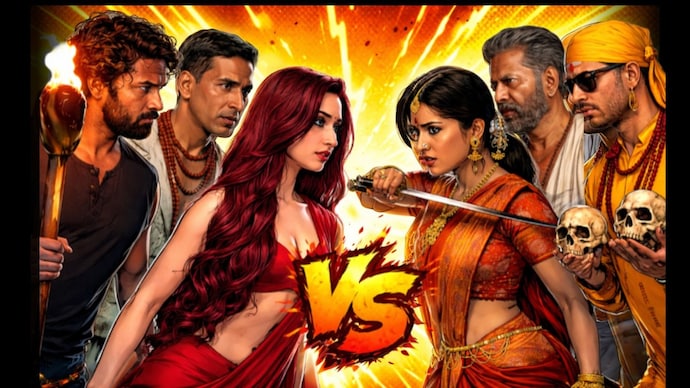

Bhooth Bangla arrived in cinemas on April 17, 2026, carrying considerably more doubt than its star power warranted. The trade had pencilled in a Rs 20 crore opening for Akshay Kumar and Priyadarshan's long-awaited reunion. The film collected Rs 42 crore in its first three days, audiences filed out of theatres satisfied, and early reviewers noted something that the genre has not always been able to claim: the jump scares actually worked.
It is a line worth pausing on, because Bhooth Bangla is not a pure horror film. What the audience response reveals is this: People went in expecting comedy and came out talking about the scares.
Walk into any good Indian restaurant, and you will understand this country's relationship with cinema. The thali is not merely a meal, it is a philosophy. A little dal, some sabzi, a sweet, a sour, a spice, everything arriving together on one plate, each element jostling for attention. We do not believe in serving one thing and letting it speak for itself. We believe in abundance. We believe in variety. We believe, fundamentally, that more is more.
Mainstream Indian cinema is the thali of global film industries. A single Indian film will, without apology, contain a love story, three to five songs, a comedic track, action sequences, and a climactic emotional monologue, sometimes within the same 20 minutes. This is not a flaw. It is a feature, a deeply cultural instinct, and for the most part it has served the industry extraordinarily well.
Except in one genre: Horror. Pure, uncut, atmospheric horror is the one dish the Indian film industry has consistently refused to serve on its own. There’s a question worth asking here: Hollywood's The Conjuring and Insidious franchises continue to mint money from Indian audiences. So, does the refusal to make true-blue horror films reflect the audience's lack of appetite for the genre or the desi filmmaker's nerve?
A genre with genuine roots
The hesitation is not historical. Indian horror has a lineage that deserves more respect than it typically receives. Kamal Amrohi's Mahal in 1949 was not merely a box office success, it launched Madhubala into stardom and gave Lata Mangeshkar one of her earliest iconic songs. Bees Saal Baad in 1962 became the highest-grossing Hindi film of its year. Jaani Dushman in 1979 was the second-highest earner of its year and remains, by many accounts, the most commercially successful horror film this country has produced.
These films worked. They frightened people, filled cinemas, and crucially, they did so without dismantling their own tension with comedy or retreating into romance whenever the supernatural became too demanding.
The Ramsay Brothers then built an entire empire through the seventies and eighties on low-budget, high-return horror. Do Gaz Zameen Ke Neeche, shot in 40 days for Rs 3.5 lakh, returned Rs 45 lakh. Purana Mandir, made for Rs 20 lakh, became the second-highest earner of 1984. These were not artistically ambitious films, but they understood something essential: The horror audience wants to be frightened, and that frightening people requires commitment.
That commitment, somewhere along the way, was lost. Bollywood’s last major horror superhit must be Ram Gopal Varma's Bhoot in 2003. There have been limited successes since: Vaastu Shastra, Phoonk, 1920, 13B, Pari and Tumbbad. But these are isolated moments rather than evidence of a sustained genre culture.
The safety net and its cost
Filmmaker and producer Karan Johar, when asked which breakthrough genre India has not succeeded in, did not hesitate. "It is pure horror. We haven't got our Nun, our Conjuring. Horror can be hugely breakthrough when we get it right, when it is genuinely scary, not gimmicky jump scares, but genuine atmospheric horror." He is right, and the numbers bear him out.
Most of what the industry has attempted is either horror comedy or erotic horror, and the commercial logic is not difficult to follow. As Johar himself noted, "Horror comedy is a community experience, you get scared together and laugh together. That community feeling you don't get at home." Stree 2 earned Rs 857 crore. Bhool Bhulaiyaa 2 earned Rs 186 crore despite mixed word of mouth. The genre's biggest commercial successes in recent Hindi cinema are not horror films that work despite being funny. They are comedies that use horror as a backdrop.
The blending is strategic and understandable. Larger cinema halls, particularly beyond the multiplex circuit, depend on family audiences. Comedy is the most reliable way to make horror acceptable for a family outing. The erotica-horror hybrid (think the Ragini MMS films), what the industry once cheerfully termed "horrex", was designed explicitly to pull in adult male audiences. Every blend has a commercial rationale. The problem is that every blend comes at a cost, and that cost is always paid by the horror itself.
When the ghost became a joke
There is a thin line between a ghost and a joke. When a film does not trust its own supernatural premise, when it winks at the audience, when it inserts a comedic beat just as the tension becomes genuinely uncomfortable, it is, in effect, apologising for the genre. And an apology is not a horror film.
The issue runs deeper than tone. Much of what passes for Hindi horror is technically under-equipped to sustain genuine fear. Bollywood's horror films frequently transplant western Gothic tropes, the haunted mansion, the possessed maiden, the sceptical scientist, into Indian settings without any authentic cultural grounding, producing something that feels neither Indian nor effectively frightening.
The misplaced jump scares, the overwrought background score, the mud-cake make-up on a possessed actor, these are not the tools of atmosphere. They are the tools of pantomime. When a horror sequence is poorly constructed, audiences do not simply remain unmoved. They laugh. And once a ghost has become a punchline, no amount of ominous scoring can restore its menace.
The South has been paying attention
Meanwhile, in the regional industries, something genuinely instructive has been happening. The Malayalam film, Bramayugam, shot entirely in black and white, rooted in Kerala's own folklore and mythology, starring Mammootty in a role of unnerving menace, earned Rs 85 crore in 2024 without a single comedy track. Bhoothakaalam, a slow-burn psychological horror exploring grief and depression through the language of the supernatural, drew a response from Ram Gopal Varma himself, who said he had not seen a more realistic horror film since The Exorcist.
Virupaksha in Telugu earned Rs 100 crore on a Rs 44 crore budget, drawing entirely from the supernatural traditions of rural Andhra. Tamil cinema gave us Pizza, Maya, Demonte Colony and Pisasu, films that understood that horror rooted in local soil is infinitely more unsettling than horror borrowed from a Hollywood template.
The pattern across all these films is consistent: cultural specificity, technical seriousness, and stars willing to commit without a comedy safety net. Mammootty did not do Bramayugam as a commercial gamble hedged with laughs. He did it as a serious artistic endeavour, and audiences responded accordingly. Amitabh Bachchan and Ajay Devgn have lent their weight to horror in Hindi cinema in the past. But overall, the instinct has largely retreated.
The proof already exists
The Conjuring franchise amassed more than Rs 300 crore in India across its eight films, with no songs, no comedy relief, no romantic subplot, and no concession whatsoever to the Indian industry's preferred formula. The Conjuring 2 earned Rs 83 crore in 2016, becoming the highest-grossing Hollywood horror film in India at the time, surpassing several bigger-budgeted Hindi releases that year. The Conjuring: Last Rites, released in September 2025, earned approximately Rs 67-68 crore in its first week alone, a new record for a Hollywood horror film in India, entering the top five highest-grossing Hollywood films of the year, sharing space with big-budget action and superhero titles.
The argument that Indian audiences are not ready for pure horror collapses entirely when held against these figures. And yet, when Hindi cinema finally did produce a pure horror film that worked commercially, it still could not fully claim the credit. Shaitaan, released in 2024 with Ajay Devgn and R. Madhavan, earned Rs 151 crore, the most commercially successful pure horror film in recent Hindi cinema history. But there is an uncomfortable footnote. Shaitaan is a remake of Vash, a Gujarati film. Even when Bollywood gets pure horror right at the box office, the creative courage has been imported from elsewhere.
What comes next
The audience exists. The appetite is proven. The blueprint is available, Kerala has been running it successfully for years. What remains missing is not the market, not the mythology, and certainly not the talent. What remains missing is conviction.
Indian cinema has one of the richest reservoirs of supernatural folklore on the planet. Every state, every district, every village has its own ghost, its own cursed house, its own legend whispered after dark. The yakshi of Kerala, the Munjya of the Konkan coast, the churail of the northern plains – this is not a country short of material. It is a country that has not yet trusted that material enough to let it stand alone, without a comic sidekick waiting in the wings to rescue the audience from genuine discomfort.
Streaming buyers, as Vikram Bhatt has noted in an interview with Outlook India, are no longer asking for the next Raaz. They are asking for The Conjuring. That shift in demand, from within the industry itself, suggests the understanding has finally arrived that pure horror is not a niche proposition but a mainstream one waiting to be properly served.
What the genre needs now is not another horror comedy franchise. It needs an original Hindi horror film, not a remake, not an adaptation, but something drawn from the ground up out of this country's own darkness, made with the craft seriousness that Bramayugam brought to Malayalam cinema, and backed by a star with the courage that Mammootty demonstrated when he chose that role. One film, done right, could change the conversation entirely.