
What a police station reveals about the Indian state
An Indian police station is where citizens bring missing persons, assaults, thefts and disputes to the state. The scene shows governance working through discretion, overload, negotiation and emotional strain.
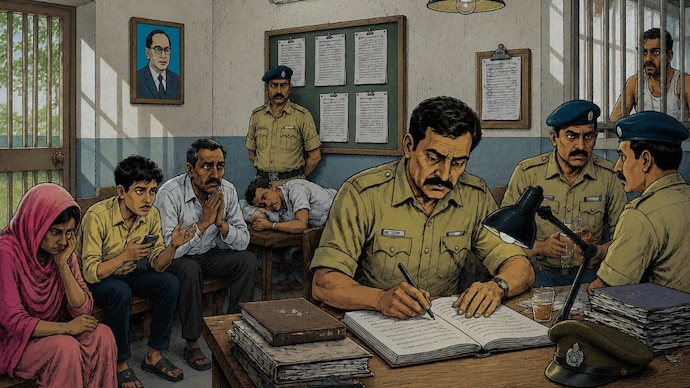


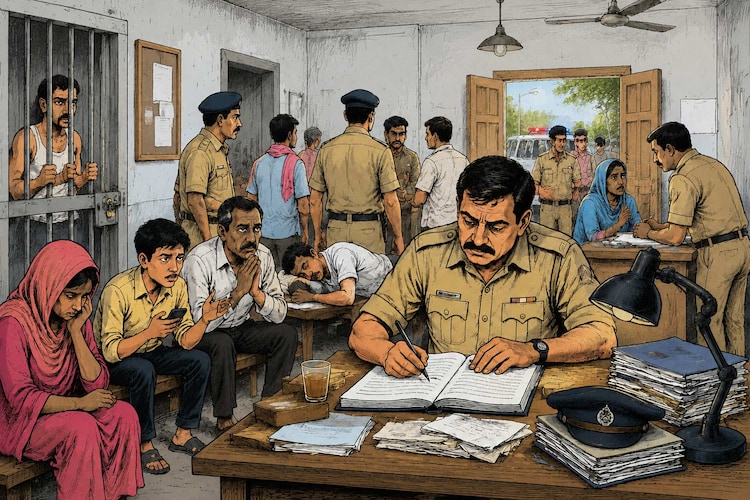
At 11:30 p.m., the police station is still awake. Two constables argue over tea while a tired sub-inspector types out an information statement beneath a flickering tube light. A frightened father asks if anyone has seen his teenage daughter. In another corner, a dihadi mazdoor sleeps uneasily on a wooden bench after losing his wages in an event he cannot properly explain in the local vernacular. Near the entrance, a woman sits silently with her dupatta pulled tightly across her face after a domestic assault she is not yet ready to describe aloud. Beside her, a teenage boy explains the theft of his mobile phone with the exaggerated urgency of someone for whom the device is also a bank account, identity card and social existence. In the lock-up, a rowdy history sheeter coughs persistently. Outside, a patrol vehicle returns from a night round. Inside, both the general diary and the case diary are updated in real time.
Political theorists often describe the state as an entity that claims a monopoly over the legitimate use of violence. But that definition, clinical and Weberian in its precision, feels incomplete inside an Indian police station. Here, the state is rarely experienced as a force. It is experienced as many things all at once. Persuasion. Delay. Improvisation. Anxiety management. Social arbitration. Theatre. Occasionally compassion. Occasionally fear.
THE INDIAN STATE'S REAL FRONT DESK
Popular imagination understands policing through spectacle: encounters, raids, sirens, crime thrillers, and manhunts. But the daily life of a police station is usually far less cinematic and far more sociological. Most police work is less about catching criminals and more about managing disorder before it hardens into violence.
One constable at a police station in Hyderabad described his previous evening almost apologetically: “No major crime, Sir. Only family issues”. By ‘family issues’ he meant a drunken assault between brothers and a domestic dispute that nearly escalated into serious violence before neighbours intervened. None of it would appear in headlines. Yet all of it consumed the station’s day and night.
On a typical day, a station house officer (SHO) may begin the day tracing a cyber-fraud complaint, spend the afternoon mediating a land dispute, and end the night supervising bandobast arrangements for a religious procession moving through a communally sensitive neighbourhood. Constables spend endless hours regulating traffic, calming agitated crowds outside hospitals, locating missing elderly persons, escorting mentally distressed individuals to care facilities and preventing drunken altercations from becoming fatal.
In large parts of India, the police station has quietly become the state’s default crisis-management centre because so many other civic institutions remain weak and inaccessible. The much reviled thana absorbs social failures that properly belong elsewhere: family breakdown, unemployment-fuelled tensions, addiction, neighbourhood conflicts and administrative collapse.
Sociologists call this ‘institutional overloading’ - when one arm of the state inherits responsibilities abandoned by several others. The Indian police station embodies this phenomenon almost perfectly.
And because preventive policing produces absences, much of its labour remains invisible. The riot that did not happen, the procession that passed peacefully, the rumour that was contained before panic spread. These do not generate headlines. And unfortunately, people tend to notice policing most dramatically when it fails, rarely when it quietly succeeds.

A MIRROR OF INDIAN SOCIETY
Anthropologists have long argued that institutions reveal themselves most honestly through everyday ritual. By that measure, the Indian police station is one of the richest ethnographic sites in the country.
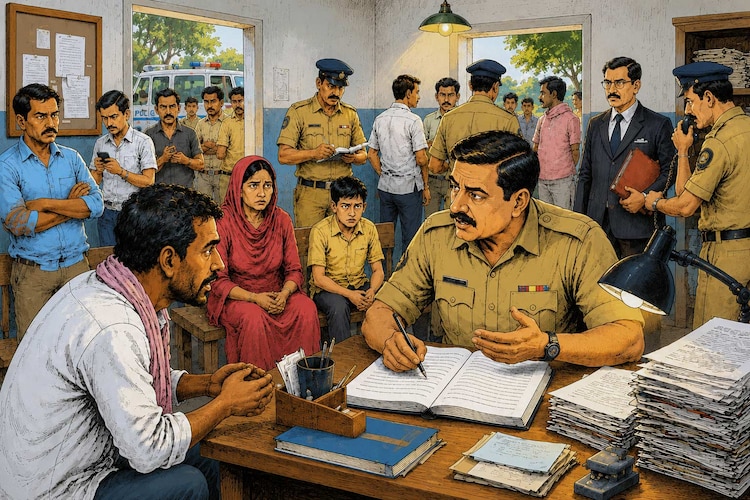
The wealthy complainant arrives with certainty already built into posture and language. The migrant labourer enters cautiously, removing slippers instinctively before crossing thresholds where he suspects power resides. The local politician does not wait at all; he walks directly inward, bypassing benches and procedures alike. Lawyers move with practised familiarity. Journalists hover in doorways. Tea vendors circulate like unofficial extensions of the institution itself.
Pierre Bourdieu once wrote about ‘social capital’ - the invisible networks of influence and confidence that determine how comfortably individuals navigate authority structures. Few places demonstrate this more vividly than a police station.
And yet the station also performs a strange democratic compression. Beneath the same slow-moving ceiling fan may sit a businessman, a domestic worker, a student activist, a pickpocket and a retired schoolteacher, all waiting for the attention of the same overworked sub-inspector. The police station is one of the last Indian institutions where sharply unequal social worlds collide physically. It is, in that sense, a profoundly Indian public space: hierarchical, chaotic, negotiated and intensely human.

THE THEATRE OF AUTHORITY
Every police station contains a carefully understood choreography of power. The placement of chairs matters. Who stands and who sits matters. Who is offered water matters. Even silence matters.
The uniform, the general diary, the lock-up, the wireless set crackling in coded fragments, the framed photographs of senior officers, the portrait of Ambedkar or Gandhi on the wall - all contribute to an atmosphere where authority is continuously performed as much as it is exercised.
But unlike the cold impersonality of bureaucratic offices, power inside the thana remains deeply personalised. Citizens do not encounter ‘the system’ abstractly; they encounter particular officers with individual temperaments, prejudices, fatigue levels and moral instincts. The difference between empathy and humiliation may depend entirely on who is sitting behind the desk that day.
This discretionary character of policing is both its necessity and its danger.
For instance, a woman reporting harassment at one station in Delhi initially spoke so hesitantly that the duty officer repeatedly asked her to “speak clearly”. Only after a senior woman constable entered the room and quietly moved her chair closer did the complainant begin describing the incident in full sentences. The law available to her had not changed within those few minutes. The enabling conditions had.
No society can function if every human conflict is processed mechanically through legal text alone. Police discretion often prevents escalation and allows practical compromise. Yet the same discretion can also produce arbitrariness, intimidation and unequal treatment. The Indian police station lives permanently inside this tension between procedural legality and negotiated order.

THE EMOTIONAL ECONOMY OF POLICING
There is another reality inside police stations that policy discussions rarely capture: emotional accumulation.
A young constable once admitted that he had stopped reacting visibly to distress calls because “if you take every case home mentally, you cannot survive this job." Hours earlier, he had helped carry the body of a suicide victim from a railway track. By evening, he was back at the station settling an argument over a parking dispute.
A police station encounters society at its moment of rupture. Officers witness burnt bodies, parents searching for missing children, suicides, abandoned elderly persons, communal panic, sexual violence and the slow corrosion of families under debt or addiction. Over time, repeated exposure to crisis creates what psychologists call ‘compassion fatigue’–a defensive hardening against emotional overload.
This does not excuse brutality, corruption or insensitivity. Institutions must still be judged ethically. But realism demands acknowledging that policing involves a form of emotional labour rarely recognised in public discourse. Few Indian professions perform emotional labour more intensely than policing. Officers must project authority while remaining publicly accessible. They must comfort victims one moment and physically restrain violence the next.
WHERE THE REPUBLIC BECOMES TANGIBLE
Democracies are often imagined through their grand symbols: constitutions, elections, legislatures, and courts. But republics survive through ordinary encounters. They survive in whether a frightened citizen feels heard while filing a complaint at midnight. Whether power behaves predictably or arbitrarily. Whether the poor can enter a state institution without instinctive fear. Whether authority appears accountable or merely distant.
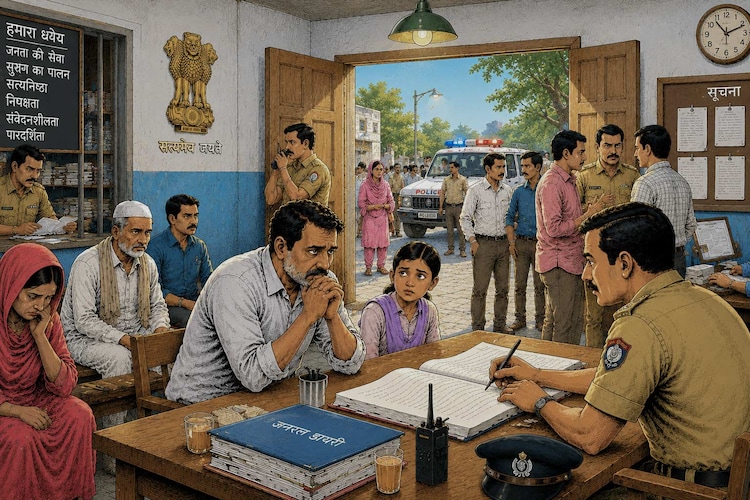
The police station remains one of the few places where the Indian state still encounters its citizens face-to-face, unmediated by apps, portals or interfaces. Here, governance has texture and temperature. It smells of paper files, sweat, dust and overboiled tea. It sounds like VHF static, ceiling fans and impatient arguments. And sometimes it looks like that father is still waiting near midnight for news about his daughter, watching every ringing phone with silent desperation while a constable tells him, for the fourth time, “We are trying.”
The Indian police station is imperfect, feared, overburdened and often deeply unequal. But it is also one of the republic’s most revealing mirrors. Because inside the thana, India is stripped of abstraction. What remains is the raw democratic reality of millions of people arriving at the same battered desk, carrying griefs, anger, fears and expectations, asking the state – sometimes timidly, sometimes furiously – to respond.