
Artemis-II launch on April 2: What happened when humans last went to the Moon?
Now, with Artemis II getting ready to take flight after five decades, the next chapter has finally begun.

With Nasa’s Artemis-II mission in the final stage before launch, four astronauts are once again getting ready to travel to the Moon for the first time in over half a century.
The final countdown of the launch began on Tuesday morning, March 31, and the liftoff is scheduled for Thursday, April 2 at 03:53 am IST.
But this is not the first time humans have travelled to the Moon.
The last time any human being ventured this far from Earth was in December 1972, aboard Apollo 17, the sixth and final crewed Moon landing in history.
What that mission achieved, and why it ended, is a story worth revisiting as humanity takes its next step.
WHAT HAPPENED WITH APOLLO 17?
Apollo 17 launched at 10:03 am IST on December 7, 1972.
The fireball from the launch was so bright it turned night to day for the more than 5,00,000 spectators gathered near the Kennedy Space Center, and was reportedly visible as far away as Miami.
Commander Gene Cernan, lunar module pilot Harrison “Jack” Schmitt, and command module pilot Ronald Evans were the crew. Schmitt was the first and only professional scientist (a geologist) to walk on the Moon.
Four days after launch, Cernan and Schmitt landed in the Moon's Taurus-Littrow valley while Evans remained in lunar orbit above.
WHAT DID ASTRONAUTS DO ON THE MOON?
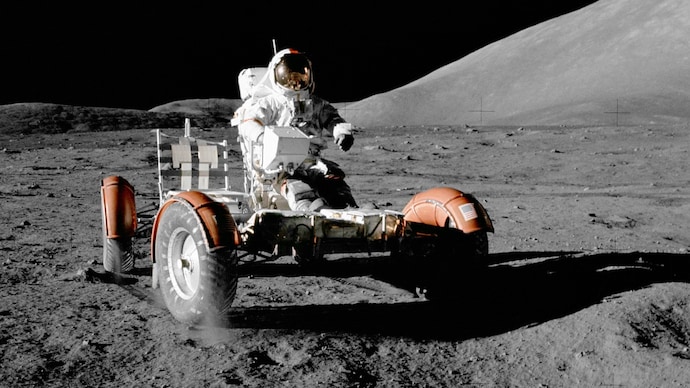
The two astronauts spent 75 hours on the Moon and completed three moonwalks totalling 22 hours and 4 minutes, marking the longest surface stay of the entire Apollo program.
The lunar rover traversed a total of 30.5 kilometres across the surface, with the crew collecting about 110 kilograms of rock and soil samples, including orange soil near Shorty Crater that turned out to be evidence of ancient volcanic activity on the Moon.
Perhaps Apollo 17’s most enduring legacy was a photograph taken about five hours after launch. The “Blue Marble” image of a fully lit Earth against the void of space, became one of the most reproduced images in history and a galvanising symbol for the environmental movement.
WHY DID WE STOP GOING TO THE MOON?
The primary reason for ending crewed Moon missions was financial. Nasa was experiencing budget constraints as shifting political priorities redirected funding away from the Apollo program.
The space agency had already turned its human spaceflight efforts toward the Space Shuttle program by the time Apollo 17 launched, but nobody imagined the hiatus would last more than 50 years.
A commemorative plaque left at the landing site, signed by the crew and former US President Richard Nixon, read: “Here man completed his first explorations of the Moon.”
Now, with Artemis II getting ready to take flight after five decades, the next chapter has finally begun.