
Chandrayaan-2 discovers water in Moon's doubly shadowed crater: What is it?
Chandrayaan-2 has found signs of subsurface water-ice beneath doubly shadowed craters near the Moon's south pole. The finding sharpens focus on ultra-cold lunar regions that could support future human missions.
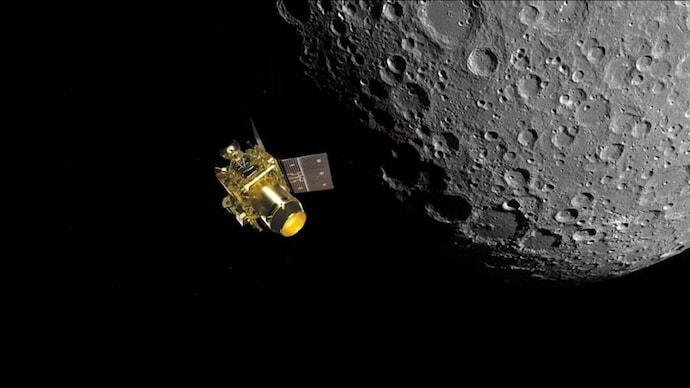
These findings have significant implications for future lunar missions. (Photo: Isro)

New Delhi,UPDATED: May 28, 2026 12:06 IST
Scientists working with India’s Chandrayaan-2 mission have found fresh evidence of subsurface water-ice hidden beneath rare “doubly shadowed craters” near the Moon’s south pole, a region now considered one of the most valuable locations for future lunar exploration.
The discovery, made using the Chandrayaan-2 Orbiter’s Dual Frequency Synthetic Aperture Radar (DFSAR), has drawn attention to these unusual lunar formations and why they are becoming central to the global race to return humans to the Moon.
So what exactly are doubly shadowed craters?
These are small craters located inside much larger permanently shadowed regions (PSRs) near the Moon’s poles. Unlike most parts of the Moon, these areas never receive direct sunlight because the Moon’s axis has only a slight tilt. As a result, deep polar craters remain in permanent darkness for billions of years.
But doubly shadowed craters are even more extreme.
They are craters within already shadowed craters, meaning they are protected not only from sunlight but also from reflected thermal radiation coming from nearby illuminated surfaces.
This creates some of the coldest known environments in the Solar System, with temperatures plunging to nearly 25 Kelvin, or around minus 248 degrees Celsius.
Scientists believe these ultra-cold conditions make doubly shadowed craters ideal cold traps where water molecules delivered by comets, asteroids or solar wind interactions can survive frozen beneath the surface for millions or even billions of years.
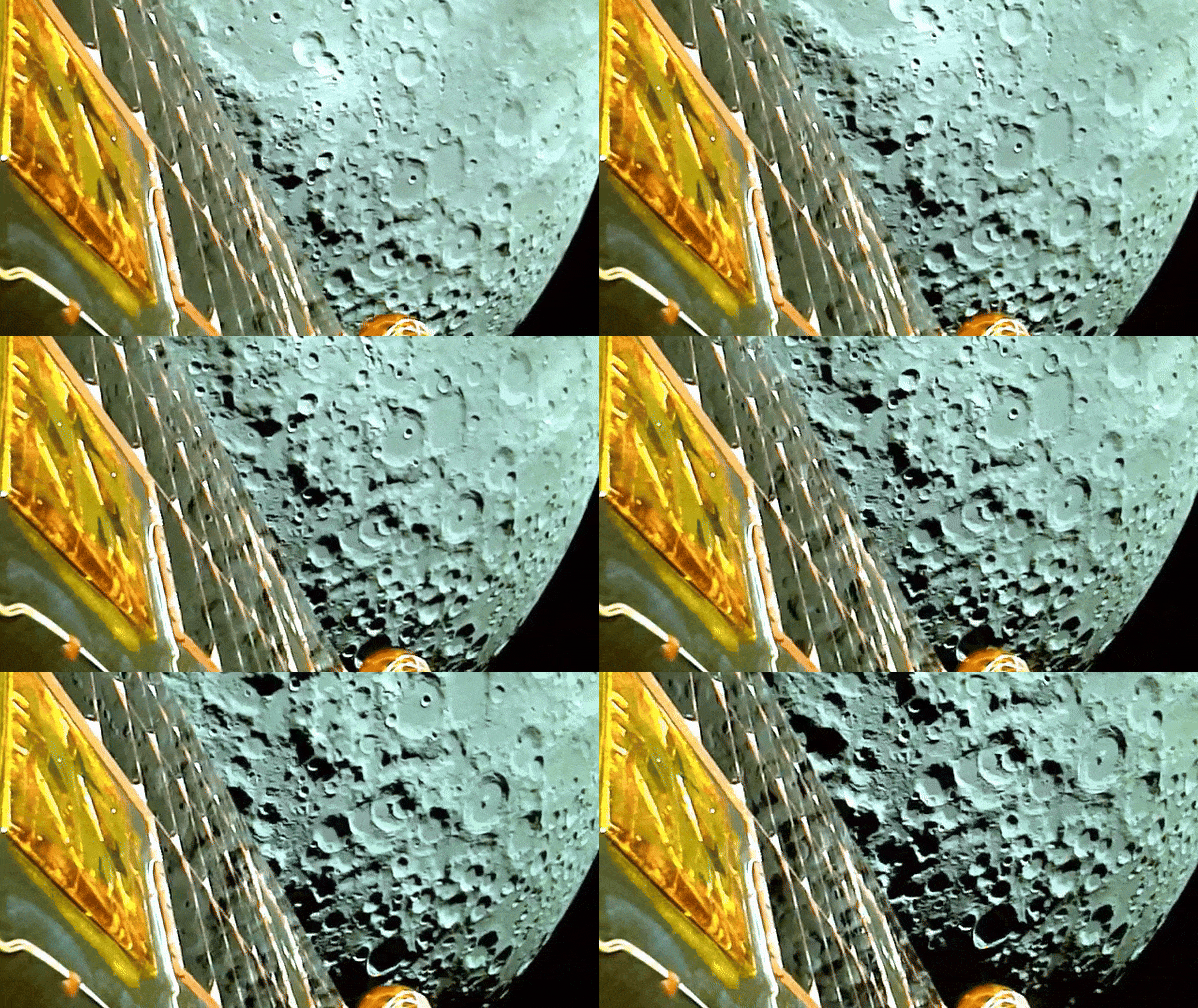
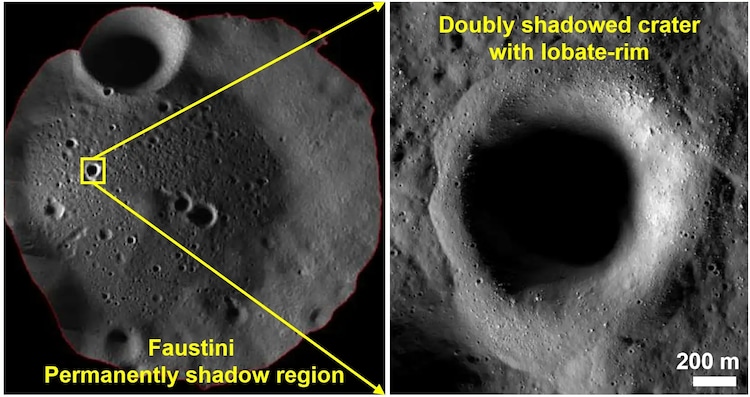
Using advanced radar polarimetric analysis, researchers from the Physical Research Laboratory (PRL), Ahmedabad, identified radar signatures consistent with the presence of subsurface ice beneath the floors of four such craters in the lunar south polar region.
The Chandrayaan-2 orbiter’s DFSAR instrument is the first fully polarimetric synthetic aperture radar sent to study the Moon. It can peer beneath the lunar surface and analyse how radar waves scatter after hitting buried materials.
One crater inside the Faustini basin, measuring around 1.1 kilometres in diameter, showed particularly strong evidence. Researchers also observed a distinctive “lobate-rim” structure, a flow-like crater edge that may have formed when an impact penetrated ice-rich ground beneath the surface.
The findings are significant because water-ice could become a critical resource for future Moon missions.
Ice can potentially be converted into drinking water, breathable oxygen and even rocket fuel, making the lunar south pole a prime target for countries planning long-term human presence on the Moon.
- Ends