
Amazon readies Rs 1 lakh-crore plan to compete with Elon Musk's Starlink
The e-commerce giant acquires satellite firm Globalstar to take on Elon Musk's Starlink. Experts say the deal is bold, but the hard part is yet to come.

Amazon has agreed to acquire Globalstar, a US-based satellite company, in a deal worth USD 11.57 billion, which is roughly Rs 1.08 lakh crore as of April 15.
The announcement, made on Tuesday, marks one of Amazon's biggest bets yet on the future of the internet. It could further give competition to the more popularly known name of Starlink, which provides the internet using satellites placed in low-Earth orbit (LEO), about 500–600 km above us.
These satellites are far closer than traditional communication satellites and can beam high-speed internet directly to phones and devices on the ground, even in remote areas with no mobile towers.
WHY DID AMAZON BUY SATELLITES?
Amazon has been building its own satellite internet service called Amazon Leo (previously known as Project Kuiper) with the goal of connecting people across the globe using a large network of LEO satellites.
The e-commerce giant, led by billionaire Jeff Bezos, has been working to deploy about 3,200 satellites in low Earth orbit by 2029, with roughly half required to be in place by a July 2026 regulatory deadline. The company is also preparing to launch its satellite internet services to customers later this year.
Globalstar currently has more than 24 satellites in low-Earth orbit, and has agreements in place to acquire more than 50 new satellites. Thanks to the newly signed deal, Amazon will now profit from all of Globalstar's satellite operations.
Crucially, its network is built for Direct-to-Device (D2D) communication. In simpler words, it can connect directly to your mobile phone without needing a special router or dish.
Globalstar currently provides satellite services like emergency text messaging, roadside assistance requests, and location sharing, available on Apple's iPhone 14 and later devices.
As part of the deal, Amazon has signed an agreement with Apple to continue providing satellite connectivity services for the iPhone and Apple Watch.
Additionally, the new deal will help Amazon's effort to contest Starlink's dominance in the sector.
It's now not a secret that Amazon is trying to catch up with Starlink, owned by Elon Musk's SpaceX. Starlink currently operates more than 10,000 satellites and offers internet services in about 150 countries.
Amazon is a distant second.
Rocket shortages, manufacturing disruptions, and launch setbacks mean Amazon has deployed just 243 of the 3,236 satellites it promised in 2019, making this deal look even more of a necessity.
A PROBLEM MONEY CAN'T FIX
But the truth on the ground might be sobering for Amazon.
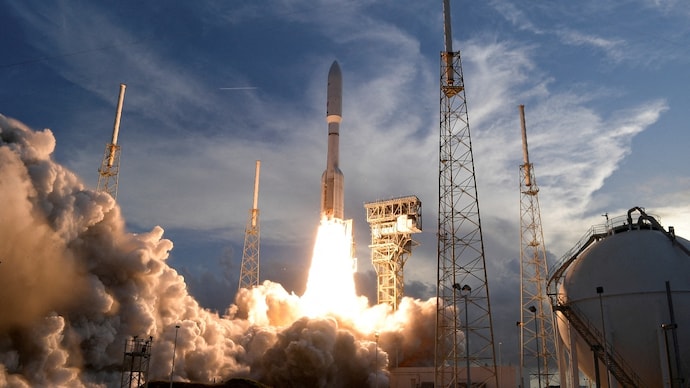
Buying Globalstar gives Amazon more satellites and radio frequencies used to transmit data, but it doesn't solve Amazon's core problem. The problem is getting those satellites into space.
The shortage has even compelled Amazon to tap rival SpaceX's Falcon 9 rockets for launches, highlighting its dependence on third-party providers.
"Unless Amazon can solve deployment speed and launch access, the gap remains structural, not just numerical," Gregory Radisic, a senior teaching fellow at Bond University told news agency Reuters.
Jeff Bezos's own rocket company, Blue Origin, is developing a rocket called New Glenn that could eventually help. New Glenn made its debut flight in January 2025 and is undergoing further testing as Blue Origin works toward more regular missions.
The acquisition is expected to close next year, subject to regulatory approvals and achievement of specific deployment milestones by Globalstar. And yes, Amazon's Globalstar deal is a significant step as it gets the company satellites, spectrum, and a partnership with Apple.
But the bottom line remains. The race against Starlink won't be won in a boardroom but on the launchpad.
(USD 1= Rs 93.38)