
Biggest Starship reaches space as giant Super Heavy rocket explodes during return
The latest test flight featured the upgraded Version 3 configuration of Starship, with improvements to both the Super Heavy booster and the upper-stage spacecraft.
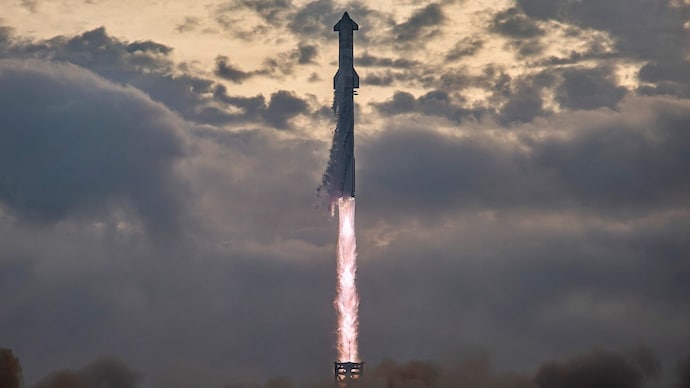

SpaceX launched the biggest and most powerful version of its Starship-Super Heavy system on Saturday morning, marking another major milestone in the company’s push to develop a fully reusable rocket capable of carrying humans to the Moon and Mars.
The latest test flight featured the upgraded Version 3 configuration of Starship, with improvements to both the Super Heavy booster and the upper-stage spacecraft. The launch lifted off successfully from SpaceX’s Starbase facility in Texas, with all eyes focused on one of the mission’s most critical moments: hot staging.
The test achieved a successful hot-staging separation, a manoeuvre in which Starship’s upper-stage Raptor engines ignite before the booster fully separates. During the dramatic sequence, flames burst through the staging ring as Starship pulled away from the Super Heavy booster at hypersonic speeds.
After stage separation, the Super Heavy booster began its planned return trajectory toward the Gulf of Mexico. SpaceX had intended for the booster to perform a controlled descent before splashing down in the ocean. However, during the descent phase, the massive booster exploded mid-air before reaching the water.
Despite the loss of the booster, the upper-stage Starship continued flying successfully in space, extending the mission well beyond the staging event. Initial visuals from the livestream showed the spacecraft maintaining stability as it climbed toward its planned trajectory.
The test represents another step in SpaceX’s iterative development strategy, where rapid launches and real-world failures are treated as part of the engineering process. The company has repeatedly emphasised that each flight provides valuable data needed to refine the system for future missions.
Starship is central to SpaceX’s long-term ambitions, including Nasa’s Artemis programme, which plans to use a modified Starship vehicle to land astronauts on the Moon later this decade. The rocket system is also intended to eventually support missions to Mars and enable large-scale satellite deployments. The Starship was carrying 22 Starlink satellites designed to test new onboard components and equipped with cameras intended to capture footage of the spacecraft after deployment. Around 20 minutes after liftoff, Starship successfully deployed the satellites while flying in space above Earth. A major setback during the 12th flight came when Starship’s engines failed to relight in space, forcing the spacecraft into an uncontrolled re-entry trajectory. The mission lasted over an hour before crashing into the Indian Ocean.
Standing nearly 400 feet tall when fully stacked, the Starship-Super Heavy combination remains the largest and most powerful rocket ever built. Saturday’s mission demonstrated both the enormous progress and the continuing challenges involved in developing a next-generation reusable launch system.
While the booster was lost during descent, the successful hot staging and continued flight of Starship marked another significant achievement for the programme.