
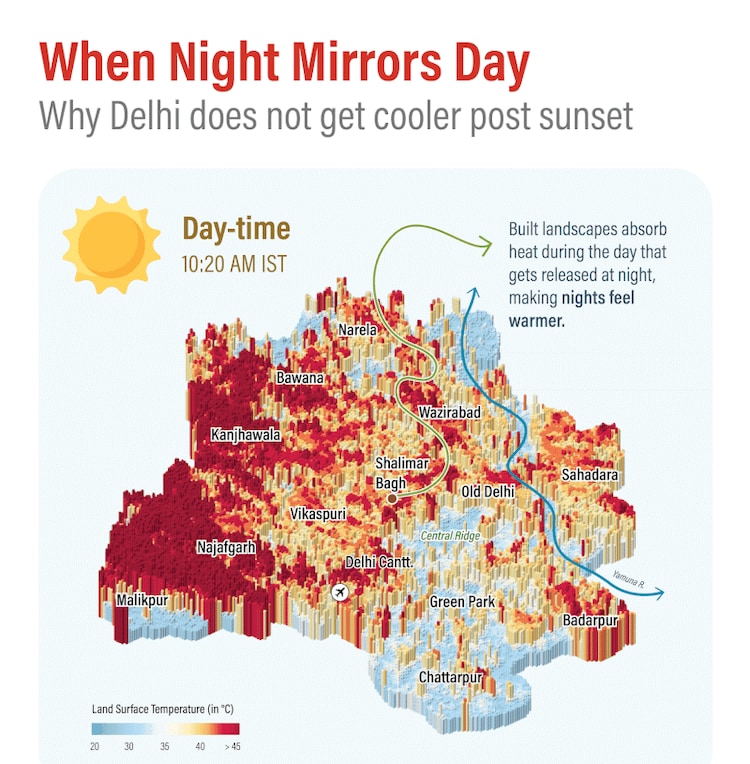
Why your house feels hot after the Sun goes down
Nights are becoming warmer due to humans, and the concrete and brick buildings we are constructing, allowing heat to linger for longer. And the impacts are far more concerning than we realise.
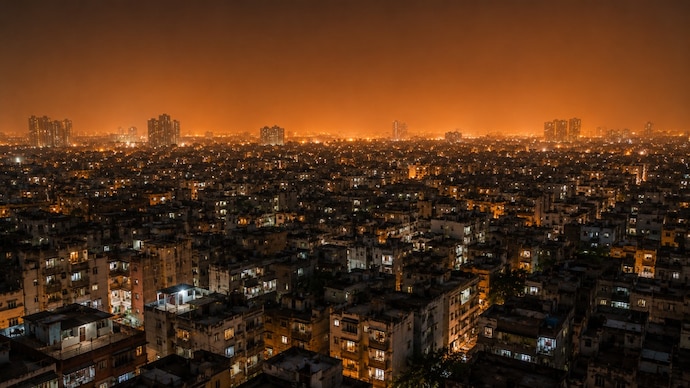
An aerial view of a dense concrete city, illustrating heat island effect and heat. (Representational Photo: AI)

New Delhi,UPDATED: May 19, 2026 13:55 IST
On the night of April 28, Delhi's Safdarjung weather station recorded a nighttime temperature of 28.4°C. That was about 4.5°C warmer than what is considered normal for that time of year.
Usually, by late April, Delhi nights cool to around 24°C, but that night stayed almost as warm as a June morning.
In other words, the heat didn’t really ease after sunset.
What's more worrying is that this was not an anomaly but part of an emerging trend.
2026 has been warm. Just how 2025 was and just like the year before that. But heat has evolved into a more complex problem, moving beyond the traditional association with sweat, thirst, and the glaring Sun. It has evolved enough to survive without the Sun, spilling into entire nights.
Delhi's warm April night was not unusual.
The capital recorded almost the same unusually warm April night in 2018, when the minimum also stayed at 28.4°C, and it was even hotter in 2017, when it touched 29°C. And in the years since, nights have turned warmer.
What used to feel like an exceptional heatwave night is slowly becoming a more regular part of Delhi’s summer.
And no, it's not just Delhi.
Just days ago, on May 13, a long-term analysis lent credibility to the trend and reframed how the country should think about its heat crisis.
The analysis was about what happens inside a home in Chennai at 9 pm in the night, when the walls are still radiating the afternoon heat, the humidity is above 75%, and there is nowhere cooler to go.
The findings revealed something that India’s entire heat governance framework has so far failed to account for, which is that the nights are not cooling down. Considering how hot the last two years have been and how 2026 has been no different, it's a serious concern for hundreds of millions of people.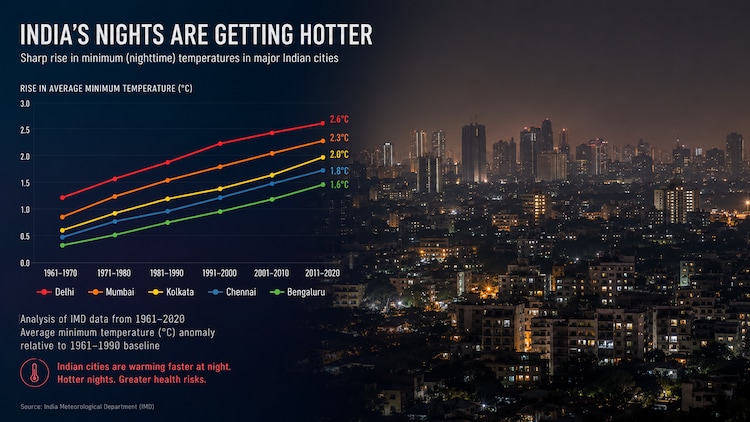
But first, let's start with the basics.
WHY ARE NIGHTS GETTING HOTTER?
"It's a combination of two things, really," said Jaya Dhindaw, Executive Program Director, Sustainable Cities, at WRI India. "It is a combination of basically heat and emission generating activities or human activity and the urban heat island effect, which is getting more and more intensified in cities and urban areas."
Human activities are the global driver of the problem; they drive emissions, hurt the environment, and as we now see, warm nights.
Over the last 40 years, from 1981 to 2022, very warm nights in India have increased faster than very hot days. Nearly 70% of districts experienced five or more additional very warm nights per summer, compared to only around 28% of districts seeing a similar increase in very hot days, according to the Council on Energy, Environment and Water (CEEW).
The other driver is how India’s cities are built, which eventually leads to what is called the urban heat island effect.
Concrete roads, brick walls, dense housing blocks, and acres of asphalt act like giant heat sponges. They soak up sunlight through the day and slowly release it through the night, keeping cities far warmer than the surrounding countryside long after sunset. This is the urban heat island effect.
Indian cities such as Delhi, Bengaluru, Chennai, and Mumbai consistently report temperatures ranging from 1°C to 6°C higher than their rural neighbours.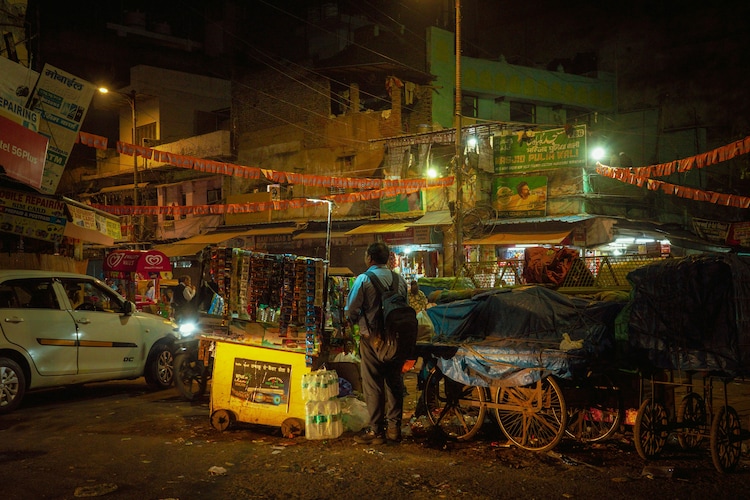
The rise in very warm nights is most pronounced in densely populated districts, often home to Tier I and II cities.
Between 2018 and 2023, Mumbai saw 65 extra warm nights. West Bengal and Assam were the hardest hit, with 80–86 additional nights above 25°C annually, said IPCC author Anjal Prakash, adding that over 70% of Indian districts had five or more very warm nights per summer between 2012–2022, and nearly 60% of districts now face high-to-very-high heat risk.
Making this worse is a severe shortage of urban tree cover, particularly in the neighbourhoods that need it most.
An analysis of 8,919 large urban areas globally found that urban tree cover mitigates between 41 and 49% of the maximum potential urban heat island effect, roughly halving the temperature gap between cities and their surrounding areas.
But the benefit is deeply unequal; densely settled low-income urban areas, where heat risk is highest, have the thinnest tree cover and the lowest cooling.
Put bluntly, the people most exposed to nighttime heat are also the least protected from it by their environment.
WHAT HAPPENS WHEN HOMES GET HOT AT NIGHT?
The analysis of Chennai homes by the research organisation Climate Trends is the most recent and apt documentation of this crisis, done using high-resolution sensor data.
Researchers installed temperature and humidity sensors inside 50 residential units across Chennai’s dense urban neighbourhoods and recorded readings every minute between October 2025 and April 2026. Critically, this period excluded peak summer, making the findings a conservative, baseline picture of what residents endure, and yet, not the worst case.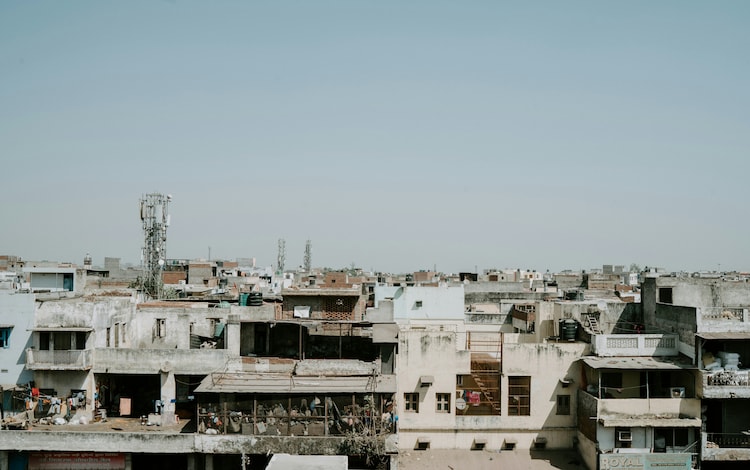
The sensors revealed that indoor temperatures across the monitored households frequently exceeded 32°C, with the worst-affected homes logging between 5,700 and 5,800 hours above that threshold, the same as exposure to eight months of continuous heat.
The majority of households recorded between 3,000 and 5,000 hours above 32°C, or four to seven months of persistent exposure. Nighttime temperatures between 8 pm and 6 am rarely fell below 31°C, even during the cooler months.
And the peak indoor temperature arrived not at noon but between 8 pm and 9 pm, hovering close to 34.7°C.
Even at its lowest, between midnight and 6 am, the indoor temperature barely dipped below 33.8°C. In essence, the house never truly cooled down.
Compounding this was humidity. Mean relative humidity levels across all monitored households ranged between 76% and 77% through the night, which is well above the threshold at which the body can cool itself through evaporation.
Humid heat is considerably more dangerous than dry heat. In humidity, the body doesn't sweat, which means it doesn't cool down, causing overheating and, in some cases, heatstrokes.
There are other health consequences too. Prolonged heat exposure affects sleeping patterns, and lack of sleep often impacts cognitive abilities and mental health.
HEAT MEETS INEQUALITY
As with numerous climate issues, this crisis too comes along with disproportionate impacts. Not everyone is equally exposed or equally equipped to survive it.
The people most at risk are those who cannot escape. They are the informal, outdoor workers, the urban poor, migrant labourers, the elderly, and children.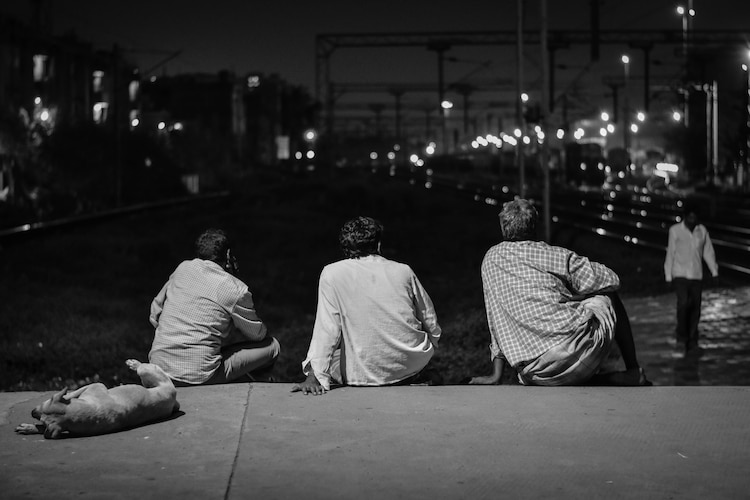
The number of very warm nights is increasing even more rapidly than very hot days, and the productivity hit is severe. Research by economists Saudamini Das and E. Somanathan, based on surveys of nearly 400 informal workers in Delhi during the summer of 2019, found that a one-degree increase in mean temperature reduced net daily earnings by 16%.
And income decides how hot your nights will be.
In Chennai, nearly all the 50 households analysed had concrete roofs, giving them near-identical thermal mass and near-identical heat retention. What income determined was only the ability to cope. Every high-income household had an air conditioner. Every low-income household had only a ceiling fan.
That in turn affects the human body.
The body’s vulnerability at night is also physiological. The human heart relies on cooler nighttime temperatures to recover from daytime heat stress. When the feel-like temperature at 10 pm is still hovering near 30°C, the cardiovascular system never gets a reset.
In simple terms, warm nights turn heatwaves from short-term events into prolonged stress periods.
WHAT ARE THE SOLUTIONS?
India is not without responses, but if they are enough stays debatable.
The country currently has over 300 Heat Action Plans, with 100 more in development, but not one of these plans mandates indoor temperature monitoring, and all are triggered exclusively by thresholds set by how hot it is outside, when the Sun is out and shining.
“Rising temperatures and extreme weather events are realities affecting our cities, villages, economies, and the daily lives of citizens. Heat stress has emerged as one of the defining challenges of our times,” Union Minister for New and Renewable Energy Pralhad Joshi said at a recent climate event.
Cities like Kochi and Mumbai are piloting data-driven greening and cooling interventions, like planting trees, creating shade corridors, experimenting with cool roofing materials, all in order to reduce urban heat island effects.
But analysts warn that master plans and climate action plans in most cities remain disconnected. Until heat governance catches up to that reality, millions of Indians will continue to lie awake through the hottest hours of the night, waiting for a relief that never comes.
"The bottom line is that it all boils down to heat governance," said Dhindaw. "Heat is currently managed by disaster management agencies and falls within the ambit of the Ministry of Climate Change, but it should also sit within the mandates of other agencies like transport, education, public works. Unless all stakeholders, all departments address it collectively and urgently, we will not be able to adapt to a warming world."
- Ends