
Is it Earth 2.0? Planet the size of Jupiter found with Earth-like temperatures
Using the James Webb Space Telescope, astronomers analysed the atmosphere of temperate gas giant TOI-199b. The observations detected methane and offered a rare window into how planetary atmospheres evolve.
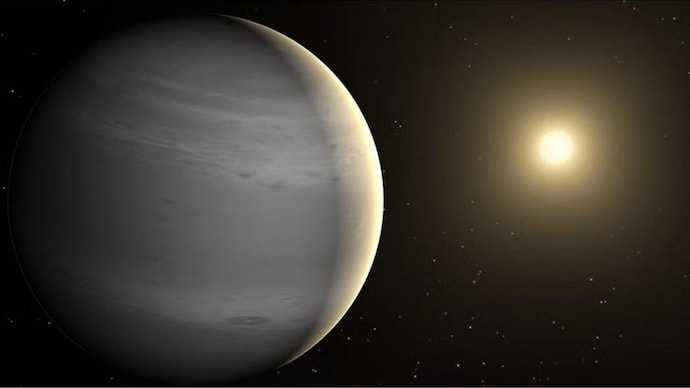

A giant planet roughly the size of Jupiter, but with temperatures surprisingly close to those on Earth, has emerged as one of the most intriguing exoplanets ever discovered.
Using the powerful NASA James Webb Space Telescope (JWST), astronomers have for the first time analysed the atmosphere of a rare “temperate” gas giant located more than 330 light-years away from Earth.
The planet, known as TOI-199b, orbits its parent star once every 100 days and has an estimated atmospheric temperature of around 175 degrees Fahrenheit.
While still far too hot for humans, scientists say it is remarkably mild compared to most giant planets discovered beyond the solar system.
Unlike the icy giants in our solar system, such as Jupiter and Saturn, or the ultra-hot “hot Jupiters” that can reach thousands of degrees due to their close proximity to their stars, TOI-199b sits in a rare middle ground.
Researchers say only a handful of such temperate giant planets are known, making this discovery especially important for understanding how planetary systems evolve.
The findings were published in the journal The Astronomical Journal by a research team led by scientists from Penn State University and NASA Jet Propulsion Laboratory.
To study the atmosphere, scientists used a technique called transmission spectroscopy. As TOI-199b passed in front of its host star, JWST analysed the starlight filtering through the planet’s atmosphere. Different gases absorb different wavelengths of light, allowing researchers to identify the atmospheric composition.
The telescope detected strong signatures of methane, a molecule long predicted to exist in temperate gas giants but never clearly observed in one before. Researchers also found hints of ammonia and carbon dioxide in the atmosphere.
“This is the first time that we have been able to study the atmosphere of a temperate giant planet in detail,” the researchers said, noting that the observations validate long-standing models of planetary chemistry and evolution.
The transit observations lasted nearly seven hours, significantly longer than the brief transits of hot Jupiters. Scientists spent nearly 20 hours using JWST to establish baseline measurements of the star before comparing them to the transit data.
Researchers believe the discovery could help improve computer models used to understand how atmospheres form, not just on distant worlds, but also on Earth itself. While TOI-199b is not a true “Earth 2.0,” its unexpectedly Earth-like temperatures and complex atmosphere are opening a new window into the diversity of planets in the galaxy.