
Isro to help upgrade Hope habitat in Ladakh for training Gaganyaan astronauts
A remote analogue habitat in Ladakh is being expanded for Gaganyaan-linked astronaut training. The upgrades will help researchers study how crews handle isolation, stress and extreme conditions.
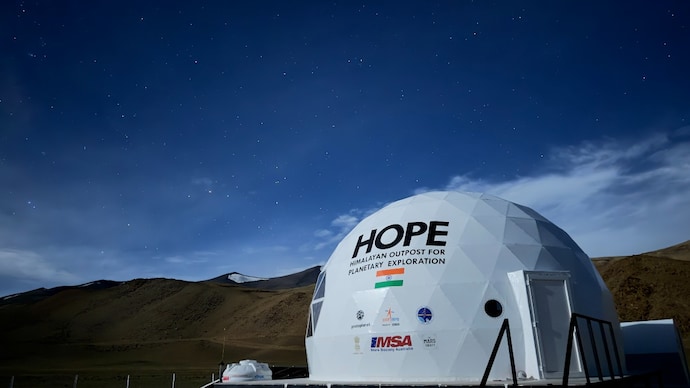
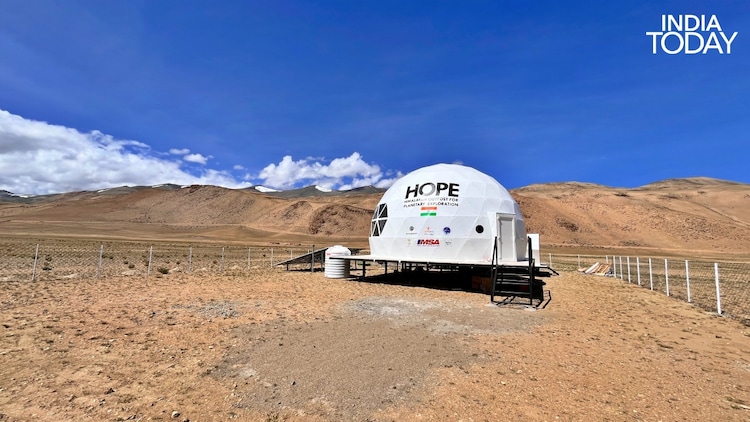
The Hope Habitat is set up in the Tso Kar valley of Ladakh. (Photo: Protoplanet)

Leh,UPDATED: May 11, 2026 13:24 IST
India’s ambitions for human spaceflight are driving new upgrades deep in the high-altitude cold desert of Ladakh, where a remote analogue habitat designed to simulate the harsh conditions of space is being expanded to support future astronaut training missions linked to the Indian Space Research Organisation’s (Isro) Gaganyaan programme.
The Hope Habitat, set up in the Tso Kar valley of Ladakh and developed by space research company Protoplanet, is now being upgraded after completing an earlier analogue isolation mission with help from the Indian space agency.
According to Dr. Siddharth Pandey, founder of Protoplanet, the initiative is being carried out in collaboration with Isro’s Human Space Flight Centre to help astronauts prepare for the physical and psychological challenges of spaceflight.
Pandey said the project gained momentum after the successful Hope analogue mission conducted in 2025.
The programme later evolved into a specialised training exercise involving Isro engineers and astronauts, aimed at studying how teams function under stressful and isolated conditions similar to those encountered during long-duration space missions.
WHY IS LADAKH IDEAL FOR SPACE TRAINING?
The Ladakh environment was chosen because it replicates several spaceflight stressors.
The region’s extreme isolation, low atmospheric pressure, oxygen scarcity, freezing temperatures, and sharp thermal swings create conditions that affect both physical performance and group dynamics.
Researchers are particularly interested in understanding how astronauts collaborate and make decisions in such environments.
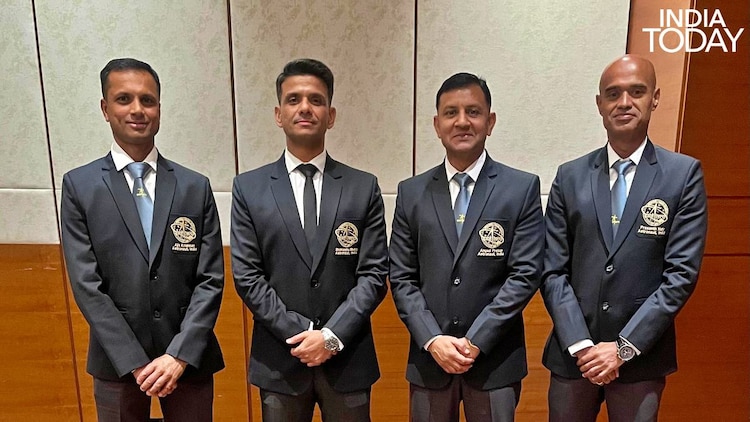
Protoplanet was recently involved in a simulation mission involving all four designated Gaganyaan astronauts, making it a rare opportunity for researchers to observe actual spaceflight crews instead of analogue participants alone.
While earlier missions primarily tested the habitat and infrastructure, the recent programme focused heavily on behavioural studies and teamwork.
HOPE HABITAT TO BE UPGRADED
To support the future Hope mission, Protoplanet is working on upgrading the communications systems, power infrastructure, and data monitoring capabilities inside the habitat.
The station will also be equipped with surveillance systems, cameras, and wearable biometric devices to study how astronauts respond physiologically and psychologically to prolonged isolation. Psychologists from the Institute of Aerospace Medicine in Bengaluru will also be stationed at the site during the future test mission.
The company plans a major expansion of the Hope Habitat over the next two years. The upgrades will allow more personnel to stay at the station while centralising the collection of scientific and behavioural data. Some improvements are expected to be completed during the current summer season in Ladakh, with additional work continuing into next year.
Discussions are underway with Isro to make such analogue missions a recurring component of astronaut training for future human spaceflight missions as part of Gaganyaan.
- Ends