

 Handcrafted ByOur Editors
 Writer dies of grief after husband's death. How heartbreak kills by damaging heart
When Iranian artist Marjane Satrapi's family said she "died of sadness" after losing her husband, it raised a question science has been quietly answering for decades. Heartbreak, after all, damages the heart, and can kill people.
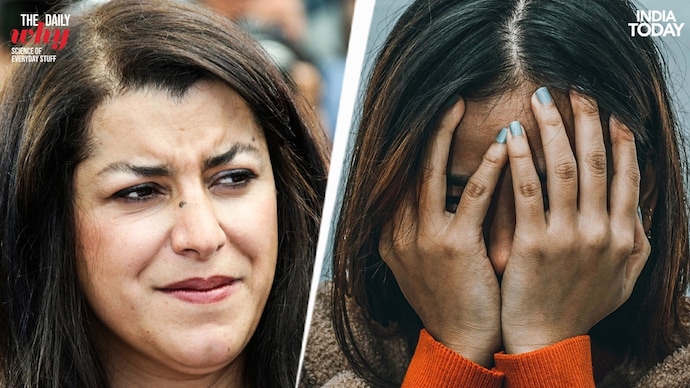
Marjane Satrapi. the creator of Persepolis, was 56 when she passed. Her family said she "died of sadness". (Images: AFP)

New Delhi,UPDATED: Jun 5, 2026 15:30 IST
There is a specific kind of quiet that comes after someone you love is gone. Not the comfortable quiet of an empty room, or the stillness before sleep.
It is a quiet that sits in the chest like weight. It follows you into the morning. It finds you mid-sentence, mid-meal, mid-laugh, and reminds you, without warning, that something is missing that cannot be put back.
When relatives of Marjane Satrapi, a French-Iranian graphic novelist, announced her passing on June 4, 2026, they described her loss in a phrase that stopped the world.
In a statement provided to French news agency AFP, they said she had "died of sadness a little over a year after the death of Mattias Ripa, her husband and the love of her life."
Satrapi was the creator of Persepolis, a critically acclaimed graphic memoir of her coming-of-age in Iran during and after the 1979 Islamic Revolution.
She died of sadness. It sounds like the end of a poem. But science has spent decades building the case that it is also a biological description, and not only for the grief of losing someone.
The same machinery underlies ordinary sadness, rejection, loneliness, and the raw ache of disappointment.
WHY DO WE FEEL GRIEF AT ALL?
Grief exists because love does, and sadness, more broadly, exists because we are built to care about outcomes, people, and belonging. Humans evolved to form deep social bonds because those bonds were survival.
A child with attentive caregivers was more likely to live. A person with loyal companions is more likely to endure famine and threat.
But attachment creates exposure, and pain, whether grief at its sharpest or sadness in its everyday form, is the price the nervous system pays for caring at all.
From an evolutionary standpoint, that pain is functional. It drives us to repair ruptured relationships, to pull support closer, and to avoid the choices that hurt us before.

Sadness slows us down and turns attention inward, which can help us reassess after a setback. Grief was not a malfunction but a biological alarm.
Anthropologist Barbara J. King, who studied grief across the animal kingdom, found it in dolphins, elephants, and chimpanzees, all of whom withdrew and stopped eating after losing a companion.
Grief, she has said, is the flip side of very close emotional attachment.
CAN HEARTBREAK DAMAGE THE HEART?
It can, and this is where the metaphor becomes flesh. In a condition doctors call broken heart syndrome, or takotsubo cardiomyopathy, a sudden surge of stress after a bereavement, a breakup, or a shock can physically stun the heart muscle. The heart's main pumping chamber, the left ventricle, balloons out of shape and loses its strength, mimicking a heart attack so closely that patients often arrive at hospital convinced they are having one.
The culprit appears to be a flood of stress hormones, chiefly adrenaline and cortisol, that briefly overwhelms the heart. Tissue taken from affected hearts shows real, though reversible, injury to the muscle cells themselves.
The condition strikes most often in women, particularly after middle age, and while it can occasionally be fatal, most people recover within days or weeks.
The phrase "broken heart" turns out to be close to literal: heartbreak can leave a mark on the organ, not just the feeling named after it.
WHAT HAPPENS IN THE BRAIN WHEN WE HURT?
When we form a deep bond, that bond is physically encoded into the brain's reward network, the same circuitry that governs hunger, pleasure, and survival.
Research by neuroscientist Dr Mary-Frances O'Connor at the University of Arizona suggests a loved one becomes embedded in the brain not merely as a memory but as a need.
The reward system learns to seek them out, anticipate their presence, and register the quiet pleasure of their return. When that person is gone, the brain does not accept the update. It keeps searching. It keeps expecting
This is why a grieving person spots a familiar silhouette in a crowd and feels their heart lift for a second, before the brain catches up.
In ordinary sadness, a milder version of the same mismatch plays out: the gap between what we wanted and what is, registering as a dip in dopamine and serotonin signalling.
The prefrontal cortex, responsible for rational thought, also becomes impaired under intense distress, producing the fog the bereaved call "grief brain." Hurt is not just an emotion. It is a whole-brain neurological event.
WHY DOES EMOTIONAL PAIN PHYSICALLY HURT?
The same neural pathways that activate during physical pain also fire during emotional pain. The brain interprets loss, rejection, and exclusion as a kind of wound.
A landmark study by Eisenberger and Lieberman, published in Trends in Cognitive Sciences, and an earlier fMRI experiment in Science, showed that social pain activates the dorsal anterior cingulate cortex and the insula, the very same regions that process the sting of a burn or the ache of a broken bone.
Crucially, this was not about death at all. Their volunteers were simply excluded from a virtual ball-tossing game, and the everyday pain of being left out lit up the brain's physical-pain alarm.
The brain does not cleanly distinguish a sprained ankle from a snubbed invitation or a shattered heart. Both register as injuries. This is why heartbreak hurts. Not poetically, but neurologically.
WHAT DO STRESS HORMONES HAVE TO DO WITH SADNESS?
Hurt does not stay in the brain. It floods the body through a cascade of stress hormones, chiefly cortisol.
Research shows cortisol can remain elevated through bereavement, disrupting heart function, sleep, and immune response.

Prolonged high cortisol suppresses immunity, which is part of why distressed and bereaved people so frequently fall physically ill.
A systematic review in the Journal of Neuroendocrinology also links grief to disruptions in oxytocin, the bonding hormone released when we are close to those we love. When the bond is broken, that chemical signal goes quiet.
WHY DO SOME PEOPLE GRIEVE LONGER THAN OTHERS?
Most people, according to longitudinal research by psychologist George Bonanno, show meaningful recovery in the months after a loss; resilience is the most common outcome.
A neuroimaging study by O'Connor and colleagues in NeuroImage found that people with complicated grief showed continued activation of the nucleus accumbens when shown photographs of the deceased.

It was as if the brain had become dependent on the presence of the person it had lost.
The yearning does not ease. It loops.
WHAT DOES SCIENCE SAY ABOUT HEALING?
Research from O'Connor's Grief, Loss and Social Stress (GLASS) Lab offers an unexpected comfort: a loved one remains physically present in the brain, encoded in its neural connections, long after they are gone. Love changes the brain, and that change does not simply disappear.
What grief asks of us is not forgetting. It is updating: the brain gradually, painfully builds a new map, one that holds the memory of a person without expecting their return.
The same is true of lesser sorrows, as the system recalibrates.

And sharing the pain helps, measurably; mourning together appears to carry a biological effect, not only an emotional one.
Marjane Satrapi spent her life turning grief into art and loss into language.
She knew something, instinctively, that science is only now beginning to confirm: that pain, expressed and witnessed and shared, is not the end of a story. In the truest biological sense, it is how love survives.
- Ends