
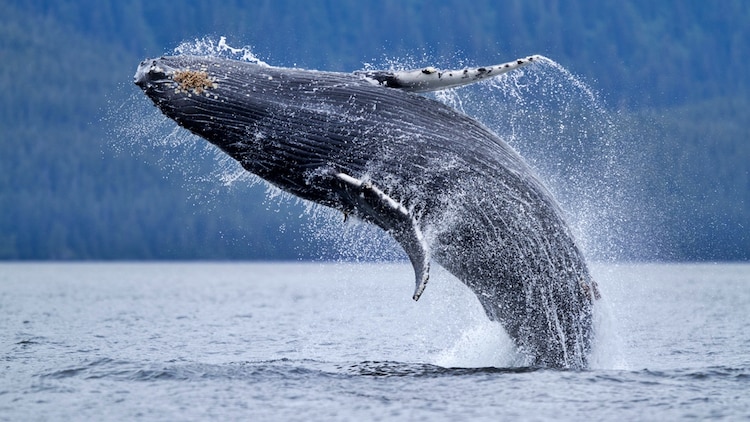
Two humpback whales complete incredible 14,500-km swim across the globe
Two humpback whales were identified travelling between Australia and Brazil in opposite directions. The rare crossings challenge assumptions about how separate whale populations are and how they may shift as oceans warm.
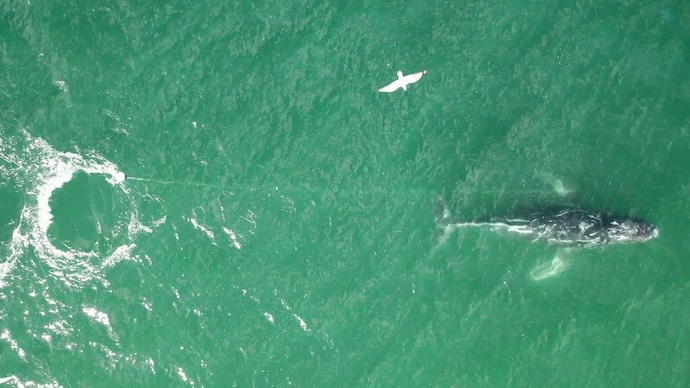
Grab taken from video footage provided by whale rescue group Organisation for the Rescue and Research of Cetaceans in Australia. (Image: AFP)

New Delhi,UPDATED: May 20, 2026 16:57 IST
Two humpback whales have stunned scientists after completing separate record-breaking journeys between Australia and Brazil, travelling more than 14,500 kilometres across the world’s oceans — the longest known movement ever recorded for the species.
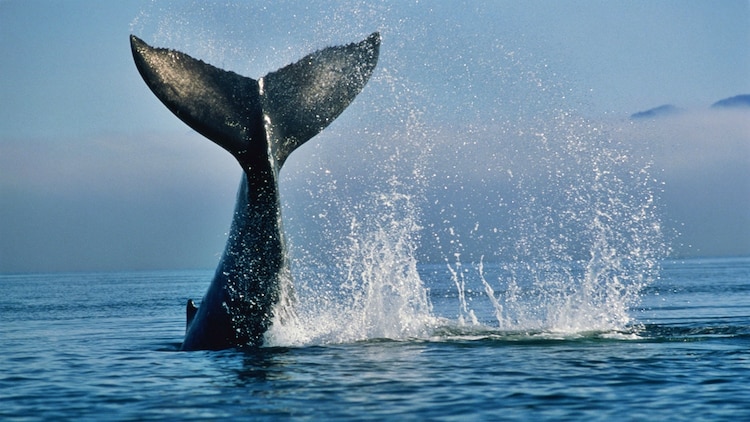
Researchers identified the whales using the unique markings on the underside of their tails, known as flukes, at breeding grounds in eastern Australia and Brazil. The two whales had travelled in opposite directions, demonstrating an extraordinary level of mobility previously undocumented in humpback whale populations.
The findings, published in the journal Royal Society Open Science, are reshaping what scientists know about whale migration and the connectivity between whale populations across oceans.
“It’s a very rare event, but it is a really wonderful demonstration of just how wide-ranging these animals are,” said Phillip Clapham, who was not involved in the study.
Humpback whales are among the most migratory animals on Earth. They usually follow well-established migration routes passed down from their mothers, travelling between cold feeding grounds rich in krill and fish and warmer tropical waters where they breed during winter.
Tracking these giant marine mammals, however, is notoriously difficult because they spend most of their lives underwater.
For the new study, scientists examined more than 19,000 whale photographs collected over four decades by researchers and citizen scientists worldwide. Using image-recognition software, they matched the distinctive colour patterns and jagged edges of whale tails to identify individual whales appearing in distant regions years apart.
One whale travelled just over 15,000 kilometres, surpassing previous long-distance records, including a humpback that once journeyed from Colombia to Zanzibar.
Researchers say they still do not know the precise routes taken by the whales because the sightings only captured the beginning and end points of their journeys. Unlike seasonal migrations between feeding and breeding grounds, whales are not generally known to move between entirely separate breeding populations.
Study co-author Stephanie Stack said the discoveries challenge long-standing assumptions about how isolated whale populations are from each other.
“Finding not one but two individuals that have crossed between Australia and Brazil challenges what we thought we knew about how separate these populations really are,” Stack said.
Scientists suspect the whales may have interacted at shared feeding grounds before diverting from their original migration routes.
The discovery also carries broader implications for understanding how whales may respond to climate change. As warming oceans alter the distribution of krill and other prey species, humpback whales could begin shifting feeding and breeding areas more dramatically than previously expected.
Researchers say advanced photo-identification techniques and global citizen-science databases are becoming increasingly important tools for monitoring these changes and tracking the movements of some of Earth’s most wide-ranging marine animals.
- Ends