
Great Conjunction 2026: Watch Jupiter and Venus pair in rare celestial moment
Venus and Jupiter are set to appear exceptionally close in the evening sky as they reach conjunction on June 9.
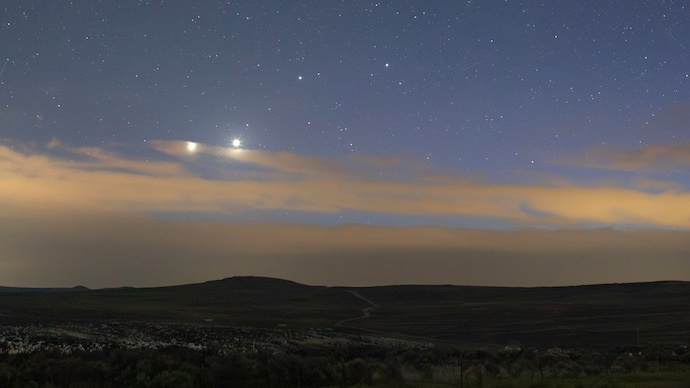

Venus and Jupiter aligned across the sky on Monday evening, creating a celestial spectacle for millions to watch.
But that's not where the event ends.
The celestial duo will be even closer on Tuesday, June 9, when Venus and Jupiter reach conjunction, appearing just 1.6 degrees apart in the sky.
The two planets sank towards the western horizon on Monday evening, and Austrian astrophotographer Michael Jaeger captured the sight of the Solar System's two brightest planets glowing side by side as they set, with a stream of Starlink satellites passing overhead.
"What a beautiful pair in the sky," Jaeger said. "Venus and Jupiter are the stars of the night as darkness falls."
The event will be visible across India shortly after sunset, if the weather permits.
HOW TO WATCH THE GREAT CONJUNCTION?
A conjunction occurs when two celestial objects appear close together in the sky from Earth's perspective.
Although Venus and Jupiter remain separated by hundreds of millions of kilometres in space, their current orbital positions make them appear almost side by side.
Venus is the brightest planet visible in the night sky, while Jupiter is the second brightest, making their close approach one of the most eye-catching astronomical events of the year.
To spot them, look low toward the western horizon soon after sunset. No telescope is required, though binoculars can improve the view.
The planets are expected to remain visible for roughly two hours before they set down the horizon.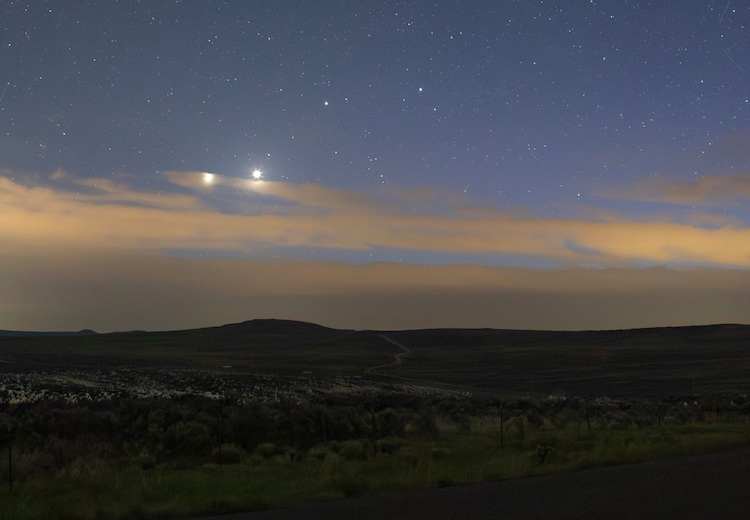
MORE CELESTIAL OCCASIONS COMING
The conjunction is only the beginning of a week-long sky show.
Over the next few evenings, Mercury and a slender crescent Moon will join Venus and Jupiter, creating a rare quartet in the twilight sky.
Such celestial alignments occur because the planets move along a common path across the sky known as the ecliptic.
While planetary conjunctions are fairly common, seeing multiple bright objects grouped together in one region of the sky is less frequent and often attracts the attention of skywatchers worldwide.
For observers in India, clear skies and an unobstructed western horizon will be all that's needed to enjoy one of the most beautiful naked-eye astronomy displays of 2026.