
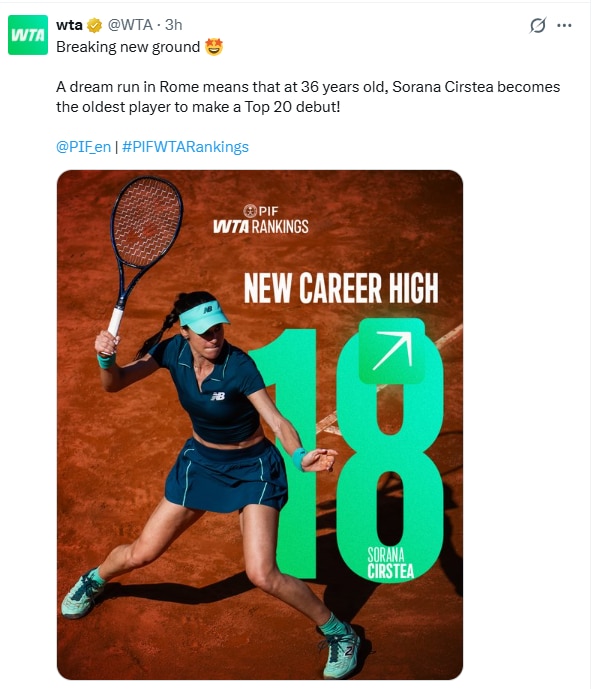
Sorana Cirstea breaks new ground in farewell season, becomes oldest top 20 debutant
Sorana Cirstea's farewell season saw a historic surge as she reached the Italian Open semi-finals and became the oldest debutant in the WTA Top 20 at 36. Her run included a win over world No. 1 Aryna Sabalenka before ending with a 6–4, 6–3 loss to Coco Gauff.
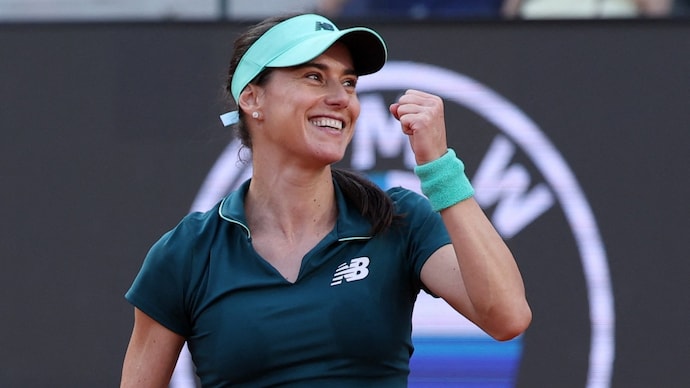
Sorana Cirstea is currently ranked No.18 in the world. Courtesy: Reuters

Sorana Cirstea’s farewell season has turned into one of the most remarkable late-career surges in modern tennis. The 36-year-old Romanian, who had already announced that 2026 would be her final year on tour, has rewritten history after her dream run at the Italian Open. Currently ranked No. 18 in the world, she became the oldest debutant in the WTA Top 20, a milestone that underlines the extraordinary longevity of her career.
Cirstea entered Rome outside the elite bracket but quickly emerged as the tournament’s standout story. Her run included a statement win over world No.1 Aryna Sabalenka in the third round, where she recovered after losing the opening set to complete a 2–6, 6–3, 7–5 comeback.
That victory not only marked her first career win over a top-ranked player but also ended Sabalenka’s strong run of consistency at WTA 1000 events. She followed it with composed straight-set wins over Linda Noskova and Jelena Ostapenko to reach the semi-finals.
Her remarkable campaign came to an end in the last four, where she was beaten by rising American star Coco Gauff, who won 6–4, 6–3.
SORANA CIRSTEA CONTINUES IMPRESSIVE RUN
Cirstea’s form in Rome was part of a broader farewell-season renaissance. Earlier in 2026, she had already captured a WTA title at the Winners Open in Romania and compiled one of her strongest win-loss records in recent seasons, showing that her decision to retire has not reduced her competitive level. Instead, it appears to have freed her to play with renewed clarity and aggression.
Against Ostapenko in the quarter-final, Cirstea produced one of her most complete performances of the tournament. She dominated the opening set 6–1 with aggressive baseline hitting and deep returns that consistently pushed her opponent behind the baseline. In the second set, when Ostapenko increased the tempo, Crstea absorbed the pressure well, holding firm in extended rallies before sealing a tense tiebreak 7-6(0) with composed execution under pressure.
Against Coco Gauff in the semi-final, Cirstea started strongly, using her forehand to dictate early rallies. However, Gauff’s movement and consistency shifted momentum. Forced into riskier shot-making, Crstea made key errors. Despite flashes of brilliance, she couldn’t sustain her level as Gauff closed out a straight-sets win.
- Ends