
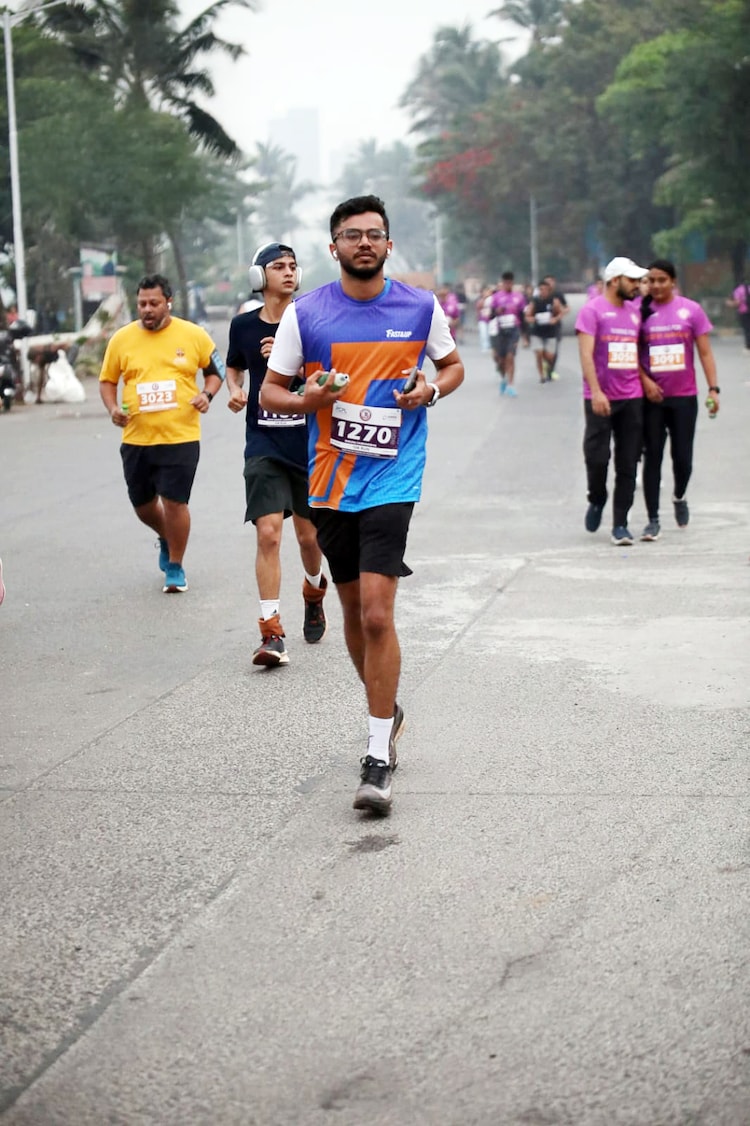
Why Indians are spending up to Rs 50,000 to run on JUST ONE DAY
Thousands of runners are spending heavily on travelling and participating in marathons in India like the TCS World 10K Bengaluru, and Wipro Bengaluru Marathon. Marathons have mushroomed and the number of participants has grown manifold. A simple sport like running has become a part of corporate India's fitness ritual.
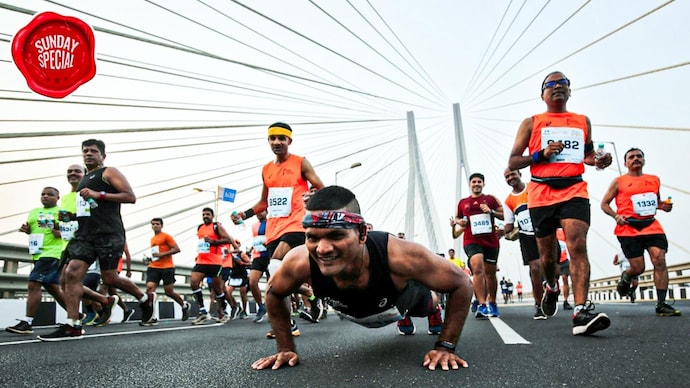
Participants of the Tata Mumbai Marathon on the Bandra-Worli Sea Link in Mumbai. (Image: Reuters)

New Delhi,UPDATED: Apr 26, 2026 07:07 IST
"When we laced up for a routine cross-country run at the National Defence Academy as Gentlemen Cadets, our Ustaad (drill instructor) once told us, 'running is a core part of your hunter-gatherer heritage. It's a survival instinct. You run well, you dominate on the battlefield. Faster [lap] this time!'," recounted a Lt Commander in the Indian Navy. When not sailing, he can be regularly seen on the tracks with resistance weights strapped to his chest in the cantonment in Vizag, where he's currently posted. He is addicted to running. It gives him a high.
So far, the Navy officer has participated in seven marathons in Mumbai, Delhi, Kolkata, and Bengaluru over the last seven years, often travelling solely for the runs. His profession demands that he stay at the top of his game at all times. But he is not alone. There are doctors' groups, techies' groups, and corporate circles that love taking part in marathons and fun runs (shorter events such as 5-km and 10-km races), and have turned it into a lifestyle.
When it comes to sports and exercises, running stands out. It is the most accessible of all. It demands almost nothing, except a decent pair of shoes. No court, no track, no arena, no nothing. You can begin with almost no formal training, unless you're chasing competition-level performance.
For a sporting activity this humble, paying Rs 40,000 to 50,000 for a few hours of running might seem absurd to many. But it is seemingly the new normal. We have published this article on a day when over 35,000 people hit the streets for the TCS World 10K Bengaluru. Many of them travelled from Mumbai and Delhi for the weekend, solely to participate in the event.
Runners India Today Digital spoke to spent about Rs 15,000 on last-minute round-trip flights, another Rs 15,000 per night at five-star hotels in south Bengaluru, and had already planned post-run beers at Toit or Arbor Brewing Co., bringing their total expenses to Rs 40,000-50,000 each. This was a group of five from Mumbai. However, their registration fee was waived because their company was one of the sponsors of the running event.
Organised by Tata Consultancy Services (TCS), it is one of India's largest running events. TCS alone sponsors 14 marathons and running events globally, including iconic races in New York, London, Boston, and Sydney. Other MNCs do so too. Wipro's Bengaluru Marathon, which is scheduled for September, offers full (42 km), half (21 km), 10K, and 5K categories.
Corporate social responsibility (CSR) is a key driver of such marathon sponsorships, which allows companies to promote a socially responsible brand image by promoting public health.
The economy around such running events is booming in India. India now hosts more than 1,500 annual running events, generating around Rs 4,000 crore ($450 million) in revenue, and attracting 25 lakh registered runners, according to a report in The Financial Express. The running gear market in India is also massive, valued at over Rs 23,500 crore ($2.5 billion) in 2025 and is projected to go beyond Rs 46,000 crore ($4.9 billion) by 2034, according to market research firm IMARC Group.
This economy is driven by the proliferation of marathon and running events, rising health awareness, and higher disposable incomes.
While companies like Abbott, Standard Chartered, Schneider Electric, and many other global MNCs sponsor marathons for a variety of reasons, including business gains, enhanced brand visibility, employee wellness, and positioning themselves as socially responsible organisations, participation in these runs by paying thousands of rupees is becoming a popular corporate and lifestyle trend in India.
No one's complaining about people trying to stay fit. But there's curiosity. Why would someone pay so much to run when it is free? While we did find some answers to our questions, others are perhaps best explained by the fact that in an era where even "Himalayan air" can be sold in canisters, running too, can be commodified.
A RUNNER'S PERSPECTIVE ON WHY HE PAYS THOUSAND OF RUPEES TO RUN ON A SINGLE DAY
Nikunj Sabharwal, 29, is preparing for the Ladakh Marathon set to be held in September this year. Today (on April 26, Sunday), he ran the TCS World 10K Bengaluru, just over three months after completing the Tata Mumbai Marathon (TMM) in January.
For the Bengaluru event, his total expenditure came to around Rs 45,000. Four of his friends from Mumbai travelled with him to participate. These days, Nikunj tries to run at as many events as possible because he loves the "high" it gives him.
Many runners often mention this "runner's high" — a surge of adrenaline and endorphins that brings a sense of euphoria of sorts, and mental clarity after a run.
For the Mumbai-based marketing executive, there is a lot of difference between solo running and running in an event with thousands of people.
"Whenever I go for runs, I go by myself," he says. "But in a marathon, when you're running with thousands of people, seeing a 60-year-old person running beside you at your pace, that pushes me. That makes me want to go faster."
He says this kind of motivation cannot be found during regular practice. "In the park or on the road, people run at a pace of their will. Also, you won't find such senior people practising alongside you. If you're not part of a running club, you're mostly running alone, and you don't see this kind of competition."
Sabharwal is clear about his spending philosophy. "I'm the kind of person who will spend a lot of money on things that excite me. If it's my hobby, I will spend."
For the TCS World 10K Bengaluru, he paid a hefty amount for his stay, but his colleagues opted for relatively cheaper hotels at Rs 5,000 to 6,000 a night.
When he ran the Mumbai marathon, it was free, as his company sponsored the Rs 3,500 registration fee.
He explains that most big-city marathons offer hotel packages that are largely sponsored. "The banner tie-ups with hotels are basically promotions. Brands get customers, runners get deals — it's a win-win, though sometimes the deal is good, and sometimes it isn't."
Sabharwal has also invested in proper gear.
After developing knee pain in his early 10-km races due to flat feet, a doctor advised him to stop using basketball shoes for running. He bought a pair of Nike Zoomfly running shoes for Rs 15,000–16,000. "After that, I started running faster. The shoes gave me a mental push," he says.
For Sabharwal, the community energy and deliberate spending makes the "absurd" expense feel completely worthwhile.
AN ENDURING MARATHONER'S PERSPECTIVE ON HOW RUNNING CULTURE HAS EVOLVED
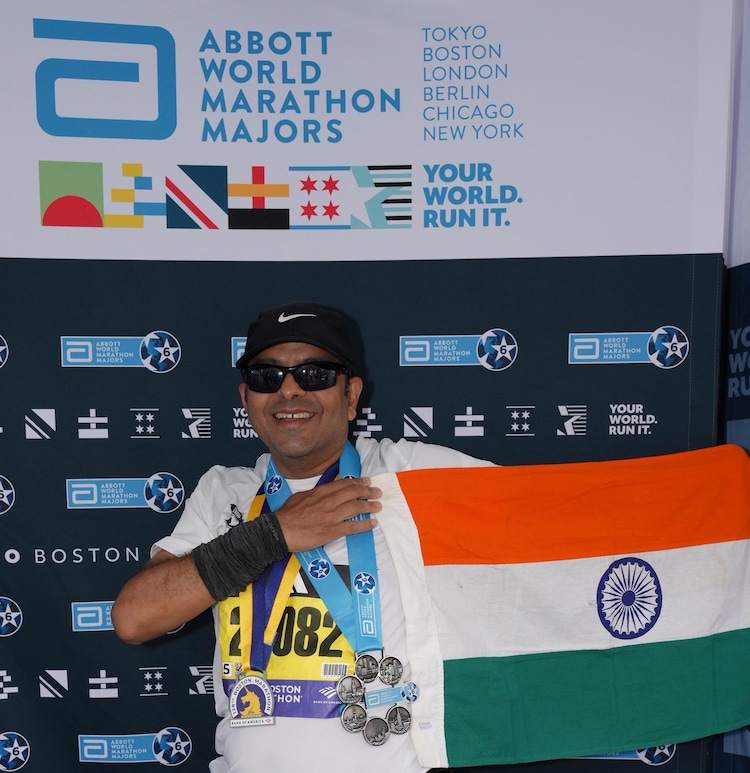
Basant Shroff has been pounding the pavement since 2013. A senior partner at one of the Big Four consulting firms, he has run enough races across enough cities and continents to comment on India's running culture transformation in real time.
"The frequency of running events has increased dramatically, and not just in top-tier cities," he says. "If you look at the calendar, the jump in the last five years is vast."
Short-distance running events have especially proliferated, with participation also surging dramatically. The Tata Mumbai Marathon, for instance, grew from around 47,000 runners in 2019 to over 65,000 in 2025, and over 69,000 in 2026.
Shroff noted that in the Indian running scene, the word "marathon" gets used loosely. A 5-km or a 10-km fun run and a gruelling 42-km race often share the same label—of a marathon. True full marathons are still very less in India.
Shroff noted that the shift in who is running is just as striking.
"When I started in 2013, I mostly saw people in their 30s and 40s. Now you see a lot of youngsters in their 20s actively taking up running." A sport once dominated by the middle-aged is drawing in a generation that runs as hard as it hustles.
For Shroff, the appeal has never been complicated.
"It's an easy sport. You just pack a pair of shoes, and wherever you travel for work, you can run and explore the city on your feet." No gym membership. No equipment.
But the running culture in India is anything but minimal today. A new trend of high spending has taken hold, and Shroff counts himself among its participants.
Shroff has completed all six World Marathon Majors — Tokyo, Boston, London, Berlin, Chicago, and New York. Now, in India, he's chasing the ProCam Slam, in Mumbai, Delhi, Kolkata, Bengaluru. Notably, ProCam Slam is a circuit that's become a bucket list for serious Indian runners.
"People are not just running," he says, explaining, "They are combining events with travel, spending time with friends and family, exploring new cities."
"To be honest, I am not surprised that people are spending just to travel from Mumbai to Bengaluru for a single race," he adds.
BEGINNERS ARE EXCITED ABOUT RUNNING TOO, BUT WOULDN'T SPEND Rs 50,000 IMMEDIATELY
Sanjana J Satish, a Bengaluru-based lawyer and relatively new runner, decided to step up from her regular workouts and participate in the TCS World 10K.
"I have always enjoyed running. It gives me a chance to clear my head," she says. "It is also a way to get my cardio in after a week of just strength training."
For Satish, the decision to participate in the TCS run was made easier because her office sponsored the entry. "I signed up through my office. The registration fee was Rs 2,250. We're running for a charity called ProvisionAsia."
Unlike many who have spent tens of thousands to run, Satish's investment for today's run was minimal. She only bought a new pair of running shoes.
For today's run, she practised once a week for the last few months, gradually increasing from 4–5 km to 7–10 km runs.
"I run mainly for mental and physical fitness," she explains. "A good run relaxes me. The baggage of the week kind of melts away, even for an hour."
Unlike many corporate runners, Satish has no interest in networking or chasing faster timings. "As much as I enjoy running, I hate runners. Annoying bunch," she says. "I run for the heck of it. Not to improve pace or anything."
When asked if she would travel to another city for a similar event, her answer was, "I would love to, but with a 9-to-5 job and other responsibilities, even the cost makes it unlikely. A big-time marathon would be worth the investment, I think. But for a 5-10 km, I don't think it is."

RUNNING, A PRIMAL INSTINCT, HAS NOW BECOME PART OF CORPORATE CULTURE
Running is both deeply primal and strangely romantic. In Greek mythology, it embodied heroic excellence.
In Homer's Iliad, Achilles was known as the "swift-footed", a title that captured the very essence of his prowess. In the Odyssey, athletic running and footraces served as a measure of Odysseus's nobility, his enduring spirit.
Runners have for long described the sport very poetically. Legendary American track and field athlete Jesse Owens, who won four gold medals at the 1936 Berlin Olympics, once said, "I always loved running, it was something you could do by yourself, and under your own power. You could go in any direction, fast or slow as you wanted, fighting the wind if you felt like it, seeking out new sights just on the strength of your feet and the courage of your lungs."
From running being a primal survival instinct in our evolutionary biology, to its celebration in ancient mythology, to its romanticisation by legendary athletes, and even its portrayal in modern pop culture — from DC and Marvel's Flash and Quicksilver to the iconic line from Hollywood, "Run, Forrest, Run!" — running is now embedded in corporate India's lifestyle and culture.
No matter if you're a great runner or a lousy one, you still keep at it.
- Ends