
Canon calls India an R&D eye-opener, its engineers are flying to Indian cities to learn how to use their own machines
For Canon, India isn't just a market. It is an eye-opener that is keeping a 90-year-old rebel brand young, curious, and perpetually innovative.
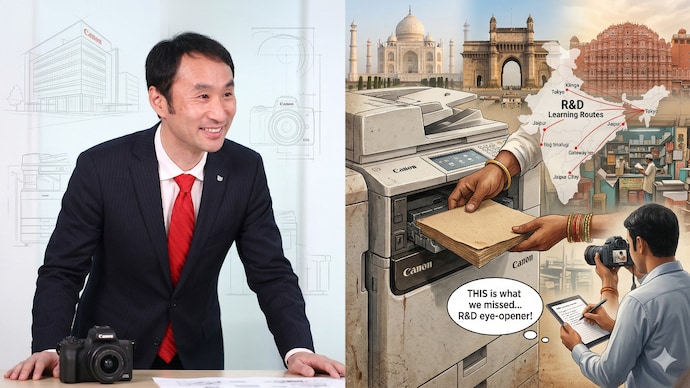

Canon needs little introduction. The brand has been synonymous with cameras since 1937. Its “solutions” are virtually everywhere, on Earth as well as in space. Yet, there is so much we do not know about it. Like, for instance, did you know that real innovation at Canon isn’t happening inside its high-tech R&D labs alone, it is also happening in the bustling copy shops of small-town India and the vibrant chaos of the Indian wedding circuit.
According to Toshiaki Nomura, President and CEO of Canon India, the country’s demands are so unique and its users so resourceful that Japanese engineers are now flying into Indian cities to see their own machines in a new light. And in that light, they learn how their hardware lives, breathes, and sometimes exceeds its own specifications. This, Nomura says, is eye-opening. But unlike other brands, including its top competition, Canon uses this pragmatic experience to get better, deploying the big takeaways into products that it hopes will eventually delight one and all, even in global markets.
From cameras to cosmic ambitions
Canon’s journey is a long one, spanning nearly nine decades. While most consumers still associate the red logo primarily with the camera they use(d) at a family function, the company’s internal evolution has been far more radical. Nomura reflects on this legacy with a sense of pride in its diversification.
"We started in the camera business back in 1937, so we have almost 90 years of history," Nomura says. "Over time, we diversified. We used to make calculators and typewriters, but today our core business is mainly imaging – which includes cameras – and printing, which is our largest portfolio."
This portfolio now stretches into territories that would surprise the average shutterbug. Canon is currently a vital cog in the world’s most advanced industries, including medical diagnostics and semiconductor manufacturing. "Medical products are a major business pillar for us now. We have a diverse range of digital imaging diagnostic products, such as CT scans, ultrasounds, and X-rays," he explains.
Perhaps most striking is Canon's role in the silicon dream. As India pushes to become a global hub for semiconductor manufacturing, Canon is providing the backbone. "We have our industrial products, specifically equipment used to produce semiconductor chips. While we are not a semiconductor manufacturer ourselves, we provide the equipment necessary to make them," Nomura notes. And the frontier doesn't end on Earth. Canon has recently stepped into the space industry, looking at miniature satellites, a sector that relies heavily on the company’s core expertise in optics and sensors.
The "India effect" on global R&D
Canon has built a strategic bridge between Indian ground reality and Japanese engineering. It is a common trope for global CEOs to talk about localising for India, but Nomura describes a reverse-flow of innovation that is genuinely rare.
"Our R&D engineers from Japan often come to India to see real-world usage scenarios, and it is an eye-opening experience for them," Nomura reveals. "They are often surprised to see how our machines are being used in ways they hadn't imagined. Indian customers know how to maximise the potential of our devices for their day-to-day needs.”
There are concrete examples where an Indian “hack” became a global product feature. Nomura cites a specific case study involving local copy shops. "One good example involves copy shops using 'coated thick media,' which initially our smaller devices didn't support," he says. "We realised there was a high demand for it in India for things like book covers. Our R&D team made modifications and brought a compatible version to market. Sales grew 10 to 30 times over. We then replicated that success in other countries, like Indonesia."
This bottom-up innovation cycle is transforming Canon’s global approach. By observing how a small-town entrepreneur in India pushes a machine to its limits, Canon is discovering hidden capabilities in its own hardware.
Managing the Indian market is often described as managing a continent rather than a country. For Nomura, the complexity of India’s states is one of its greatest strengths. "Business varies significantly region by region and state by state. It isn't like managing one country; it feels more like 28 different countries in our portfolio," he remarks.
The imaging business in India is famously driven by the wedding industry, which Nomura estimates accounts for roughly 60 percent of the imaging revenue. Moreover, the rise of OTT platforms, film-making, and the professionalisation of content creation has opened new doors.
"We see massive opportunities in imaging. There are newer opportunities in B2B areas like OTT, filmmaking, and broadcasting," Nomura says. He also addresses the elephant in the room: the smartphone. While some see the mobile phone as stifling competition, Nomura views it as complimentary. "Some see smartphones as a threat to imaging companies, but we see them as complementary. They invite more people to become comfortable with photography and videography. Eventually, those users want higher image quality, and that is where our products come into the picture."
The silent partner
In 2026, AI is the word on everyone’s lips, but Canon’s approach is notably understated. While others might slap an AI sticker on every box, Canon is focusing on what the technology actually does for the user.
"We incorporate a lot of AI technology into our products without necessarily speaking about it," Nomura says. In cameras, AI is used for deep learning-based object tracking, ensuring a subject stays in focus even if temporarily obstructed. In printers, AI is used for "proactive maintenance."
"We use AI to analyse machine behaviour and customer usage," Nomura explains. "This allows for proactive maintenance: predicting when a part will wear out so we can replace it before it breaks. This reduces downtime for the customer."
Behind the technical jargon and market share data (where Canon holds a commanding 30 percent in India and a 23-year streak as global No.1), lies a deeply rooted Japanese philosophy: Kyosei.
"Our corporate philosophy is Kyosei. It is a Japanese word meaning 'living and working together for the common good.' That is our DNA to run the business," Nomura explains. "We don’t chase short-term gains, we prioritise how we can contribute to society and build win-win situations for all stakeholders."
This philosophy manifests in their approach to the value-conscious Indian consumer. Nomura acknowledges that while India is price-sensitive, it is not cheap. "Indian people are not just looking for a cheap product. They are looking for value for money: reliability and consistency without compromise," he says. Balancing this need for affordability with rising global component costs is a challenge, but Nomura is committed to absorbing costs where possible to match customer expectations.
You cannot survive 30 years in India without robust after-sales support. Nomura is clear that a sale is just the beginning of the journey. In a market as geographically vast as India, service is as critical, if not more.
"Selling the product is only part of the journey, we have to take care of the customer throughout the entire life cycle," Nomura says. Canon has built an ecosystem that covers almost every pin code in the country, boasting over 600 authorised service centres.
But beyond the numbers, there is a sense that the relationship between Canon and India has matured into one of equals. India is no longer just a destination for Japanese products, it is the place where those products are tested, reimagined, and perfected. When Japanese engineers fly back to Tokyo, they carry with them more than just feedback. They carry a new perspective on what is possible. India isn't just a market. It is an eye-opener that is keeping a 90-year-old rebel brand young, curious, and perpetually innovative.