
Amazon's AWS openly criticises AI coding hype, says it can slow teams down
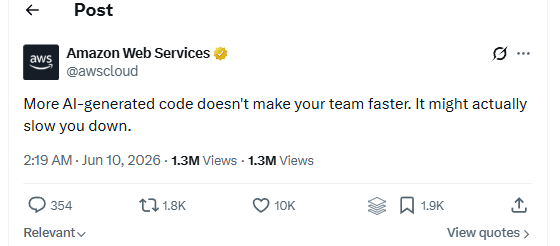
AWS has surprised social media users by arguing that more AI-generated code does not automatically make developers more productive and can sometimes slow teams down. The viral post comes as parent company Amazon continues to push AI adoption internally and invest heavily in AI infrastructure.

Amazon's AWS openly criticises AI coding hype, says it can slow teams down. (Image generated using AI for representational purposes)

New Delhi,UPDATED: Jun 10, 2026 16:49 IST
Amazon's cloud division AWS has left social media users puzzled after posting a tweet that appears to challenge one of the biggest promises of the AI era. In a post on X, AWS said that producing more code with AI does not automatically make software teams faster and could even slow them down. The statement quickly went viral, crossing 1.2 million views and triggering a wave of reactions. Many users were surprised to see the message coming from AWS, considering parent company Amazon is spending billions of dollars on AI and actively encouraging wider AI adoption across its workforce.
"Is this tweet from an intern?" one user asked, while another joked that someone at AWS might be "losing their job today." One of the most-liked reactions came from a user who said they had to check multiple times to make sure the post was actually published by AWS and not a fake account.
The company argued that writing code has never been the biggest challenge in software development. Instead, the harder part is getting software released, fixing bugs, and ensuring systems continue to run smoothly after deployment.
"The real bottleneck was never writing code. It's releasing it, debugging it, & keeping it running well," the AWS post said.
To support its point, AWS referred to comments from Honeycomb CTO Charity Majors, who discussed how her team approached AI adoption. Rather than chasing ambitious productivity targets often associated with AI tools, she reportedly aimed for a more realistic improvement.
AWS said Majors did not pursue a "10x" productivity goal and instead focused on achieving a 2x improvement while maintaining quality standards. According to the post, her team also created a set of principles around AI use instead of forcing employees to use the technology. One of those principles was, "Every AI output has to have a human owner. If you don't want your name on it, it's probably not good work." The post ended with a simple reminder: "Quality first, quantity second."
Amazon forcing employees to use AI, says this won't be counted in performance reviews
The comments are notable because they come at a time when Amazon itself has been aggressively pushing AI adoption across its business. Reports in recent months have suggested that employees inside Amazon are facing growing pressure to use the company's internal AI tools as the tech giant invests billions of dollars into AI infrastructure.
According to a Financial Times report published in May, Amazon has expanded the use of an internal AI platform called MeshClaw. The tool allows employees to build AI agents that can interact with workplace software and automate routine tasks such as code deployments, email management, and workplace application workflows.
The report also claimed that Amazon introduced targets requiring more than 80 per cent of developers to use AI tools every week. Employees told the publication that AI usage was being tracked internally through token consumption metrics, creating pressure to increase usage even when the technology was not always necessary.
Some employees reportedly said workers were using AI tools for additional non-essential tasks simply to increase their usage numbers. Others raised concerns about the security implications of giving AI agents broad access to workplace systems and accounts.
Amazon has maintained that AI usage statistics are not used in employee performance reviews and has said its AI tools help workers automate repetitive tasks. The company has also stated that it remains committed to the safe and responsible deployment of generative AI technologies.
- Ends