
Sridhar Vembu says AI is giving no gains, tech companies are firing workers for no real reason
Weeks before top AI leaders started softening their warnings around job losses, Zoho founder Sridhar Vembu was already questioning whether AI was truly delivering real productivity gains. He also suggested companies may be using AI to cut labour cost and impress investors.

Zoho founder Sridhar Vembu

New Delhi,UPDATED: May 27, 2026 17:23 IST
For nearly two years, the global tech industry pushed a strong narrative around AI that it would massively improve productivity, automate white-collar work and eventually replace millions of human jobs. Companies invested billions into AI infrastructure, investors poured money into startups, and executives repeatedly warned employees to prepare for disruption. But while many tech leaders are only now starting to soften those claims, Sridhar Vembu appears to have been questioning the AI story weeks earlier.
Over the past few weeks, the Zoho founder has repeatedly criticised the current AI hype cycle on X, arguing that actual productivity gains remain limited and that companies are using AI as a convenient explanation for layoffs that are really tied to economic pressure and investor expectations.
His comments are now drawing more attention online because several major tech leaders, including Sam Altman, Jeff Bezos and Jensen Huang, have recently started changing their tone around AI replacing jobs.
Vembu questioned AI layoffs
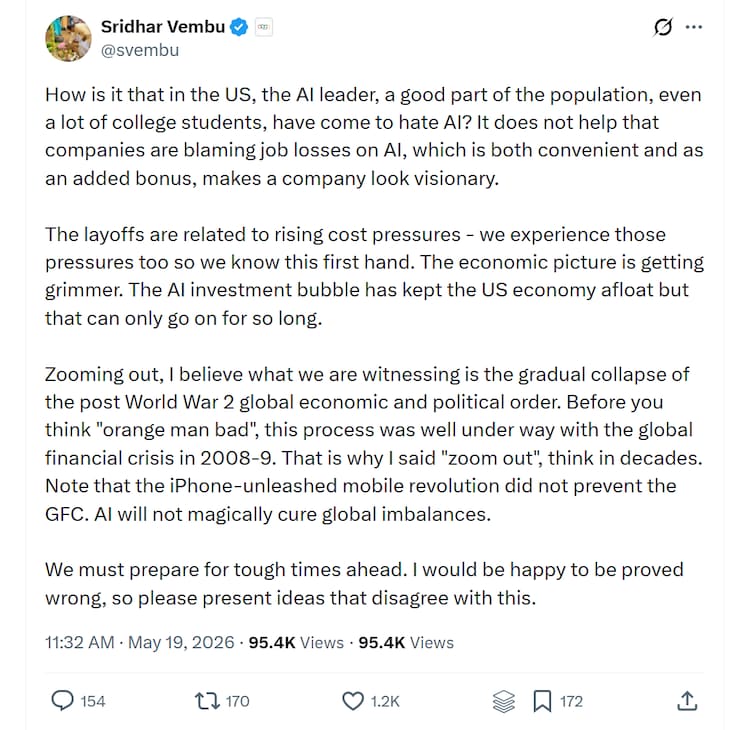
One of Vembu's strongest comments came on May 19, where he openly questioned why large parts of the American public, including college students, have started developing negative feelings toward AI despite the technology being promoted as revolutionary. According to Vembu, companies are wrongly linking layoffs with AI progress.
"It does not help that companies are blaming job losses on AI, which is both convenient and as an added bonus, makes a company look visionary," he wrote on X.
Vembu argued that layoffs are more closely connected to rising costs and economic pressure rather than AI suddenly becoming capable enough to replace workers at scale. "The layoffs are related to rising cost pressures," he added.
Earlier today, he also warned that the economic picture globally is becoming weaker and that AI alone cannot solve those deeper problems.
“The AI investment bubble has kept the US economy afloat but that can only go on for so long,” Vembu said.
In the same post, he argued that previous technological revolutions also failed to prevent economic crises, pointing to the global financial crisis of 2008 despite the smartphone boom created by the iPhone era.
"AI will not magically cure global imbalances," he wrote.
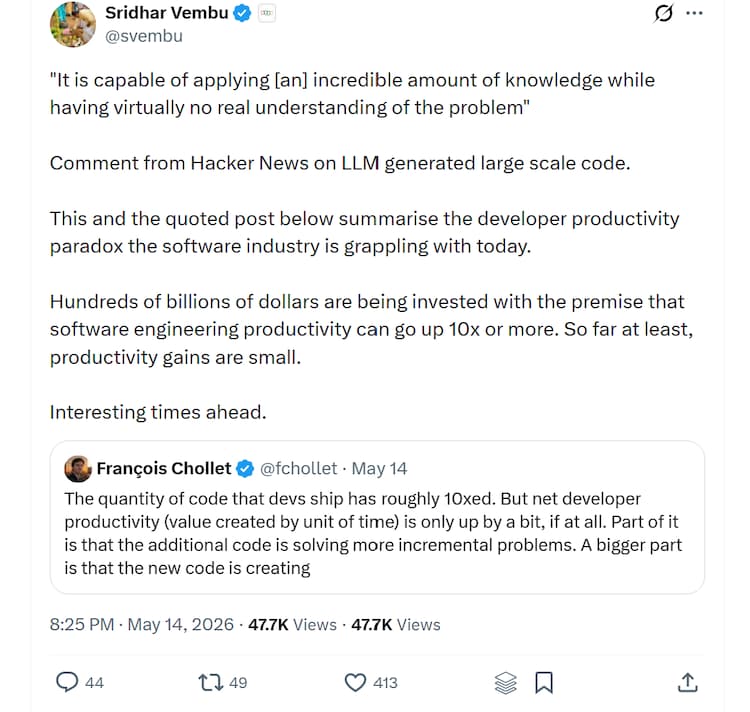
Vembu also questioned one of the biggest assumptions driving the artificial intelligence race, that AI tools will dramatically increase software engineering productivity.
In another post shared on May 14, he referred to what he called a “developer productivity paradox.” Discussing AI-generated coding tools based on large language models, Vembu suggested that companies are investing hundreds of billions of dollars, believing productivity could rise 10 times or more, but reality is looking very different so far.
His comments are gaining attention because the narrative around AI has largely focused on efficiency, automation and workforce reduction, but no one was talking about the outcome AI has been giving. In fact, companies like Amazon across the world have continued investing aggressively in AI infrastructure while also reducing staff numbers.
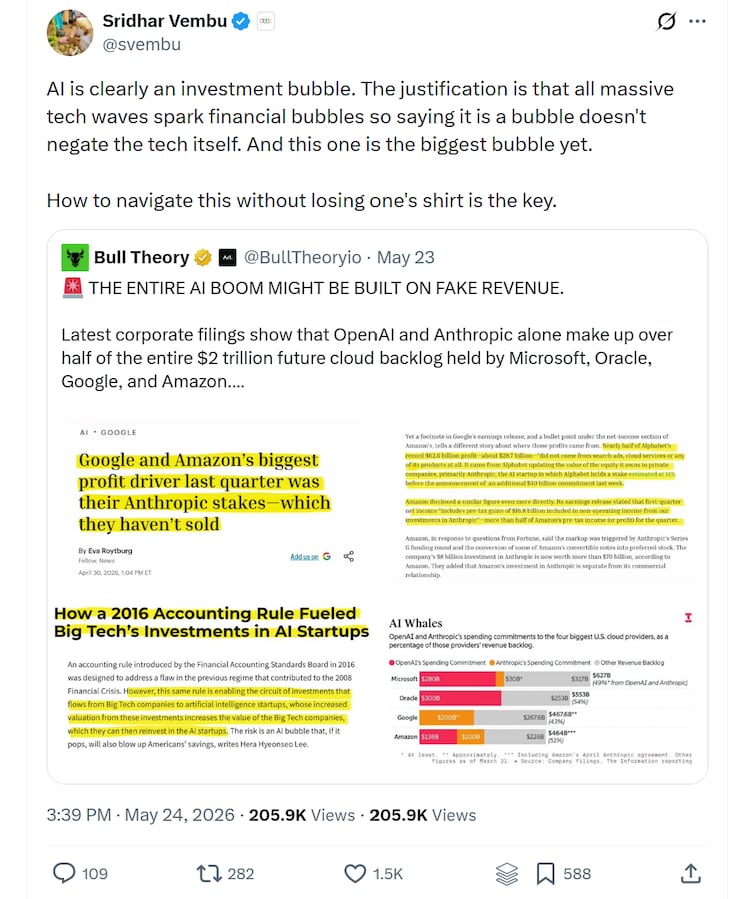
In another recent post, Vembu directly called the current AI boom an "investment bubble." According to him, large technology revolutions often create financial bubbles, but this one may be the biggest yet. His comment came while responding to a viral X thread that accused major tech companies and AI startups of creating circular financial loops involving cloud spending and investments.
The thread claimed companies such as Microsoft, Amazon, Google and Oracle are heavily investing in AI startups like OpenAI and Anthropic, while also earning huge cloud business revenue from those same startups using their infrastructure. The post argued that this cycle is helping inflate growth numbers and investor confidence even though many AI businesses are still struggling to generate sustainable profits. While those claims remain debated online, Vembu's response suggested he believes the AI economy is being driven more by investment momentum than real productivity gains.
Tune on AI and jobs is changing
What makes Vembu’s comments more notable now is that some of the same tech leaders who previously warned about massive AI-driven job losses have recently started stepping back from those claims. For instance, Sam Altman has just admitted that his earlier fears around AI replacing entry-level white-collar jobs have not become reality as quickly as expected. Speaking virtually at a conference hosted by Commonwealth Bank of Australia in Sydney, Altman said he had expected more jobs to disappear by now after the rise of ChatGPT.
"I’m delighted to be wrong about this," Altman said.
According to him, society still values human interaction much more than many people in the tech industry originally assumed. "I don’t think we’re going to have the kind of jobs apocalypse that some of the companies in our space advocate or talk about," he added.
Similarly, Jeff Bezos recently argued that AI will mostly improve worker productivity instead of completely replacing humans. Speaking to CNBC, Bezos said AI can automate some tasks, but humans will still be needed for creativity, decision-making and problem-solving.
"It’s going to be done with a bulldozer instead of a shovel," Bezos said while describing AI-assisted work. Meanwhile, Jensen Huang directly criticised executives who blame AI for layoffs.
"I think the narrative that connects AI to job loss for many of the CEOs that are doing it, it is just too lazy," Huang said in an interview with Singapore broadcaster CNA. According to Huang, some companies may simply be using AI-related language to justify restructuring or cost-cutting decisions.
- Ends