
Rubio's Taj Mahal photo sparks Iran jibe on US grasp of ancient civilisations
Marco Rubio posed at the Taj Mahal and got a history lesson from Iran. Trump stood next to trees in China older than the United States. Washington keeps threatening civilisations it clearly never studied.
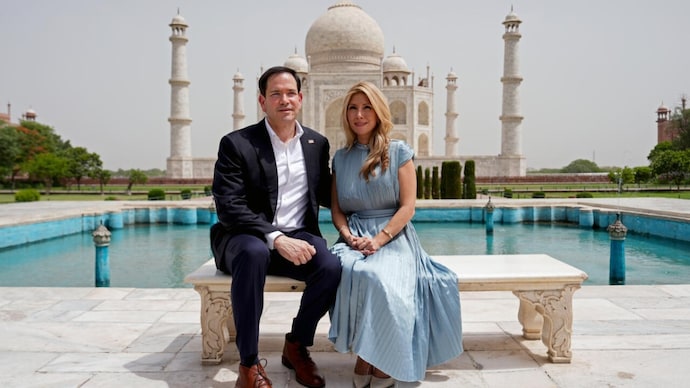

Marco Rubio walked up to the Taj Mahal, took a photograph, posted it, and got cooked by Iran on the internet. Not with missiles. Not with sanctions. With a sentence. Tehran pointed out, politely but devastatingly, that the Taj Mahal was built for a Persian queen. A woman of Persian descent, Persian culture, Persian identity, all of it carved into Indian marble. The man who flies around issuing threats against ancient civilisations had just posed for a tourist photo inside one of their greatest monuments without knowing it.
Iran did not raise its voice. It just pointed. And that, precisely, is the difference between a country with 3,000 years of memory and one that still calls a 250-year-old building historic. The question this moment raises is not a small one. Does Washington actually know who it is talking to? The answer, increasingly, appears to be no.
Rubio and the broader Washington establishment have made a habit of threatening Iran with extinction. Literal extinction. "End of civilisation" language, deployed with confidence, as though the target is something fragile and new. But Persia predates Rome. It predates Greece as a unified culture. It survived Alexander, survived the Mongols, survived occupation and bombing and decades of sanctions, and it remains. The language is intact. The poetry is intact. The identity is intact.
When Washington tells Tehran it faces the end of its civilisation, Tehran hears something specific. It hears a country that never read a history book threatening a country that wrote them. The same pattern plays out with China, just with different scenery.
Washington's strategy is straightforward enough on paper. Cut off the supply chains, isolate the economy, apply pressure until something breaks. It is the kind of approach that works against a fragile new state. It is not the kind of approach that works against a 4,000-year-old civilisation with its own philosophical traditions, its own systems of governance, and its own very long memory of watching outside powers come and go.
During a recent visit to China, Trump came across trees older than the United States of America. Just trees, standing there, having outlasted every empire that ever threatened the country they grew in. The symbolism is almost too convenient, but it is real. The country Washington wants to isolate has trees that predate the American republic. The river does not care about the dam.
This is the strategic mistake Washington repeats. It treats Iran and China as modern rivals, as competitors in the same market who can be outmanoeuvred and pressured into submission. But neither country thinks in election cycles. They think in centuries. They have watched far more powerful empires arrive, threaten, and collapse while they remained.
The Mongols conquered China. China absorbed the Mongols. Alexander reached Persia. Persia outlasted his entire empire by two millennia.
That is not ancient trivia. That is the context in which every American threat lands, and it lands badly.
Rubio's Taj Mahal photograph was not just an embarrassing moment on social media. It was a metaphor for the entire posture. America walked into a monument built by the civilisation it threatens, took a selfie, and called it diplomacy.
You cannot end something that was old when you were nothing.