
After 2.5 lakh people lost their jobs, Sam Altman and others now stop hyping AI
Sam Altman and Dario Amodei have begun retreating from their earlier warnings that AI would wipe out white-collar jobs. The shift comes after more than 2.5 lakh tech layoffs and amid signs that AI is costlier to deploy than expected.
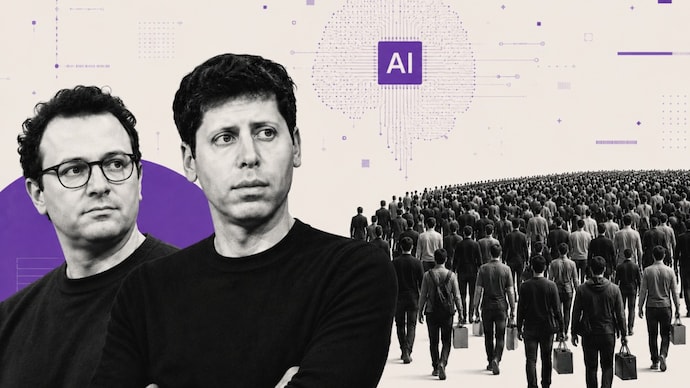

For the better part of the last year, the script for the future of work was written in the language of an impending apocalypse. Silicon Valley prophets took turns on conference stages and podcasts to deliver a stark warning that AI would soon gut the white-collar workforce. All of it. Nobody was safe, apparently because AI was supposed to do everything, better than a human could, without tiring and with efficiency that humans could never match.
But where employees saw a threat to their livelihood, organisations saw opportunity for their bottomline. They too heard the warnings, delivered by OpenAI boss Sam Altman, Anthropic boss Dario Amodei and other tech leaders as a way to brag about the supposed potency of their AI tools. And when they heard these warnings, they acted. They believed that AI can indeed replace employees. They slashed their workforce, to cut costs or to go all-in on AI.
Now in 2026 that chorus of doom is slowly fading. Instead, it is now converging on a line that says AI and humans can coexist in a workplace. Two of the most influential AI gurus, Altman and Amodei, are virtually admitting their early intuitions were wrong. The grand proclamations on jobs are being replaced by a complex, messy reality where human workers remain necessary. The technology itself is proving far more expensive to deploy than anyone anticipated.
Altman, for example, on multiple occasions painted a doom and gloom scenario in 2025. This in turn sent the signal to organisations that AI was good enough to replace human employees. In June 2025, Altman issued specific warning that entry-level roles were at serious risk of immediate elimination.
Yet, during an interview at a Commonwealth Bank of Australia conference in Sydney this week, Altman completely flipped the script. He told the audience that he no longer believes the world is headed for a jobs apocalypse. “I’m delighted to be wrong about this,” Altman said. “I thought there would have been more impact on entry-level white-collar jobs being eliminated by now than has actually happened.”
He noted that he now understands more about why job apocalypse hasn't occurred, acknowledging that this was an area where his professional intuitions were simply off. “We really do care about our interactions with people,” Altman said. “This updated me to thinking that the jobs picture is likely to be very different than we thought.”
This came just weeks after he termed CEOs “tone-deaf” for replacing employees with AI tools, while casually side-stepping the idea that these CEOs were fired up in their zeal by the promises and tall claims that AI gurus like Altman made in 2024 and 2025.
“I know some AI CEOs are saying things like 50 per cent of the jobs are gonna go away. To say nothing of how tone deaf it is for someone to be saying my company's gonna eliminate 50 per cent of the jobs I don't think that's the right way to think about it,” he had said in the first week of May.
This week in Australia he acknowledged the change in his stance “People are like, oh you could have saved the world a lot of fear mongering and a lot of doom and gloom but at the time I was like, I see this is a real risk we should probably talk about it, and it still may,” Altman said, adding, he was “obviously grateful” he was proven wrong.
Anthropic chief executive Dario Amodei too has been one of the most ardent job doomsayers, claiming in 2025 that up to half of all entry-level white-collar jobs would be wiped out within five years, potentially driving global unemployment up to 10 or 20 percent.
Turns out, AI may be too expensive, in some cases, even more expensive than human workers. Therefore, the business case for replacing human workers with AI is beginning to fall apart already.
Amodei too is slowly inching towards a way where it is more of AI and human collaboration instead of AI replacing humans. “Even if you're only doing five per cent of the task, that five per cent gets super-amplified the AI does the other 95 per cent, and you become far more productive,” Amodei said a few months ago.
It seems that change is in the air when it comes to AI and jobs. Sadly, it is taking place after a brutal one and a half year that has already impacted a large number of people, spreading anxiety and misery that job losses tend to bring.
Tech layoffs through May 2026 have breached the 1,15,000 threshold, rapidly closing in on the 1,24,000 total cuts recorded across the entirety of 2025. Meta, Amazon, and Snap have explicitly pointed to AI restructuring as a primary driver of these headcount reductions. Challenger, Gray & Christmas, a company that offers career assistance to laid-off employees, tracked nearly 50,000 job cuts through April of this year, where AI was cited as a core justification.
Now as Altman and Dario walk back a little, though it is not yet clear if their latest views are based on genuine insight or just an attempt to control anger that people have towards AI, people are trying to point out their hypocrisy. That is because, in large part, the AI-driven layoffs have been fuelled by the AI cheerleading that tech leaders have indulged in.
Reacting to Altman’s comments, full-stack developer Joseph N Aburu, wrote on X: “Sam Altman saying AI won’t destroy jobs feels a bit convenient coming from the guy leading the charge on it. We’ll see how this one actually plays out.”
Evan Kirstel, a tech influencer, mused that it was all for show. He wrote: “Altman 2024: AI will eliminate entire classes of white-collar jobs. Altman this week: Delighted to be wrong. Amodei made the same pivot. Both weeks from trillion-dollar IPOs. Doom sold compute contracts. Optimism sells equity to retail.”
Coming on the heels of reports that highlight how AI is proving to be more expensive than humans it is replacing, the comments from Amodei and Altman are sure to muddle the pool further.
AI has made the future of work and workplaces uncertain and that is not going to change anytime soon. But an equally big problem is the lack of clarity from people who are in the driver’s seat. Because the rest of the world is taking their cues from what these people say. But if what they say in 2026 is different from what they said in 2025, it creates confusion. At least for over 2.5 lakh tech employees who have been laid off in the last 17-odd months this confusion has already created a lot of pain.