
 Handcrafted ByOur Editors
 Microsoft and others rethink AI use, cost rising fast and no productivity gains
AI was supposed to save money. But as AI meets messy realities of work, tech companies are curbing their enthusiasm. Microsoft is now going easy on Claude due to its cost, while Uber has in just 5 months exhausted its entire AI budget for 2026.

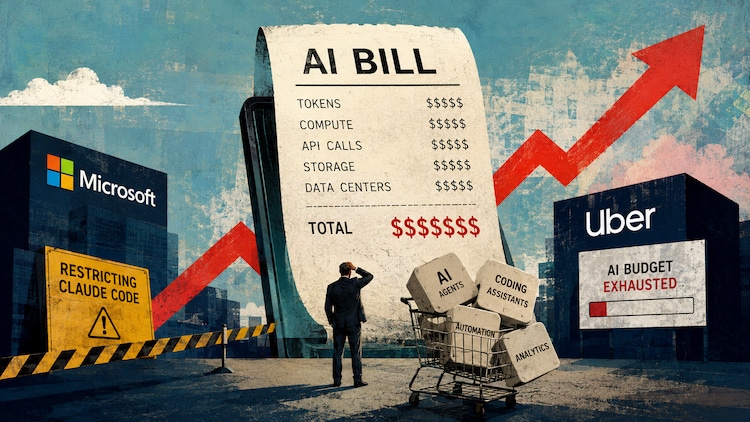
The promise that AI would cut operational costs is running into a big reality check. (Image created using AI by Divya Bhati)

New Delhi,UPDATED: May 26, 2026 15:46 IST
The promise of AI in 2025 was simple: adopt it and you will save on operational cost. This would be due to two reasons. One, AI will cost less than what a company has to pay to a human employee. And two, AI will boost productivity by 10X or something like that.
The reality of AI in 2026 is simple. Instead of productivity going up by 10X it is the cost of AI that has risen up sharply. Some industry insiders have even started suggesting that it is cheaper to pay for a competent human employee instead of deploying Claude. The cost question around AI has become so stark that even companies like Microsoft and Uber are finding it difficult to justify their AI expenses.
Last week a few reports highlighted the supposed misalignment in AI benefits and costs that companies have started to notice. At Microsoft, the management has asked thousands of engineers to stop using Claude Code and instead move to an internal AI tool. The deadline to do so is June 30. While the company has not publicly commented on the reason why just months after pushing Claude Code on its employees it is moving away from the Anthropic tool, reports suggest it is because of the money employees are burning on Claude tokens, the expense that is not, at least for now, visible in productivity gains.
India Today Tech has reached out to Microsoft for a comment and we will update the copy when we get one.
At the same time, there is the case of Uber. The company allocated a certain amount of money towards AI expenses. It then rolled out access to Claude Code for its 5000 engineers in January. A few weeks ago its CTO Praveen Naga said Uber had exhausted its entire annual AI budget in just 5 months.
This was reconfirmed by Uber COO Andrew Macdonald on Monday. Highlighting that AI use has not resulted in any productivity gain so far, Andrew said in the Rapid Response podcast: “We’re going to have to start talking about token consumption and the associated costs versus headcount. If you’re not actually able to draw a direct line to how much useful functionality you’re shipping to your users, that trade becomes harder to justify.”
The information coming from inside Microsoft and Uber is forcing many in the industry to take a note. Former Infosys boss Vishal Sikka, who has his own AI startup now, commented on X. He said “token costs are becoming a real issue” and that in future there will be “more scrutiny of AI usage.”
Until now, companies were hoping to take the magic pill called AI and trim their costs, just like Ozempic was doing for people trying to lose weight. But 2026 is giving a rude shock to them. It is showing productivity gains are not there yet even though AI cost is rising sharply.
“Budget blowouts at Microsoft and Uber signal a shift,” Kaustubh Kashyap, founder and CEO of AI startup Fexo GenAI, tells India Today Tech. “AI experimentation ends, reality sets in. The honeymoon ends and now ROI has to be part of the evaluation.”
Honeymoon ended by tokens
As more and more companies wake up to the cost of AI and the prices that tools like Claude, Gemini and ChatGPT charge, there is one word they will hear again and again. This word is Token.
As we explained in our definitive AI dictionary and terminology, tokens is the unit in which AI tools measure input and output. It is like an electricity unit, which can be metered. In 2026, as pressure on Google, Anthropic and OpenAI mounts to show AI-related revenue, they are moving to token-based pricing for their clients.
In the earlier pricing, AI companies were subsidizing the AI use. It has been estimated that Claude and ChatGPT cost around $1500 to $5000 to run for a user who pays just $200 per month. But now with AI companies coming under pressure to show revenue, the subsidy is gradually ending. From Claude to Gemini, everyone is moving to token-based pricing instead of a flat monthly or annual fee.
On May 20, Google informed Gemini users that “we’re introducing compute-based usage limits that factor in the complexity of your prompt, the features you use, and the length of your chat.” The same is the story with Claude and, in certain instances, ChatGPT.
The token-based pricing is going to be prohibitively expensive for most companies and users. Even the well-heeled clients, like Microsoft that has billions in profit and revenue, are feeling the pinch. Kashyap says token-based pricing may work during pilot projects, but it becomes far harder to sustain when thousands of employees start using AI tools every day.
The token-based pricing is so steep that some in the tech industry are saying that it makes AI more expensive than having a human employee. Even Nvidia, which has become the world’s biggest company as it rides the AI wave, is clear. Bryan Catanzaro, Nvidia’s vice president of Applied Deep Learning, recently noted that for his team, “the cost of compute is far beyond the costs of the employees.” For him it is probably cheaper to hire a human instead of relying on Claude Code tokens.
Companies need to recalibrate
Industry insiders say the rising cost doesn’t mean AI hype and boom is headed for a bust. Far from it. But it is likely to lead to recalibration of AI strategies within companies.
Sunil Golani, head of cloud solutions at Ingram Micro, says businesses should view AI as a strategic investment rather than a short-term cost-cutting tool. “The conversation needs to shift from cost to value," he tells India Today Tech. “The real question is not how much AI will cost, but what enterprise value it can unlock.”
One aspect of AI use that industry insiders highlight is the volume. They say that companies need to watch out for volume. This is apparently a problem that Microsoft is struggling with. Reports highlight that employees are using Claude Code so much that it is leading the AI tools to consume 2X to 3X tokens even for simple coding work.
Rahul Garg, founder and CEO of Moglix, an e-commerce company, highlights that the AI cost is driven by volumes. “The driver is volume, not price," he tells India Today Tech. “Token prices have fallen nearly 80 per cent in the past year and close to 99 per cent over three years, yet enterprise AI spend has roughly tripled in the same window.”
According to Garg, agentic AI workflows can consume between five and thirty times more tokens than a traditional chatbot query. In other words, even if individual AI interactions become cheaper, overall spending is rising as companies deploy AI across more teams and business functions.
The rising cost, notes Zeiss India CFO Dhaval Radia, should force companies to rethink unchecked AI adoption. “AI is not becoming too expensive. Instead, unmanaged AI is becoming expensive,” he tells India Today Tech.
Radia believes the industry is moving beyond the experimentation phase. The first wave of AI adoption was driven by excitement and curiosity. The next wave will be driven by accountability. He says, “We are now entering the phase where business leaders will ask harder questions: what productivity is actually unlocked and what business outcome does each token consumption support?”
This is a sentiment echoed by Srividya Kannan, founder and CEO of Avaali Solutions. She believes that many organisations have spent too much time measuring AI adoption and not enough time measuring the value it brings. “Many organisations have measured AI adoption by usage, number of pilots, employees enabled or agents deployed,” she says. “The next phase must be about measuring the cost of AI against business outcomes.”
The business outcomes need to matter because not adopting AI is not an option. Instead, the adoption needs to be managed better. Vijay Gopalakrishnan, partner at Deloitte India, suggests a way out of the AI conundrum that enterprises will inevitably face. He says companies should focus on selecting the right business use cases for AI instead of going with a shotgun approach. “AI doesn't have to be expensive for enterprises,” he says. “Costs can be managed when an AI solution is designed and operated effectively.”
- Ends