
Java book author says AI-written code offers only marginal productivity gains
As companies push AI-generated coding tools, veteran programmers including Bjarne Stroustrup, Linus Torvalds and Java author Vlad Mihalcea are raising concerns about code quality and productivity claims.
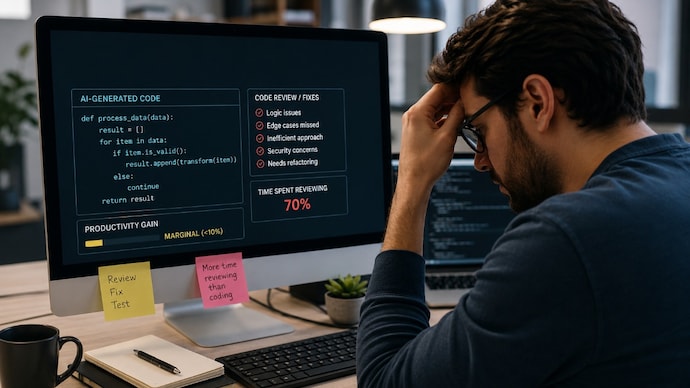
AI-generated code faces growing criticism from veteran software developers. (Photo: AI generated)

New Delhi,UPDATED: May 22, 2026 12:08 IST
The internet is full of predictions about how artificial intelligence could reshape the future of software engineering. Many AI experts have claimed that the technology could eventually eliminate large numbers of junior coding jobs. Companies such as Meta and Amazon are increasingly pushing for more AI-written code, even as they invest heavily in artificial intelligence and cut jobs in other areas.
But while the AI boom has created excitement and anxiety around faster coding and automation, a growing number of veteran programmers are beginning to question the quality of the code being generated by these systems.
“The productivity gains are marginal”
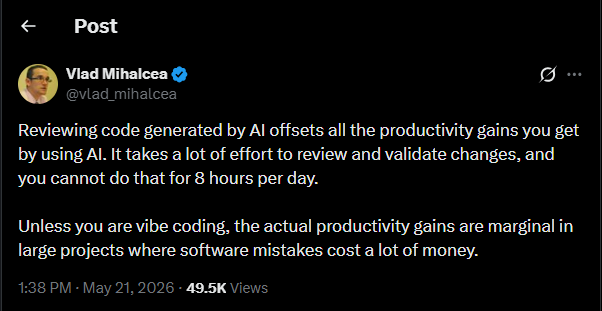
Vlad Mihalcea, the author of the book High-Performance Java Persistence, recently argued that the supposed productivity gains from AI-generated code may not be as impressive as they appear.
According to Mihalcea, developers spend so much time reviewing and validating AI-written code that many of the time-saving benefits disappear.
“Reviewing code generated by AI offsets all the productivity gains you get by using AI. It takes a lot of effort to review and validate changes, and you cannot do that for 8 hours per day,” he wrote in a post on X.
He added that unless someone is “vibe coding,” the productivity gains remain limited in large-scale projects where software mistakes can become extremely expensive.
“Unless you are vibe coding, the actual productivity gains are marginal in large projects where software mistakes cost a lot of money,” he said.
Veteran coders are sounding the alarm
Mihalcea’s comments echo concerns recently raised by Bjarne Stroustrup, the creator of C++. Stroustrup reportedly said the quality of AI-generated code has become so poor in some cases that senior developers are choosing to retire rather than deal with it.
Speaking to Ryan Peterman, Stroustrup said that in programming language design, code would still continue to be written by humans using abstraction and deeper understanding.
“I think that in the field I’m mostly interested in [programming language design] – code will still be written by humans, and they will use abstraction,” he said.
Linus Torvalds gets “angry”
Linus Torvalds, the creator of Linux, also pushed back against exaggerated claims surrounding AI-generated software.
According to Zdnet, Torvalds said he becomes furious whenever people claim AI can write nearly all their code for them.
“My opinion has always been that AI is a great tool, but it's a tool,” he said.
“When I see people saying, ‘hey, 99 per cent of our code is written by AI,’ I literally get angry.”
At the same time, the creator of Linux acknowledged that AI can still significantly improve developer productivity. He compared the impact of AI tools to compilers, which convert human-readable code into machine-readable binary code.
According to him, AI tools could potentially improve productivity “by a factor of 10.”
But he also warned that developers still need to fully understand what the AI is generating.
“You need to understand not just your prompts, but you need to understand the end result too, because that's the only way you can maintain it long term,” he said.
AI may write code, but humans still need to understand it
For now, AI may be able to generate code in seconds. But according to some of the world’s most experienced programmers, humans are still the ones who have to deal with the consequences when that code goes wrong.
- Ends