
After cancelling WFH for Zoho employees, Sridhar Vembu says AI is not magic, tough times ahead
Zoho founder Sridhar Vembu has warned that AI is being overhyped as companies continue to blame job cuts on the technology amid rising economic pressure. He also said the global economy could face tougher times ahead despite the ongoing AI boom.

After cancelling WFH for Zoho employees, Sridhar Vembu says AI is not magic, tough times ahead. (File Photo)

New Delhi,UPDATED: May 19, 2026 17:30 IST
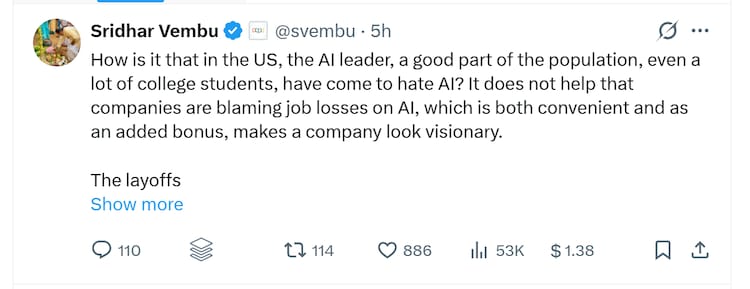
Even as debates around AI continue to dominate the tech industry, Zoho founder Sridhar Vembu has warned that AI alone will not solve the deeper economic problems facing the world. A day after cancelling a wider work-from-home policy for Zoho employees, Vembu shared a far more serious concern that the global economy may be heading into difficult times despite the ongoing AI boom. In a detailed post on X, Vembu questioned why many people in the United States, including college students, are increasingly becoming sceptical of AI even though the country remains the global leader in the technology. According to him, part of the reason is that companies have started linking layoffs to AI, which makes businesses appear futuristic while also offering a convenient explanation for job cuts.
"The layoffs are related to rising cost pressures, we experience those pressures too so we know this first hand," Vembu wrote.
Sridhar Vembu says AI boom cannot fix economic problems
Vembu suggested that the growing economic pressure on companies is a larger issue than AI itself. While billions of dollars are currently flowing into AI, he believes this investment wave may only be temporarily supporting the economy rather than fixing its structural problems.
“The economic picture is getting grimmer. The AI investment bubble has kept the US economy afloat but that can only go on for so long,” he said.
Vembu argued that the world may be witnessing a gradual change in the global order that was built after World War II. Referring to long-term economic changes rather than short political cycles, he said the cracks had already started appearing during the 2008 global financial crisis.
He further noted that major technological revolutions in the past did not necessarily prevent economic instability. Drawing a comparison with smartphones, he said the mobile revolution triggered by the iPhone did not stop the financial crisis back then, and similarly, AI may not magically correct today’s global imbalances.
“AI will not magically cure global imbalances. We must prepare for tough times ahead,” he added.
He is basically saying that companies are wrongly using AI as the main reason for layoffs, while the real issue is growing economic pressure and rising costs. He believes AI is being overhyped and may not be able to fix the deeper global economic problems that could lead to tougher times ahead.
Zoho stands firm on office work despite PM Modi’s appeal
His comments come shortly after he publicly rejected the idea of expanding work-from-home options at Zoho despite recent calls from Prime Minister Narendra Modi encouraging citizens and companies to reduce fuel consumption through remote work and virtual meetings amid global uncertainty linked to the West Asia conflict.
Vembu revealed that Zoho internally discussed whether the company should bring back broader work-from-home flexibility. However, after internal discussions, the company decided against it because face-to-face collaboration was proving more effective, especially for research and development teams.
"Ultimately, after a lot of people inside weighed in on my X post, we decided not to expand WFH because the productivity of face to face problem solving is much higher in R&D," he wrote.
According to Vembu, solving technical problems becomes slower when employees work remotely for long periods. He explained that spontaneous discussions and faster collaboration happen more naturally when teams work together physically.
"I have experienced this in my own development team - issues take longer to resolve when you are not meeting the people involved in solving the problem. Collaboration happens more fluidly face to face and we come up with better solutions," he said.
While Zoho may not be expanding remote work, the company is still exploring other ways to reduce fuel consumption and improve sustainability. Vembu said Zoho is looking at electric bus fleets for employee transport, electric cooking systems in canteens and continued investments in solar energy infrastructure.
- Ends