
Your smartphone may soon connect to satellites in India, but Apple and Google see challenges
Apple and Google have reportedly asked the Indian government for more clarity on direct-to-device satellite connectivity rules, raising concerns around battery life, hardware limitations and network integration.
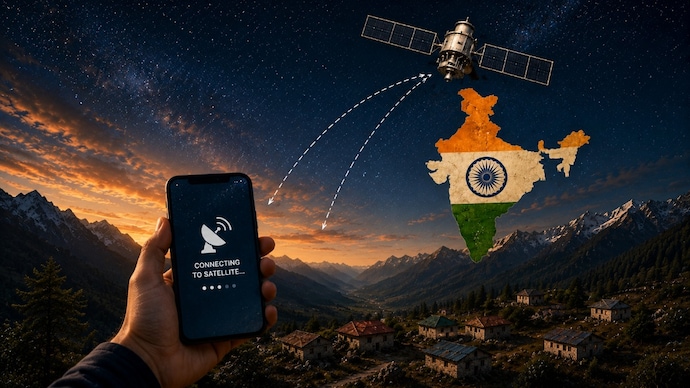

India is exploring direct-to-device (D2D) satellite connectivity, a technology that could allow smartphones to connect directly with satellites in areas where mobile networks are unavailable. But as the government moves ahead with discussions around the technology, Apple and Google have reportedly asked for more clarity on how such services will operate under India’s rules.
According to an Economic Times report, Apple shared its views with the Department of Telecommunications (DoT) during discussions held a few months ago on satellite communication technology. Google and several other stakeholders have also reportedly submitted their feedback to the regulator.
The companies are said to be seeking clarity around how satellite messaging and emergency communication features would function within India’s telecom framework.
Why India wants satellite connectivity on smartphones
The technology could prove especially useful in India, where mobile coverage still remains patchy across hilly states, dense forests and border districts. In several remote pockets, telecom towers are either difficult or financially unviable to install.
In such situations, satellite messaging could allow people to call for help, share their location and communicate during emergencies without depending on a nearby cellular tower.
Over the past few years, satellite connectivity has started appearing on premium smartphones globally, mainly as an emergency SOS feature when terrestrial networks fail.
The technical concerns raised by companies
However, companies have reportedly pointed to several technical and engineering challenges that still need to be addressed before satellite connectivity becomes practical on mainstream smartphones.
One of the biggest concerns is battery drain. Connecting directly to low-earth-orbit satellites requires significantly more power compared to traditional mobile networks.
Another challenge is antenna limitations. Smartphones are designed to remain slim and compact, leaving limited room for hardware capable of maintaining stable satellite communication.
The companies have also reportedly flagged the difficulty of ensuring reliable connectivity under real-world Indian conditions, including difficult terrain and environmental factors.
In addition, integrating satellite communication with existing 4G and 5G mobile networks without affecting user experience remains another key challenge.
Concerns around India-specific requirements
According to the report, Apple and other companies are also worried that India-specific obligations could force manufacturers to redesign satellite features that are currently being developed as globally standardised systems.
Apple has reportedly advised the DoT against mandating hardware modifications or recertification requirements for smartphones to enable satellite connectivity.
Manufacturers have been cautious about expanding satellite features because the technology itself is highly complex. A smartphone’s tiny antenna communicating with satellites hundreds of kilometres above Earth leaves very little room for engineering compromises.
Government consultations are still ongoing
The Department of Telecommunications is currently holding informal consultations with industry players to better understand the possibilities and limitations of D2D satellite technology before framing formal rules.
Meanwhile, the Telecom Regulatory Authority of India (TRAI) has also issued a consultation paper seeking views on whether such services should use dedicated satellite spectrum or existing mobile network airwaves.
The discussions highlight that while satellite connectivity on smartphones holds promise for India, several technical and policy-related questions still remain unresolved.