
In AI era, students can't rely on intelligence. They must learn to think
Young people nowadays often have this question: how should they navigate a career and life where AI has potential to make their knowledge and technical skills irrelevant? The answer is: cogito, ergo sum!
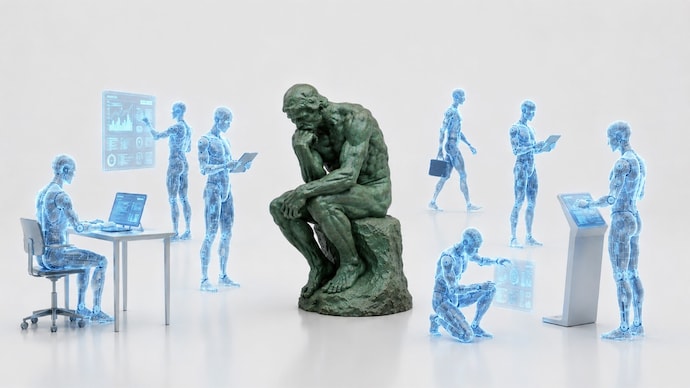
A concept image showing Rodin's famous Thinking Man sculpture surrounded by imagined AI systems. (Photo: AI generated)

New Delhi,UPDATED: Jun 7, 2026 10:16 IST
Cogito, ergo sum! No, this is not a magic spell from the Harry Potter books. But it should become the mantra with which you navigate the era of AI. Way before the world caught the AI fever, OpenAI chief scientist Ilya Sutskever in 2023 made a somewhat cryptic tweet. He wrote, “If you value intelligence above all other human qualities, you’re gonna have a bad time.” It elicited a number of responses, including from Elon Musk who simply said, “Uh oh.”
What the tweet implied wasn’t very clear. And since then there have been a number of interpretations. Some people said it was a jibe aimed at OpenAI CEO Sam Altman, who was in a power struggle with Ilya and a few others. Some say it was a statement on the inevitability of superintelligent AI. Different people, different takes.
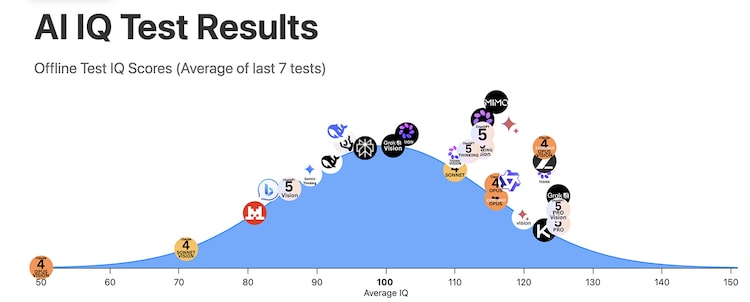
But one way to look at the tweet is to consider it a casual warning with which Ilya is hoping to prepare humans for an era when AI would surpass all of us in technical skills and intelligence. In some way, it has already happened. On technical skills, for example in accurate (but not meaningful) writing or coding, a recent AI system like Claude Opus 4.7, is better than most humans. Most of the top AI systems now score above 120 points in standard IQ tests, significantly higher than the average for humans.
With even more “intelligent” AI systems set to arrive in future, Ilya’s tweet will attract greater attention. And one way people will interpret it will be that in the AI era, intelligence doesn’t matter. Instead, humans have to draw up on something else to keep themselves relevant.
What could be this something? The answer indicates what young people nowadays should focus on as they prepare to enter a world where AI is more intelligent than them. And the answer is cogito, ergo sum, the words of philosopher Descartes that literally mean “I think, therefore I am.” Although, what they really imply is up for debate as it so happens with everything that philosophers say.
Recently I spoke to some college students in a session titled AI And Journalism. One question came up again and again. What will be our future if AI can do work that humans currently do? As the students asked this, there was a palpable anxiety in their voices, a sense that they would enter a world that probably would value their skills and abilities less.
I did not have a definitive answer to this question. No one at the moment does. But I told them what I often tell my own team in the India Today newsroom, who worry about their own jobs getting impacted due to AI. I told them that instead of getting fixated on their technical skills, they should get better at thinking.
The answer, in a way, comes from what Demis Hasabis, Google DeepMind CEO and the biggest authority on all things AI, once told a gathering in Athens. Addressing the question of what humans would need to successfully navigate their career and life in the AI era, Demis said: “Learning how to learn will be the next generation's most needed skill.”
Indeed, the ability that would define people’s careers and work in the coming years will not be how well they know the theory of Creative Destruction. Instead, it would be the ability to come across the theory of Creative Destruction, think about it, and then apply it to the problem that has landed on your desk.
The arrival of AI, in that sense, must lead to a change in how students and young people at work approach learning, skills, and intelligence. Instead of fixed knowledge or hard-wired skills, they must work towards acquiring fluid intelligence, the kind that could be adapted and utilised to solve problems of any kind.
This requires a different way of thinking, which sadly is not taught in Indian schools and colleges. It also requires students to think beyond the technical skills, and broaden their horizon. That will not happen if you only read something like Higher Engineering Mathematics by B S Grewal. Instead, you will have to acquire a different way of looking at the world and will have to also, apart from Mr Grewal’s excellent book, read Ways of Seeing by John Berger.
AI can do a lot of things. But it does so as a highly-accomplished scholastic parrot. It is extremely intelligent and great at wholly-structured tasks such as coding. But it cannot think, and may not be able to think the way humans do. It is this thinking part that will become more and more important in the AI era where, as Sam Altman somewhat unwittingly says, intelligence would be like electricity, plenty and available by meter.
Currently, people coming out of Indian colleges are not particularly good at the thinking part. They don’t think deep enough, they don’t think in a novel way, they don’t think through, almost always the second-order thinking is missing, and they rarely think in terms of solutions.
It is not their fault, though. Thinking is something that is no longer in fashion. We live in reel times and not real times, and in the world of infinite scrolling, thinking is not encouraged. It is also not their fault because the Indian education system is geared more towards the exams and less towards deep thinking. The end goal, which happens to be a degree that will get you a job, is more important than the journey. Hence, all the cheating and test paper leaks that go all around us.
This will have to change. I wish it changes institutionally. But if not institutionally, students must change it at a personal level.
The way to bring about the change would be to make studies and learning more general and less specific. That means there must be a greater emphasis on reading general purpose subjects and not just memorisation of technical concepts. In simple words, this means that students must READ History, Geography, Physics, Philosophy, and Literature. They must know their films and music inside out and not just have an expertise on Philip Kotler. The students in the AI era must not only know Algebra, but also Al-Gabr. It means they must not only know what is binary in computer science but also understand the Aristotelian logic of True and False, which some 2200 years after Aristotle died led to the creation of iMac.
Of course, AI knows all of this. And so does Wikipedia. But just like Wikipedia cannot think despite hosting the entire world’s knowledge, the AI systems too cannot. They know everything but they cannot form unique connections between this knowledge.
Only humans can. And humans can do it because they READ and EXPERIENCE. Reading is our superpower. Maryanne Wolf, who has spent years researching how children acquire the ability to think deeply, calls reading the single most important factor. In her book, Proust And The Squid, she writes: “Human beings invented reading only a few thousand years ago. With this invention, we rearranged the very organisation of our brain, which in turn expanded the ways we were able to think, which altered the intellectual evolution of our species.”
It is this “ability to think” that would become increasingly important in the AI era. Because AI cannot think. Or as Demis Hassabis puts it, AI cannot come up with something like E = MC2. Not yet, and possibly not anytime soon. Recently, the DeepMind CEO was asked when he would consider AI equal to humans. He said, “The kind of test I would be looking for is training an AI system with a knowledge cutoff of, say, 1911, and then seeing if it could come up with general relativity, like Einstein did in 1915.”
It is in thinking where humans still have an advantage. They can think in an abstract manner, with an imagination that is unique, to imagine and create things that have never been done earlier. Such as Theory of General Relativity. In the AI era, this is the kind of thinking humans would be expected to do at workplaces, in their careers, in their life. They must prepare for it. They must acquire the ability of thinking through their way to novel solutions. It would be in demand even when ChatGPT and Claude take over the workplaces.
- Ends