
Bengaluru founder shares 5 toxic behaviours normalised in Indian workplaces
A Bengaluru startup founder listed five toxic workplace behaviours in a LinkedIn post. The post drew wide responses from professionals discussing burnout, boundaries and respect at work.


A Bengaluru startup founder's post triggered a discussion on workplace culture after she listed five toxic behaviours she believed became so common in Indian offices that employees were often expected to simply accept them.
Aloona, the Bengaluru-based co-founder of Mindbun, took to LinkedIn to share a list of workplace practices that she believes employees have been conditioned to tolerate despite their damaging impact on well-being and work-life balance.
"Toxic stuff that is normalised in Indian workplaces, but shouldn't be," she wrote, before listing five common experiences that several professionals instantly related to.
According to Aloona, one of the most troubling behaviours was managers publicly humiliating employees. She criticised workplaces where shouting, abusing or belittling people in front of colleagues was treated as acceptable, particularly during team stand-ups and high-pressure sales meetings.
She also questioned the culture of entire teams adjusting their schedules around leaders who maintained unconventional working hours. Referring to bosses who wake up late and schedule calls at odd hours, she argued that employees should not be expected to remain available simply because a senior leader chooses to work on a different schedule.
Another issue she pointed out was the expectation that employees remain accessible even during personal crises. She pointed to situations where workers were repeatedly contacted while sick, hospitalised, grieving or dealing with emergencies, describing it as an unhealthy disregard for personal boundaries.
Weekend work also featured prominently on her list. While acknowledging that emergencies could arise, Aloona criticised companies that routinely scheduled meetings and stand-ups on weekends despite advertising five-day work weeks during hiring.
Rounding out her list was a complaint familiar to many professionals, leaders who appeared disengaged for most of the week only to suddenly declare tasks "urgent" late on a Friday afternoon, forcing employees to scramble before the weekend.
"None of this is okay. None of this should be okay," she wrote, adding that workers are often told to "grow up" or develop a "thicker skin" when they raise concerns. "Remember they are the problem, not you," she concluded.
Take a look at the post here:
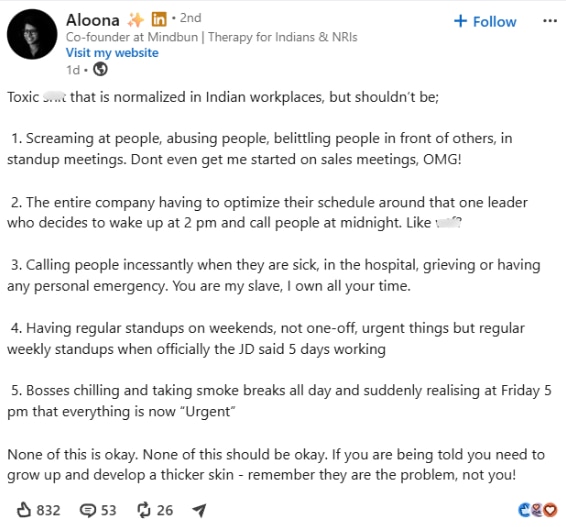
The post gained traction, with many professionals sharing their own experiences of toxic workplace culture.
Several commenters expanded the list with examples from their own careers. One user said employees were often pressured to cancel medical appointments and reschedule them for weekends, while another pointed to managers gossiping about their own team members behind closed doors.
Others criticised workplaces where aggressive or offensive language was brushed off as normal corporate behaviour.
A therapist who joined the discussion observed that people often underestimated the long-term psychological effects of workplace environments. They argued that toxic office cultures could significantly affect emotional well-being, self-worth and even a person's nervous system over time.
Many users also echoed Aloona's broader message, saying professionalism should never require humiliation, constant availability or sacrificing personal well-being. Several commenters stressed that respect at work should be considered a basic expectation rather than a special benefit.