
Bengaluru man shares post on mother cleaning son's vomit in Kolkata Metro coach
A Bengaluru man shared a post on how a mother cleaned her child's vomit inside Kolkata Metro, which led to discussions on civic sense and responsibility in a public space.


A man from Bengaluru shared how a mother calmly cleaned up after her son vomited inside the Kolkata Metro, earning praise online for her sense of responsibility.
Pawan Patankar, who works as an Assistant Manager at Flipkart, shared the post on LinkedIn describing the incident that unfolded inside the Kolkata Metro.
According to his post, a child suddenly vomited inside the metro coach. While such situations often led to discomfort or avoidance from fellow passengers, what happened next really stood out. The child’s mother immediately took responsibility and cleaned the floor herself using a handkerchief, without complaints or hesitation.
Patankar described the act as a powerful display of civic sense. He emphasised that public spaces, whether metros, roads, or offices, were shared assets, and maintaining cleanliness should not be seen as someone else’s duty. “No complaints. No excuses. Just responsibility,” he wrote, adding that real change began not with policies, but with individual mindset.
Take a look at the post here:
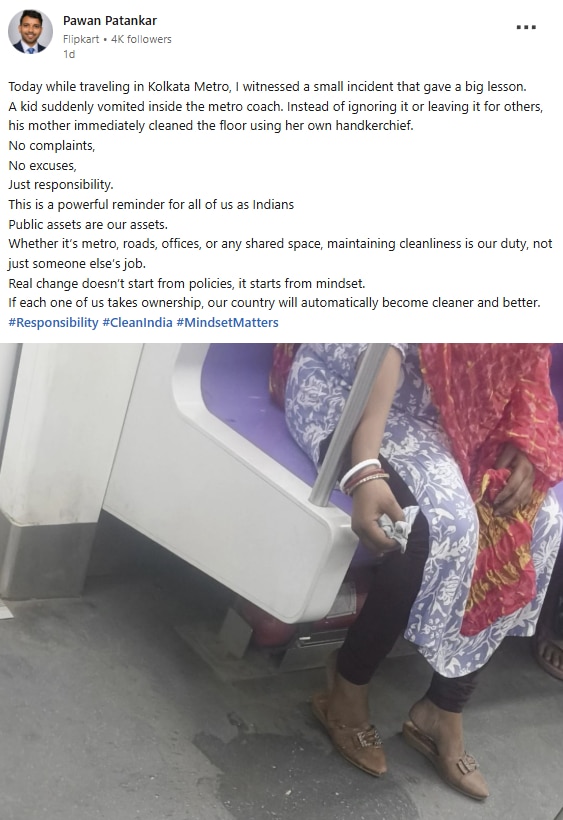
The post's comments section was flooded with praise and pride from users, who also discussed the importance of accountability and civic behaviour.
Social media users widely appreciated the mother’s actions, describing it as a simple yet meaningful example of taking ownership of public spaces. Several emphasised how such gestures, though small, reflect a deeper sense of responsibility and respect for shared environments.
Several users pointed out that true civic pride lies not just in demanding better infrastructure or services, but in how individuals treat public property in their daily lives.
They noted that the woman’s instinct to clean up immediately, rather than leaving it for authorities or staff, demonstrated a mindset that prioritises collective well-being over personal convenience.
Others described the act as a textbook example of civic sense, saying it set a standard for how people should behave in similar situations. There was also a broader sentiment that if more individuals adopted such habits, it could significantly improve cleanliness and public hygiene across cities.