
Chennai founder questions Rs 7.2 LPA job candidate's Rs 16 lakh ask, gets slammed
Chennai-based entrepreneur Sumanth Raman, the founder of Algorithm Health, shared his experience in a post on X, recounting a conversation with a candidate who was interviewing for a technology role.

Chennai founder questions Rs 7.2 LPA job candidate's Rs 16 lakh ask (Representative pic from Pexels)

New Delhi,UPDATED: Jun 3, 2026 12:29 IST
Chennai-based entrepreneur Sumanth Raman has found himself at the receiving end of criticism online after saying he felt “out of touch with today's generation” following a job interview in which a candidate earning Rs 7.2 lakh per annum demanded a salary of Rs 16 lakh.
Raman, the founder of Algorithm Health, shared his experience in a post on X, recounting a conversation with a candidate who was interviewing for a technology role.
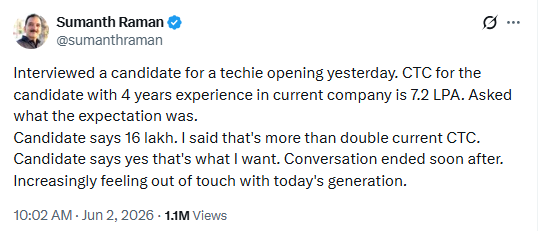
“Interviewed a candidate for a tech opening yesterday. CTC for the candidate with four years' experience in the current company is Rs 7.2 LPA. Asked what the expectation was. Candidate says Rs 16 lakh. I said that's more than double current CTC. Candidate says yes, that's what I want. Conversation ended soon after. Increasingly feeling out of touch with today's generation,” Raman said in his post.
The post went viral as it garnered over one million views and triggered a debate about salary negotiations, market rates and whether a candidate's current pay should influence hiring decisions.
Several users argued that the entrepreneur's reaction reflected outdated thinking and said salary expectations should be based on an employee's skills and market value rather than their existing compensation.
“Candidate dodged a bullet. You people will suck the soul out of people and pay them as little as possible. And you're out of touch because you haven't lived the life of a youngster in this situation. Four years for Rs 16 LPA is below the baseline today for big MNCs. I guess you need to update your figures,” one user said.
One of the comments read, “You're right to feel increasingly out of touch with a generation that knows what they are worth and what the market price is. In your generation, you didn't have the tools that people have now to know when they are being shortchanged. Obviously, you'll feel out of touch. The current generation has higher self-respect per capita.”
Others were more blunt in their assessment of the salary demand itself.
“It's not a big demand. He is underpaid,” one user said, while another added, “Good for the candidate! If the previous CTC is the baseline and not a skill, then they had better stay at the current company. What an age-old, intrusive practice!”
Several comments also aimed at what users perceived as a tendency among employers to anchor salary discussions about a candidate's current pay.
“I think the candidate is asking only Rs 7 lakh as salary. The remaining Rs 9 lakh is torture compensation to work with you. Reduce the toxicity, and you will get employees working at half the salary, happily,” a user remarked.
“That candidate got saved from a toxic, overworking and underpaying work culture. This generation has more knowledge of market realities. Sixteen LPA with four years of experience is absolutely fine,” another said.
The discussion soon expanded beyond Raman's post, with some users highlighting what they described as widespread underpayment in parts of the job market.
“Honestly, some employers just want cheap labour that they can exploit for profit without paying them properly. It's crazy that even now, I see people with seven years of experience making only Rs 3 LPA,” one comment read.
Among the most-liked responses was a comment that questioned why the candidate's existing salary should be relevant at all.
“The more interesting question is why a candidate earning Rs 7.2 LPA felt they were worth Rs 16 LPA. If the market agrees, they're not unrealistic, they're underpaid. Salary expectations should be measured against market value, not against what a previous employer decided to pay. Otherwise, companies are benchmarking talent against historical discounts rather than current value,” the user said.
As the post continued to circulate online, people also discussed changing workplace expectations, pay transparency and the growing willingness among younger professionals to negotiate aggressively for higher salaries.
- Ends