
Non-resident Bengali's fiery post fuels debate on Bengal's economy, jobs amid polls
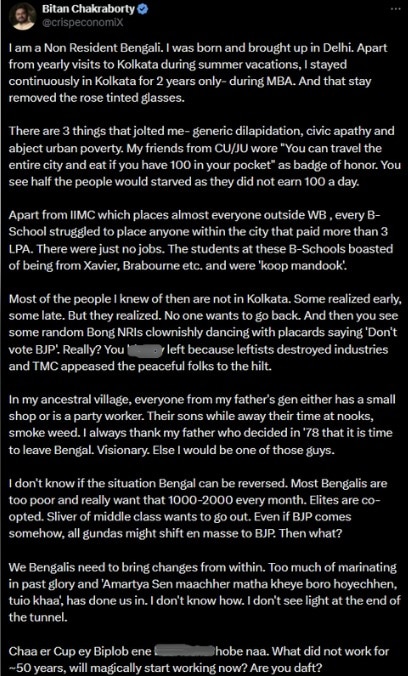
Bitan Chakraborty, an assistant professor of finance in Delhi-NCR, said he was born and brought up in Delhi and had only spent extended time in Kolkata for two years during his MBA, apart from annual summer visits.
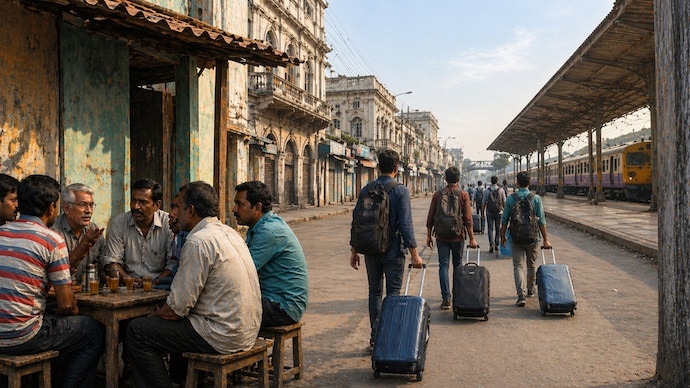
Non-resident Bengali’s fiery post fuels debate on Bengal’s economy, jobs amid polls (AI-Generated Image)

New Delhi,UPDATED: Apr 23, 2026 17:53 IST
In the midst of the West Bengal Assembly elections, a now-viral X post by a “non-resident Bengali” has triggered a heated debate over the state’s economic condition, job opportunities and political foresight.
Bitan Chakraborty, an assistant professor of finance in Delhi-NCR, said he was born and brought up in Delhi and had only spent extended time in Kolkata for two years during his MBA, apart from annual summer visits.
“That stay removed the rose-tinted glasses,” he said, adding that he was struck by “generic dilapidation, civic apathy and abject urban poverty." He also claimed that job opportunities in the city were limited.
Many of his peers, Chakraborty said, saw surviving on Rs 100 a day in the city as a “badge of honour”, but he argued that “half the people would have starved” if they earned that little. He further claimed that, apart from institutes like the Indian Institute of Management Calcutta that place students outside the state, most business schools struggled to help students secure well-paying jobs within West Bengal.
Chakraborty also alleged that many graduates eventually left the city in search of better opportunities. “Most of the people I knew of then are not in Kolkata. No one wants to go back,” he wrote, while criticising what he described as political and economic decline in the state.
Speaking about his ancestral village, he claimed that many from his father’s generation either ran small shops or were linked to political networks, while younger men “while away their time at nooks”. He credited his father’s decision to leave the state decades ago, saying, “Else I would be one of those guys.”
He expressed scepticism about the possibility of change, saying that a large section of the population depends on small monthly financial support and that political shifts alone may not alter ground realities.
“I don't know if the situation Bengal can be reversed. Most Bengalis are too poor and really want that 1,000-2,000 every month. Elites are co-opted. Sliver of middle class wants to go out,” he said, adding: “I don’t see light at the end of the tunnel.”
However, he also suggested that change must come from within the community. “We Bengalis need to bring changes from within,” he said, criticising what he described as an overreliance on past glory.
Read the entire post here:
Chakraborty’s account was widely dissected and bisected by social media users as it garnered close to two lakh views on X.
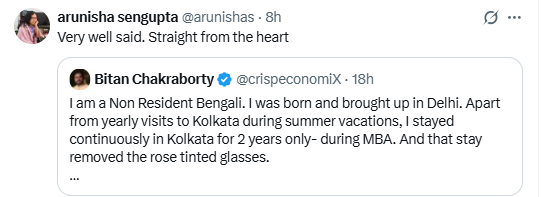
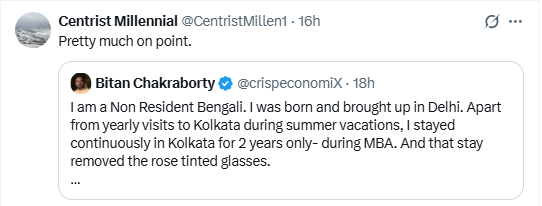
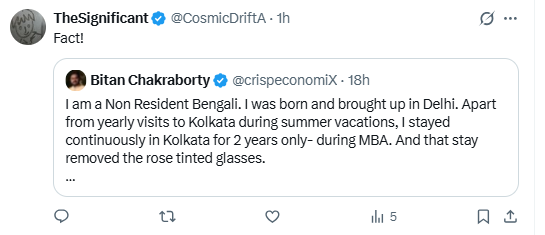
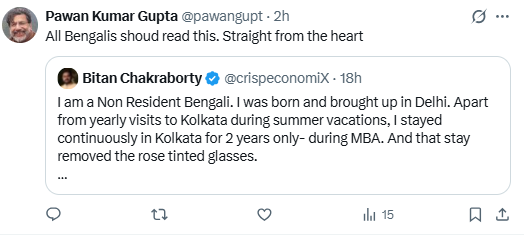
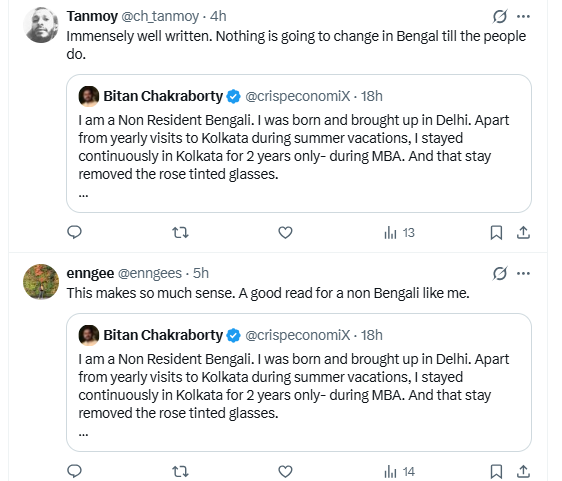
Most of the users applauded him for his “accurate” and “brutal” post, but a small section disagreed, saying the state has the “resource, resilience and capability” to recover.
“The penultimate para is the solution. Bengalis have to crave for change from within,” one user wrote.
Somebody also pointed out that, “The entire community feeds on nostalgia which is exploited by the political class,” while some expressed hope that Bengal can regain its past prominence.
The discussion comes at a time when West Bengal is witnessing an intense electoral contest. The ruling All India Trinamool Congress, led by Chief Minister Mamata Banerjee, is seeking a fourth consecutive term, while the Bharatiya Janata Party is aiming to form the government after a strong showing in the previous election.
Polling is being held for 294 Assembly seats across two phases, with 1,478 candidates in the fray. The counting of votes is scheduled for May 4.
- Ends