
Did cutting foreign aid funding cause one of the worst Ebola outbreaks in modern history?
A rare Ebola strain with no vaccine or treatment spread undetected through the Democratic Republic of Congo and Uganda for weeks. The systems built to catch it had already been dismantled.
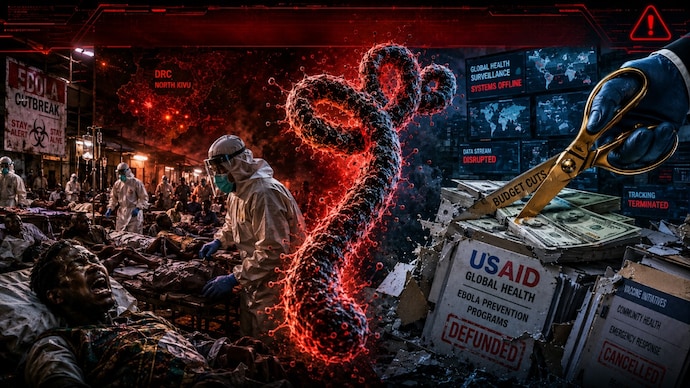

On the 17th of May 2026, the World Health Organisation declared a public health emergency of international concern. It was only the ninth time in history the agency had made that designation. By late May, more than 900 suspected cases had been identified across the Democratic Republic of Congo and Uganda. At least 220 people had died. This is already the third-largest Ebola outbreak on record, and health officials warn the true numbers are far higher.
At the centre of the crisis is the Bundibugyo strain of the Ebola virus, a rare variant first recorded in Uganda in 2007. Unlike the more familiar Zaire strain, for which vaccines now exist, the Bundibugyo strain has no approved vaccine and no licensed treatment. It kills roughly one in three people it infects. Early laboratory tests in the affected regions returned negative results because facilities tested for the wrong strain entirely. The virus circulated undetected for nearly three weeks before officials identified it correctly.
The first suspected case dates to the 24th of April. A confirmed identification did not come until the 15th of May. By then, the outbreak had already taken root across multiple provinces in eastern Congo, including Ituri, North Kivu and South Kivu, all of them active conflict zones where health infrastructure had been weakened by decades of armed fighting. Cases later appeared in Goma and the Ugandan capital, Kampala, two densely populated cities where rapid transmission becomes significantly harder to contain.
Health experts and former officials point to one factor above all others as the reason this outbreak was not caught sooner: the systematic dismantling of United States foreign aid.
The US Agency for International Development, known as USAID, had for years maintained programmes that funded local health surveillance, trained community health workers, equipped laboratories and supported emergency response teams across central Africa. Those programmes were frozen and then gutted under the Trump administration. Total US disbursements to Congo fell from roughly 33 million dollars to 10 million dollars in a single year. Overall, USAID support to the country dropped from nearly 1.2 billion dollars to 693 million dollars.
The consequences were immediate and tangible. Experienced community health workers who had managed previous Ebola outbreaks lost their funding and sought other employment. A laboratory in Ituri lacked the equipment to test for Bundibugyo and set samples aside rather than transfer them to a facility with better capacity. When those samples eventually reached Kinshasa, they arrived at the wrong temperature and in insufficient quantities, which slowed analysis further. Nicholas Enrich, former acting assistant administrator for global health at USAID, put the damage plainly. In a time when hours matter, the response was delayed by weeks.
The International Rescue Committee, a former USAID partner in Congo, scaled back its surveillance operations and sanitation measures in Ituri. Hospitals across the affected areas ran short of gloves, masks and protective aprons. Doctors worked without adequate protection and without certainty of when supplies would arrive.
It was against this backdrop that US Secretary of State Marco Rubio addressed the outbreak in a public briefing. His framing was instructive. The administration's stated priority, he explained, was to ensure no Ebola cases entered the United States. He described multiple agencies working to contain the crisis to the countries where it was located, and assured Americans that the administration was doing everything possible to protect them. "We cannot and will not allow any cases of Ebola to enter the United States," he said.
The United States eventually pledged 23 million dollars in emergency funding, more than double the amount originally removed from detection and prevention programmes. Researchers began rapid development of a Bundibugyo-specific vaccine, though experts acknowledged that even in the most optimistic scenario, a rollout would take months.
The arithmetic is not complicated. Prevention costs less than catastrophe. The world is now paying for both.