
Why Iran needs to return to the negotiating table
Even without public acknowledgement from Iran, satellite assessment points to deep losses after 40 days of war, the damage its leaders are likely weighing behind closed doors.

Despite putting strict conditions that seem to be stalling the second round of talks in Islamabad, Iran may have little choice but to return to the table, squeezed by a crippling maritime blockade, battered by large-scale damage to military and civilian infrastructure, and the urgency of managing a fraying ceasefire before it expires on April 22.
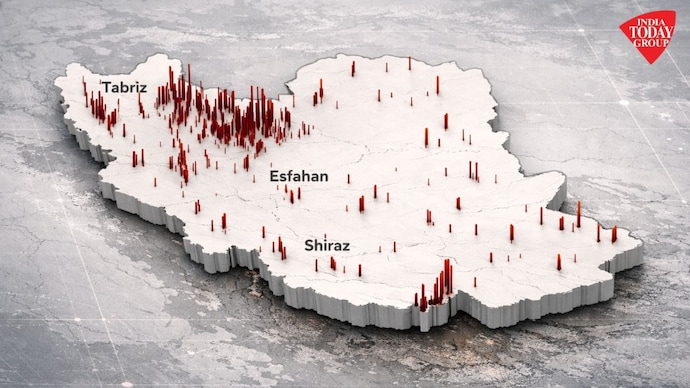
The 3D figure below shows pockets of apparent structural damage detected across Iran after the war began on February 28. The assessment, shared with India Today, is based on damage analysis of Copernicus Sentinel-1 radar imagery by Corey Scher and Jamon Van Den Hoek of Conflict Ecology, the Oregon State University.
However, Iran is not ruling out diplomacy altogether. Iranian Parliament Speaker Mohammad Bagher Ghalibaf publicly defended negotiations with the US on Iranian state television on Saturday, arguing that diplomacy with the United States, alongside military power, is necessary to secure Iran’s objectives.
Ghalibaf also reportedly criticised hardline IRGC officials, including Supreme National Security Council (SNSC) member Saeed Jalili and hardline parliamentarian Amirhossein Sabeti, for opposing negotiations during a meeting with advisers, but his criticisms were likely implicitly directed at IRGC Commander Major General Ahmad Vahidi.
The country is already under severe strain, with its economic troubles deepening amid roughly a week of blockade-related disruption in and around the Strait of Hormuz, the loss of much of its conventional naval capability, and serious blows to its leadership.
The true extent of the damage on the ground remains difficult to assess in the absence of internet access and amid restrictions on commercially available satellite data. Videos and photographs from inside Iran continue to trickle onto social media, but the country’s internet blackout has sharply constricted the flow of digital dissemination of information.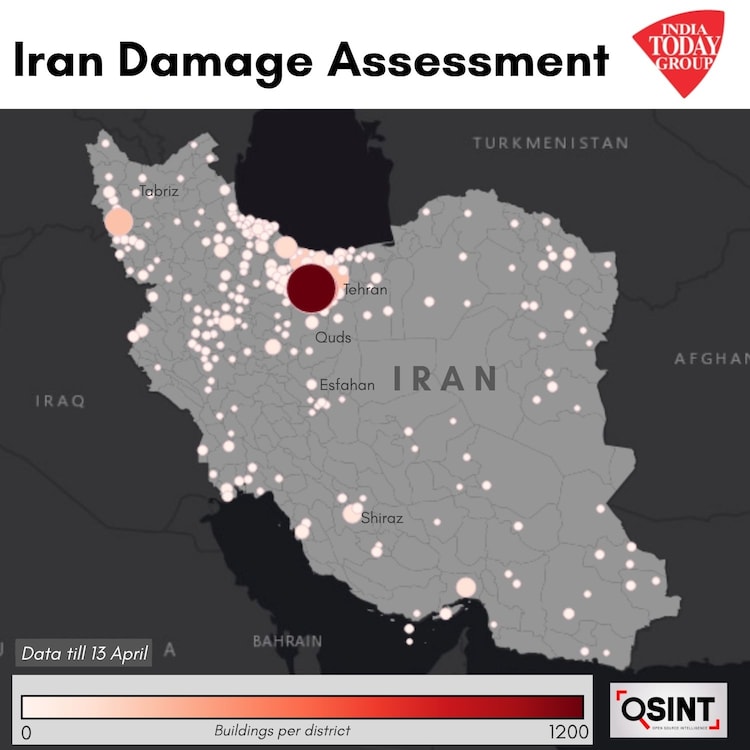
India Today has sifted through multiple open-source datasets and satellite-based assessments to estimate the scale of the damage. According to an assessment of open-access radar satellite data, roughly 7,645 building structures across Iran appear to have been damaged, including 60 educational institutions, 12 health facilities, and several strategic military and nuclear sites.
Digital black spots, the lack of high-resolution satellite imagery, and constraints on ground reporting have left radar-based imagery from Sentinel satellites as the most viable means of mapping the scale of destruction across the country.
Analysis by Jamon Van Den Hoek and Corey Scher, geospatial researchers at Oregon State University, relies on Sentinel-1 C-band SAR coherent change detection, or CCD. In all, 528 Sentinel-1 images captured after the onset of the conflict were analysed against more than 19,674 coherence estimates derived from two years of pre-conflict baseline data.
As per data analysed by the researchers, damage was detected in at least 256 of Iran’s 1,058 districts, with the heaviest concentration of damaged structures in and around Tehran.
Tehran appears to be the single heaviest concentration of damage in the country, with roughly 24 per cent of all recorded building damage falling within about 20 km of central Tehran, and about 30 per cent within 25 km.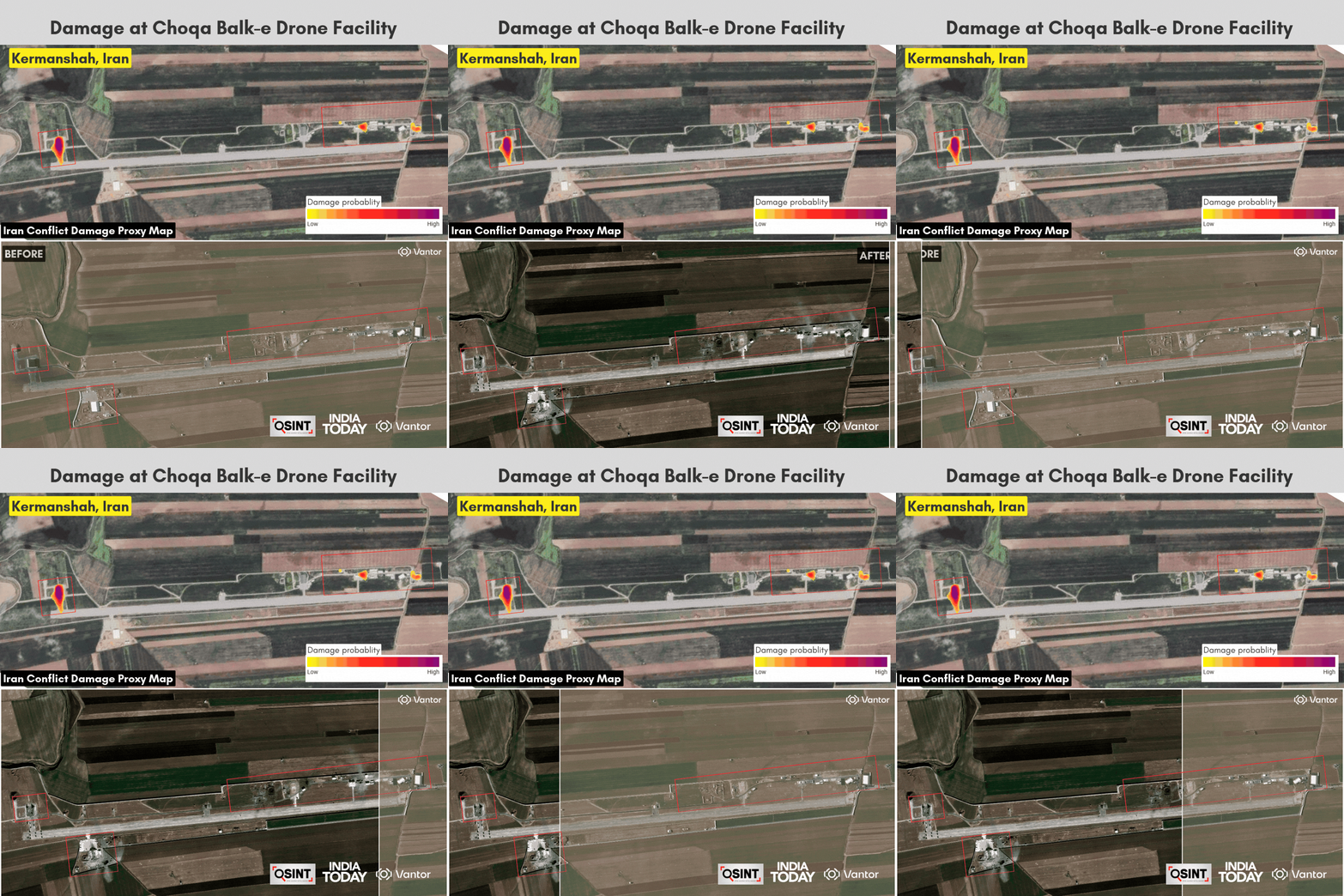
Damage assessments from the Iran Conflict Damage Proxy Map, developed by Bellingcat researchers, offer a deeper look at the strategic sites that appear to have been hit. Using radar-based imagery, Bellingcat traced signs of damage to several military and defence locations, including the Khojir Missile Production Complex outside Tehran, Fath Air Base in Karaj, the IRGC’s Ashura Garrison in Isfahan, and the IRGC’s Valiasr Barracks in Tehran, along with other defence infrastructure.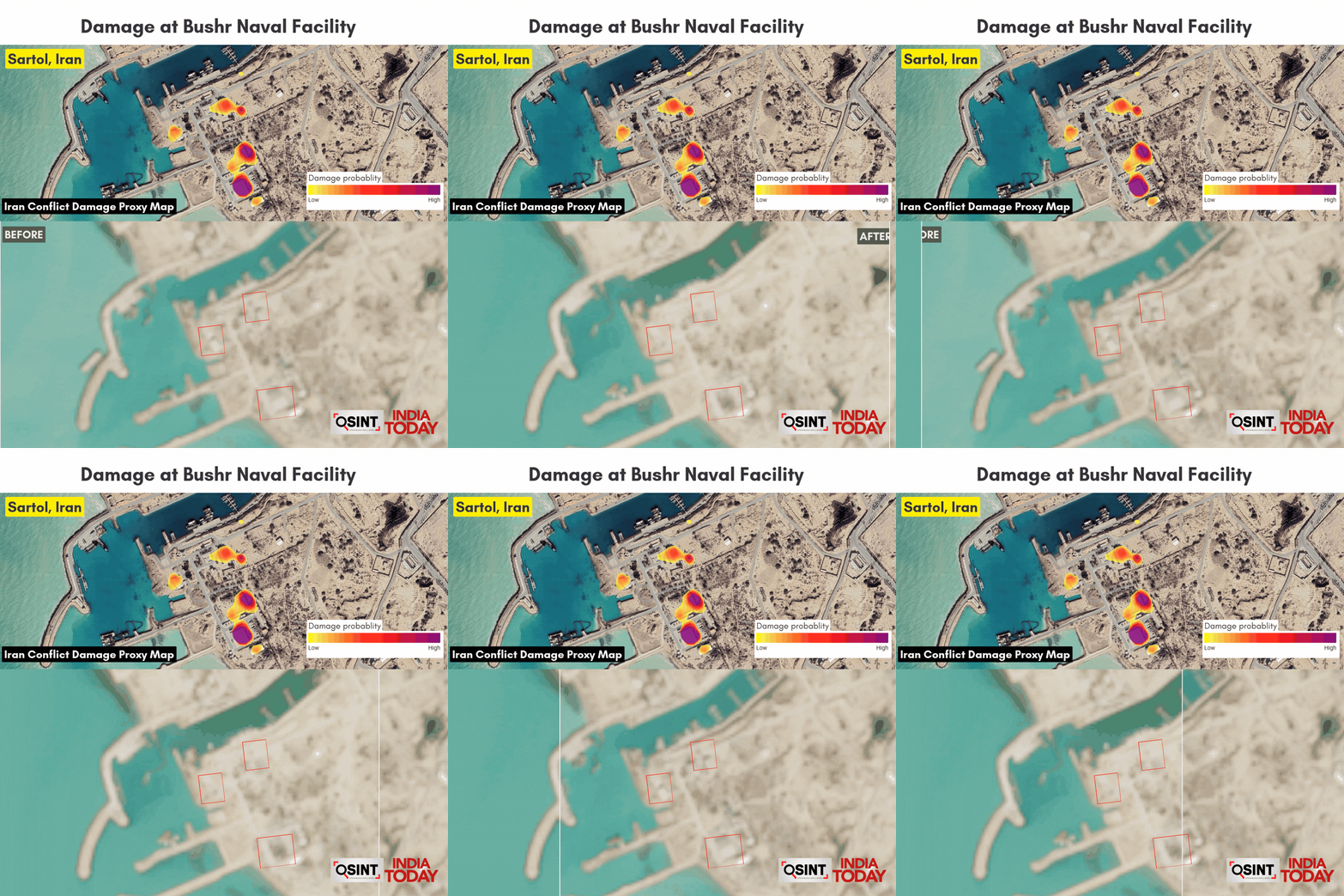
Using the same tool, India Today identified additional pockets of apparent damage at several critical sites, including Kharg Island; the South Pars gas field and the Asaluyeh processing hub; the Alborz fuel depots; Bandar Abbas Military Harbour; the Konarak naval base; Bushehr’s naval facilities; and the Choqa Balk-e Alireza drone base, while also testing the tool’s accuracy by matching its signals against Sentinel-2 imagery.
When the damage runs this deep and reaches both strategic assets and the leadership around them, the battlefield can start looking a lot like a prelude to the negotiating table. However, Iran might have another reason for the same, which is that Lebanon, a highly contested point during the first round of talks, is now under a ceasefire, which was Tehran’s precondition for attending any further negotiations. But, even before the Trump-brokered ceasefire was agreed upon, Israel had inflicted enough damage on Lebanon.
Damage in Lebanon
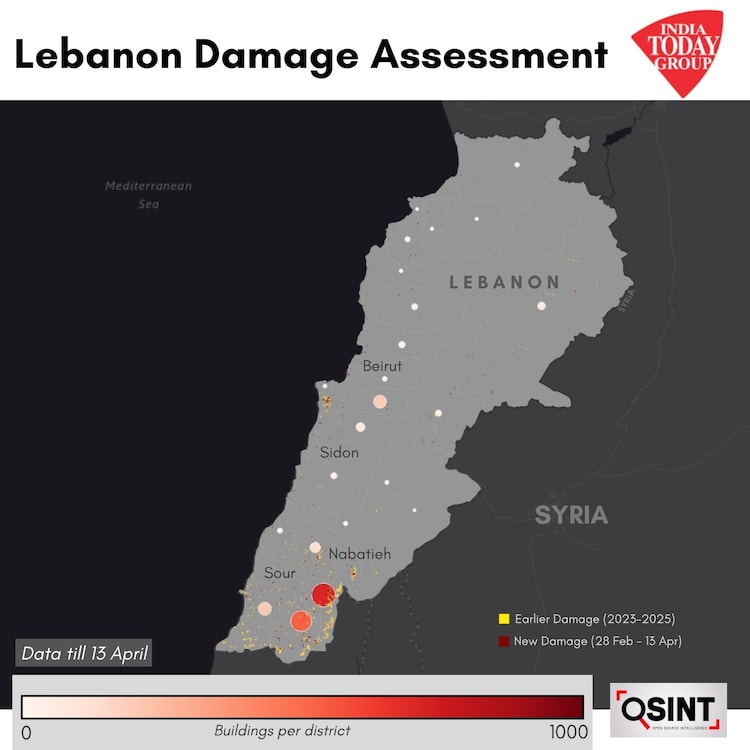
In the run-up to the first U.S.-Iran talks in Islamabad, Tehran made Lebanon a sticking point rather than a side issue. Iran had reportedly told intermediaries that any ceasefire arrangement with Washington and Israel would also have to halt Israeli operations against Hezbollah, effectively tying its own diplomacy to the Lebanese front. Iran reinforced that position publicly on April 10, when Parliament Speaker Mohammad Baqer Qalibaf said a ceasefire in Lebanon and the release of Iran’s blocked assets had to come before negotiations could begin. A day earlier, after heavy Israeli strikes in Lebanon, he said it would be “unreasonable” to move ahead with talks at all.
Intense Israeli attacks are estimated to have damaged or destroyed approximately 2,154 buildings across Lebanon. But when a U.S.-backed 10-day ceasefire took effect on April 17, the war between Israel and Hezbollah did not so much end as enter a murkier, more uncertain phase.
Iran briefly reopened the Strait of Hormuz, only to shut the passage again as Washington maintained its naval blockade.