
Truth about Pakistan, Munir revealed: Iran visit video spills beans
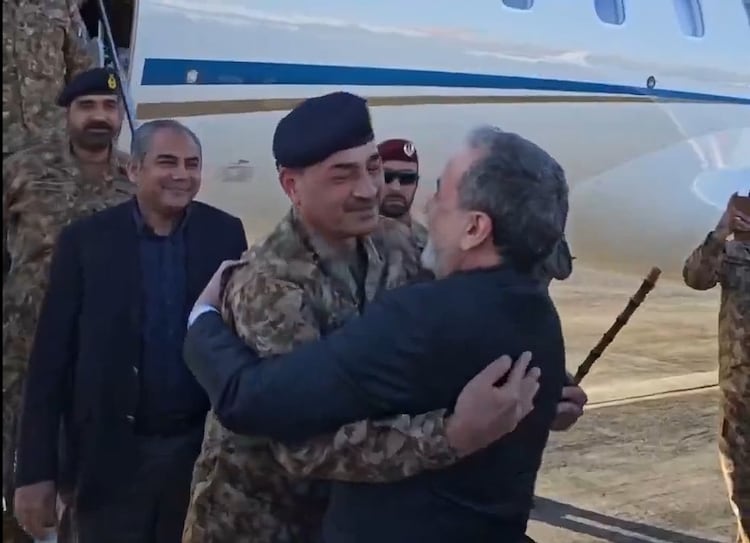
Pakistan army chief Asim Munir's Tehran visit has once again revealed who holds power in Pakistan. While Interior Minister Mohsin Naqvi stood back, Munir was the first person to de-board the flight in Tehran and was greeted by Iran's Foreign Minister Abbas Araghchi.
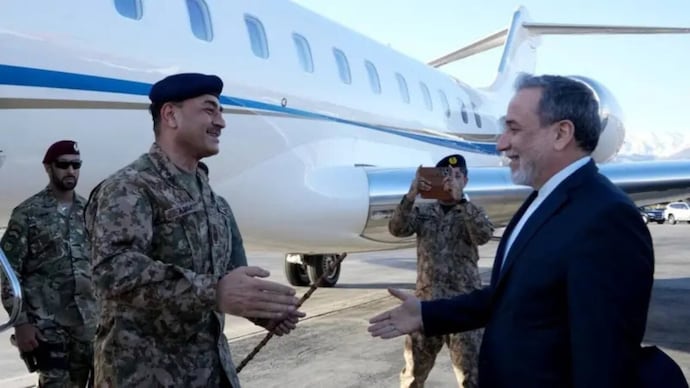
Pakistan Army Chief Asim Munir was received by Iranian Foreign Minister Abbas Araghchi. His aide-de-camp stood close behind him, holding a bulletproof shield. (Image: X)

Protocols tell us a lot about the inner workings of a country, its power hierarchy and the person around whom authority actually revolves. It was strikingly visible during a high-level diplomatic trip that Pakistan Army Chief Field Marshal Asim Munir made to Tehran on Wednesday. The visuals of Munir landing in Iran tell a lot about who truly calls the shots in Islamabad. It also solidifies the notion that the military establishment, not the civilian leadership, is in charge of Pakistan.
In a video of Munir's reception in Iran, shared by its Foreign Minister Abbas Araghchi, Munir was seen stepping off the plane first. Pakistan's Interior Minister (equivalent to Home Minister) Mohsin Naqvi was almost tucked away in the background, and was the second person to step out of the aircraft.
Even more telling, Munir's aide-de-camp stood close behind him holding a bulletproof shield – the kind of security usually reserved for heads of state, not military chiefs. Many observers said this moment laid bare the real power structure in Pakistan, which has been an open secret for decades.
The visit by the Pakistani delegation came just days after the first round of US-Iran talks in Islamabad ended without a deal. Those negotiations, held on April 11, brought together senior American and Iranian officials but failed to resolve key issues like Iran's nuclear programme, sanctions and the situation in the Strait of Hormuz. With tensions still high after the US-Israel war on Iran that began in late February, Pakistan stepped up as a "mediator".
Now, Islamabad is pushing hard to organise a second round of direct talks.
The Pakistani military's mouthpiece, ISPR, confirmed that Field Marshal Munir led a high-powered delegation that included Interior Minister Naqvi. The group flew to Tehran late on Wednesday to hold talks with key Iranian leaders and carry fresh messages aimed at bridging the gap between Washington and Tehran. According to reports, the Pakistani side is keen to keep the backchannel alive and prevent any further escalation in the Middle East.
Looks like even the Iranians know with whom power rests in Pakistan. Foreign Minister Abbas Araghchi, who himself received the Pakistani delegation at the airport, embraced Munir as soon as he stepped out of the airport. In a post on X, Araghchi said, he was "delighted to welcome Field Marshal Munir to Iran". The post had no mention of Naqvi.
"Expressed gratitude for Pakistan's gracious hosting of dialogue, emphasising that it reflects our deep and strong bilateral relationship. Our commitment to promoting peace and stability in the region remains strong — and shared," Araghchi posted on X.
It was the visual in that same video that caught everyone's attention.
Just for context, Naqvi is not just any Pakistani politician. While he is the number two in the PM Shehbaz Sharif's Cabinet, he also serves as the chairperson of the country's all-powerful cricket board, the PCB. But on arrival in Tehran, Naqvi was seen standing quietly behind the army chief. He appeared almost hidden from view as Munir greeted Araghchi.
Then there was Munir's armed military aide, who carried the bulletproof shield, a level of personal protection normally given only to presidents or prime ministers during state visits. Unlike civilian leaders, military chiefs usually do not receive bulletproof shield protection when disembarking on official foreign visits.
Moreover, it is the civilian leadership which leads such delegations in democracies. Not the military leadership.
Previously, a video from Field Marshal Asim Munir's visit to the World Economic Forum in Davos in 2026 had sparked online ridicule after speculation that he was wearing a bulletproof jacket under his suit.
However, in the latest video, Pakistani commentators and people on social media pointed out what was really going on.
Former Information Minister in Imran Khan's Cabinet, Fawad Chaudhry, did not mince words when asked who was really heading Pakistan's mediation efforts.
Speaking to news agency ANI, Chaudhry said, "Frankly, there are no two opinions about that. Right now, Pakistan is led by General Asim Munir. He is the de facto leader of Pakistan. The decision-making right now is with the Field Marshal or CDF. Even yesterday, President Trump actually named General Asim Munir as the Leader of Pakistan, and he has not even bothered to talk about Shehbaz Sharif."
This is not the first time questions have been raised about the balance of power in Pakistan. For decades, the army has played a major behind-the-scenes role in politics and foreign policy.
But the Tehran visit and the airport footage have now brought that reality into out pnce again. While Prime Minister Shehbaz Sharif's government remains in office, day-to-day decisions on sensitive diplomatic and security matters appear to rest firmly with the army chief.
Pakistan's elected governments have often struggled to assert full control over foreign and defence policy, and the latest video shows how Pakistan's nervous system operates. The beans have truly been spilt.
- Ends