
China's 'Haqeeqat': A stark documentary on the 1962 war
The film, made with government assistance just two years after the war, is a dramatised account of the heroic resistance put up by the Indian Army against invading Chinese troops in the Ladakh sector.
For most Indians who even rememberIndia and Chinawent to war a half-century ago, the only movie reference is Haqeeqat, a black and white Hindi film made by Chetan Anand in1964. The film, made with government assistance just two years after the war, is a dramatised account of the heroic resistance put up by the Indian Army against invading Chinese troops in the Ladakh sector. The movie features superlative performance by Balraj Sahni as the major of a company facing up to Chinese aggression: in one memorable scene he sardonically chews on his cigarette as he watches a Chinese soldier mouthing 'Chini Hindi bhai bhai'. Haqeeqat, is silent about the war in Arunachal Pradesh, then known as the North East Frontier Agency (NEFA) where an entire Indian division of over 15,000 soldiers collapsed and retreated.

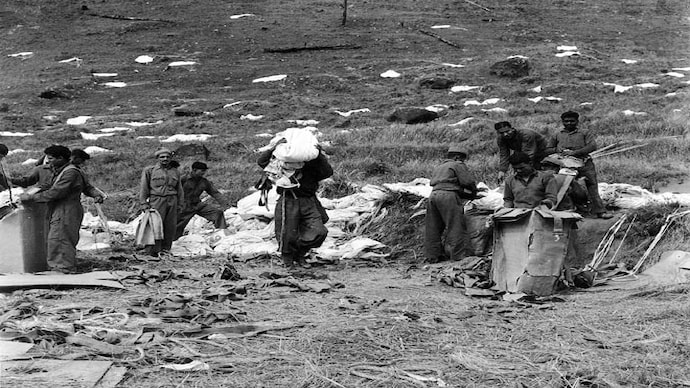
'People's Liberation Army (PLA) Chinese troops continued to push south?' as PLA troops move with ant-like efficiency?'but Indian troops ran away even much faster (sic)," the voice- over notes gravely as it shows hundreds of tired and hungry Indian soldiers, arms raised being rounded up and marched along by PLA soldiers; one encircled Indian officer stands in a trench with his arms raised, he smiles tapping his shoulder-epaulettes with his pay book and pleads repeatedly "I'm an officer".
Brigadier John Dalvi, the commander of the doomed 7 Brigade captured by the Chinese five hours after they attacked on October 20, 1962, appears briefly, wearing Indian army issued winter clothing. He smiles hesitantly and then steps away to avoid the camera. For some bizarre reason, the documentary shows all the Indian POWs smiling, as if greatful to be taken alive. It is an eerie face of defeat.

The documentary toes the official Chinese line on the 1962 war: India was to blame for the war because it attacked first. The Chinese troops only responded to the Indian army's 'Operation Leghorn'. The Chinese overran the Indian army 'like a knife through cheese' but they were generous in victory: Indian soldiers who 'are really hungry, with no will to fight' are fed by the Chinese; PLA soldiers distribute cigarettes to squatting Indian soldiers, nurses feed the wounded soldiers with chopsticks and tend to their wounds. The PLA are shown meticulously documenting the captured Indian ordnance and then returning these war stores to India without any conditions, in an act of good faith. The Chinese then withdraw from all the territories they occupy because 'China claimed they had no desire to settle the border dispute by force.'
